
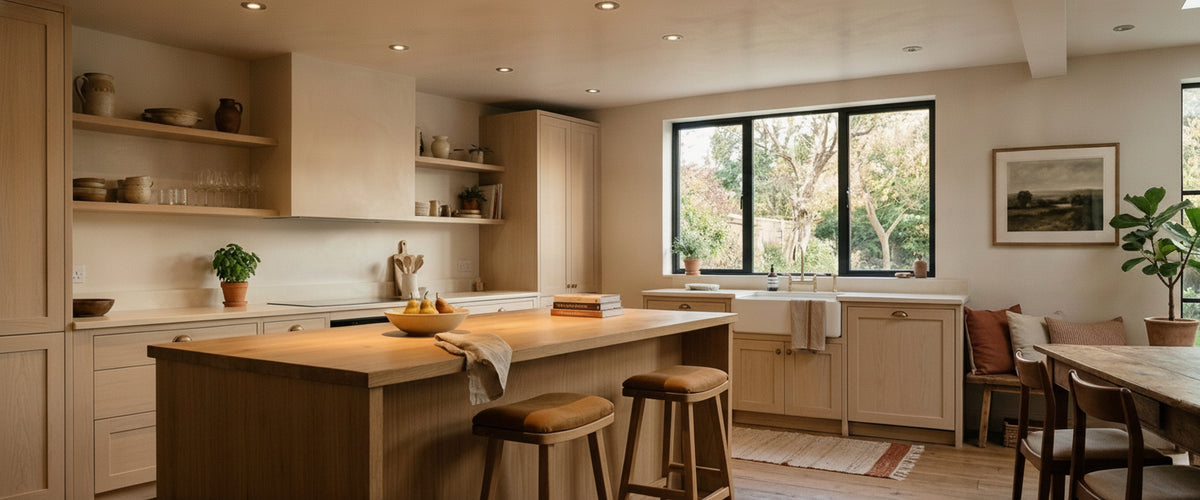

Fourteen downlights, one beautiful kitchen, and a ceiling that strobed every time the dimmer dropped below halfway. That was the call we took from a client in a Bath townhouse last winter, and the culprit was not the bulbs. With recessed dimmable led downlights, the lamp gets the attention while the driver and the dimmer quietly decide whether the room glows or flickers. Get those two right and downlights become a calm background layer. Get them wrong and no amount of expensive trim will rescue the ceiling.

At a Glance
- Are LED downlights dimmable? Many are, but only when the fitting, driver and dimmer are all rated to work together. A "dimmable" label on the lamp alone guarantees very little.
- GU10 and MR16 behave differently. GU10 runs at mains voltage. MR16 runs at 12V through a transformer, which adds a second component to the dimming chain.
- Check the minimum load. LED circuits draw so little power that many older dimmers cannot read them properly.
- Beam angle shapes the room more than wattage. Narrow beams accent; wide beams wash.
- Downlights are a supporting layer. Pair them with pendants, wall lights or lamps for the warm, diffused light that makes a room feel lived in.

Why the Driver, Not the Lamp, Is the Real Dimming Decision
An LED does not dim the way a filament did. A halogen lamp simply received less power and glowed lower and warmer. An LED needs electronics, the driver, to translate the chopped-up signal from a dimmer into a steady current. If that translation is poor, you get flicker, a buzzing noise, a sudden drop from 20 per cent to off, or a faint ghost glow when the switch says the light should be dark.
In integrated recessed dimmable led downlights, the driver is built in or sits in a small box on the cable tail above the ceiling. In a lamp-based fitting, the driver lives inside the bulb itself. Either way, it is the component you should ask about first. Good specification sheets list compatible dimmers by model. Vague ones just say "dimmable" and leave you to find out after the plasterer has gone home.
MR16 Versus GU10 on the Same Trailing-Edge Dimmer
Swap a GU10 for an MR16 and you might assume the dimming would behave the same. It rarely does.
A GU10 has two chunky push-and-twist pins and runs straight off the 230V mains. Its driver is inside the lamp, so the dimming chain is short: dimmer, then lamp. On a modern trailing-edge dimmer, a decent dimmable GU10 usually fades smoothly.
Dimmable MR16 LED downlights are a different animal. The MR16 runs at 12V, so each fitting (or group of fittings) needs a transformer between the mains and the lamp. Now the chain is dimmer, transformer, lamp, and every link has opinions. Older wire-wound transformers were designed for halogen loads and can misbehave badly with LEDs. Electronic transformers vary wildly in how they handle a tiny LED draw. We see this most in 1990s and early 2000s refurbishments where the original MR16 transformers are still buried in the ceiling void. The owner swaps in LED lamps, the dimmer is unchanged, and the result is a soft, irritating shimmer.
Our honest view: in a new project, GU10 or integrated fittings are simpler. Keep MR16 only where the ceiling depth is genuinely tight, and replace the transformers with LED-rated drivers at the same time.
Flicker, Hum and Minimum Load: The Sums UK Circuits Need
Most domestic dimmers in the UK were sized for halogen, where a 400W rating was typical and a few lamps easily cleared the minimum. Recessed dimmable LED downlights changed the arithmetic. Six 5W GU10s draw roughly 30W, which can sit right at, or below, the minimum load some dimmers need to operate cleanly.
Every dimmer has two LED figures that matter, usually printed on the back plate or the data sheet:
- Minimum LED load. Fall below it and you get flicker at low levels or lights that will not fully switch off.
- Maximum LED load. This is almost always far lower than the halogen rating, because LED drivers draw a brief surge of current when they switch on.
Back to that Bath kitchen. Fourteen 6W lamps on a single leading-edge dimmer designed for halogen: the load was technically within range, but the dimmer type was wrong for the drivers. Our client's electrician fitted a trailing-edge LED dimmer, split the run into two circuits, and the flicker vanished. The alabaster pendants over the island went on their own circuit too, which turned out to be the change the client loved most.
The same discipline applies to decorative fittings with integrated LEDs. A multi-light piece such as the Blossom 8 Light LED Glass Ring Chandelier carries its own driver, so if it is going on a dimmer, its compatibility and load need checking just as carefully as the downlights, and it is usually happier on a circuit of its own.
Wiring any of this is a job for a qualified electrician. In England, all domestic electrical work must meet Approved Document P of the Building Regulations, and new circuits or work in bathrooms are notifiable, so a registered installer who can self-certify is the simplest route.
Beam Angle and Trim Finish in a Plastered Ceiling
Once recessed dimmable LED downlights sit flush in plaster, the beam angle becomes the whole personality of the light. Roughly speaking:
- 24 degrees or narrower gives a defined pool, good over a dining table or a piece of art.
- 36 to 40 degrees is the general-purpose spread for kitchens and corridors.
- 60 degrees and wider washes the floor evenly but can make a room feel flat and office-like.
Dimmable adjustable LED downlights, the tilting gimbal type, earn their place when you want to graze a textured wall, light a bookcase or angle onto a sideboard. A fixed downlight only ever looks straight down.
Trim matters more than catalogues admit. A white trim disappears into a white ceiling. A brushed brass or bronze trim reads as a deliberate detail and can echo brass fittings on stone pieces elsewhere in the room. The same thinking works with cooler metals: where the island pendants are polished, such as the Half Moon LED Pendant Light in Polished Chrome, a chrome or satin nickel trim keeps the ceiling and the pendants reading as one family rather than two competing finishes. Deep-recessed or anti-glare baffles push the LED further into the housing, so you see the light on surfaces instead of a bright dot overhead. In living rooms and bedrooms, that single choice does more for comfort than any colour temperature setting.
Two practical notes for UK ceilings: where the room above is habitable, fire-rated fittings are generally expected, and in bathrooms the fitting's IP rating has to suit its zone. Your electrician will confirm both.
Where Recessed Dimmable LED Downlights Help a Room, and Where They Flatten It
Downlights are at their best doing quiet, functional work. Kitchens need even light on worktops. Corridors and stairs need safe, glare-free illumination. Bathrooms benefit from a soft dimmed level for late-night visits. In all of these, recessed dimmable LED downlights are hard to beat.
Where they fail is as the only light source in a sitting room or bedroom. A grid of downlights pushes every bit of light onto the floor and leaves faces in shadow. The walls go grey, the ceiling goes dark, and the room feels like a waiting area. In a bedroom, where a downlight above the bed lands straight on the pillows, a glass table lamp such as the Blossom LED Glass Table Lamp puts warm light at face height and lets the ceiling stay dimmed or off.
This is where we think stone does the heavy lifting. Alabaster and onyx are translucent. Light passes through the stone and comes out diffused, warm and slightly amber, with the veining visible as soft shadow. A single alabaster pendant at eye level, or a pair of wall lights either side of a chimney breast, gives the room the side light and glow that downlights cannot. If you are planning that layer, browsing our alabaster lighting collection alongside the ceiling plan helps you decide how many recessed dimmable LED downlights you actually need. Usually it is fewer.
One studio lesson worth passing on: never position a downlight directly above an alabaster pendant. The hard beam lands on the top of the stone and washes out its glow, and the effect is like shining a torch onto a lampshade. Offset downlights by at least the pendant's width, or put them on a separate dimmer so the stone can lead in the evening.
Questions to Settle Before the First Hole Is Cut
Bring this list to your electrician before any recessed dimmable LED downlights are ordered, ideally before the ceiling is boarded:
- Which dimmer will we use, and is every fitting on its compatibility list? Ask for the model numbers in writing.
- What are the minimum and maximum LED loads per circuit? Do the sums with the real wattages, not the halogen equivalents.
- Integrated or lamp-based? Integrated fittings can be slimmer and better sealed. Lamp-based fittings let you change colour temperature later.
- What cut-out size do we need? Matching existing holes saves patching plaster on retrofits.
- Fire-rated, IP-rated or insulation-coverable? Each room may need something different.
- How will circuits be split? Separate the downlights from pendants, wall lights and lamps so each layer dims independently.
- What colour temperature? Around 2700K sits comfortably beside the warm glow of alabaster. Cooler whites make the stone look oddly orange by contrast.
Buyer's Checklist: Choosing Recessed Dimmable LED Downlights
- Driver and dimmer compatibility confirmed on paper, not assumed.
- Trailing-edge LED dimmer specified unless the manufacturer says otherwise.
- Beam angle chosen per task: narrow to accent, medium for general use.
- Anti-glare or deep-recessed trims in living spaces.
- Trim finish chosen to match the room's metalwork or disappear into the ceiling.
- Fire and IP ratings confirmed for each room.
- A decorative layer planned at the same time, so the ceiling is not doing all the work.
For guidance on quality and safety marks when comparing fittings, the Lighting Industry Association is a useful independent starting point. And when the technical layer is settled, the fun part begins: browse the wider niori lighting range to choose the pendants, wall lights and lamps in alabaster, marble and onyx that will give the room its character once the downlights dim down for the evening.