
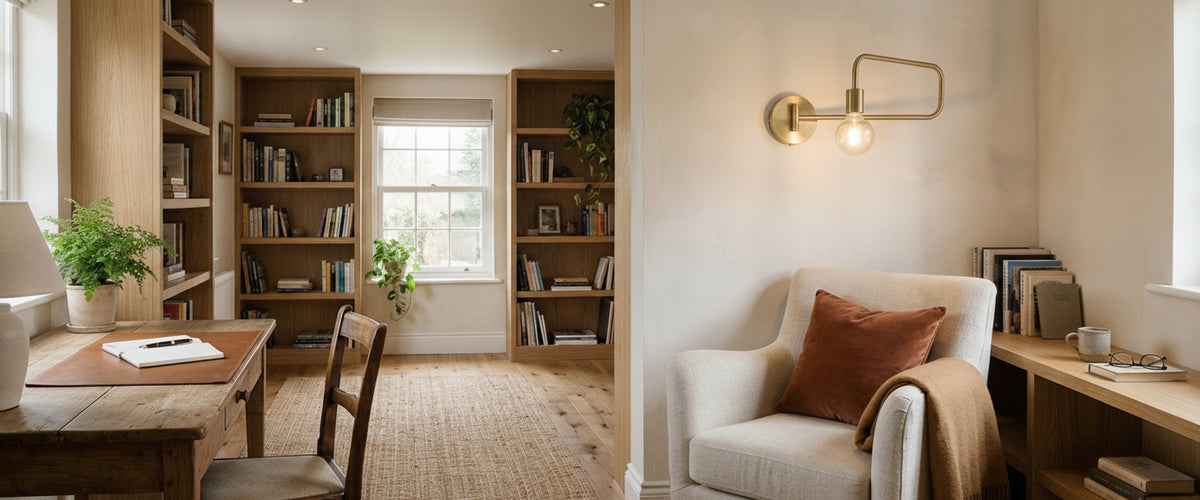

Most of the dimming complaints we hear get blamed on the light fitting, and almost none of them have anything to do with it. A dimmable E27 LED is a small power supply dressed up as a bulb. Whether it behaves depends on how its driver talks to the dimmer on your wall. Get the pairing right and an alabaster pendant fades down like candlelight. Get it wrong and it shimmers, hums, or snaps from dark to half-bright with nothing in between.

Quick Answer
- Only a dimmable E27 LED will dim, and that label does not promise it will dim on every dimmer.
- Pair LEDs with a trailing-edge dimmer rated for LED loads. Older leading-edge dimmers from the halogen era cause most of the trouble.
- Flicker, pop-on and dead travel each point to a specific mismatch, so diagnose before you swap anything.
- Alabaster absorbs and warms light, so a 2700K bulb looks warmer and softer inside stone than inside glass. Size your lumens up to match.
- Test one or two bulbs on the real circuit, with the real bulb count, before you order for a whole house or venue.

Not All Dimmable E27 LEDs Are Built for the Same Dimmer
E27 only describes the cap: a 27 mm Edison screw, sold in the UK as ES. It tells you nothing about the electronics packed into the neck of the bulb. Two dimmable E27 LED bulbs with identical lumens, colour temperature, and filament styling can carry completely different drivers. One might be a bare-minimum circuit that tolerates dimming on a good day. The other might be a properly engineered constant-current driver tuned for trailing-edge phase control.
The box rarely tells you which. What you want is a published dimmer compatibility list, a stated minimum dimming level, and a clear note on whether the bulb is designed for trailing-edge, leading-edge, or both. If a manufacturer will not publish that information, treat the silence as your answer.
Batches matter too. Two boxes of the same bulb model, bought a few weeks apart, can dim differently on the same circuit because the supplier has quietly changed the driver. Same part number, same packaging. That is why we tell every project client to buy the full quantity from one delivery, plus a few spares that live in a drawer on site.
Flicker, Pop-On and Dead Travel: What Each Fault Tells You
When a dimmable E27 LED misbehaves, each fault is a symptom with a fairly predictable cause. Read it before you start replacing things.
Flicker or Shimmer at Low Levels
Usually the total load is too small for the dimmer. Many wall dimmers have a minimum load that a couple of 6-watt LEDs simply cannot meet, so the dimmer loses its grip on the waveform near the bottom of the dial. The fix is often a dimmer with a lower minimum load, or an electrician adjusting the dimmer's low-end trim if it has one.
Pop-On
You turn the dimmer on at a low setting and nothing happens, then you nudge it up and the bulb jumps straight to 30 percent. The driver needs a certain voltage to start, and the dimmer is not delivering it. Some trailing-edge dimmers include a soft-start or kick-start setting designed for exactly this.
Dead Travel
A large section of the dial does nothing at all. The dimmer's range and the driver's usable range only partly overlap. It is irritating rather than harmful, and a dimmer with adjustable minimum and maximum settings usually solves it.
Buzzing and Ghosting
An audible hum from the bulb or the switch is the classic sign of a leading-edge dimmer driving an LED. A faint glow when the light is off (ghosting) comes from a small leakage current through the dimmer or an illuminated switch, which an LED will happily turn into visible light. Ghosting is mostly cosmetic. Buzzing means the dimmer and driver are fighting each other, and it deserves an electrician's attention.
How the Same 2700K Chip Reads Through Alabaster, Opal and Clear Glass
A colour temperature on the box describes the bare chip. What reaches your eye depends on what the light passes through, and this is where alabaster behaves very differently from glass.
Alabaster is a soft, translucent stone, and light travelling through it is scattered and partly absorbed by the grain and veining. The warmer end of the spectrum gets through more readily, so the glow comes out honeyed. A 2700K dimmable E27 LED inside an alabaster bowl tends to read closer to candlelight, and as you dim it the effect deepens further. Thickness and veining vary from piece to piece, which is part of the appeal, so two pendants on the same circuit may glow very slightly differently. If you are browsing alabaster pendants wall lights and lamps for a kitchen or study where you want a crisper daytime feel, 3000K is worth considering; for living rooms and bedrooms, 2700K is usually right.
Tinted shades shift the light in a similar direction, just more predictably than stone. Where you want that honeyed cast in a corner of the room without the weight of carved stone, an amber-toned shade such as the Briller LED Floor Lamp Amber Acrylic, Gold warms the light on its way out, so the source itself does not need to be pushed to the very warm end of the scale.
Opal glass diffuses evenly and stays close to neutral. The 2700K you bought is roughly the 2700K you see, and opal lets through more light than stone of a similar size.
Clear glass hides nothing. The bulb becomes part of the design, so the filament shape matters and glare at full brightness is real. Dimming helps, but a clear shade is where a poor driver's flicker is most obvious. If you love the sparkle of a clear shade but would rather not audition exposed filament bulbs, an integrated fitting like the Briller LED Large Wall Light, Clear Acrylic Spheres builds the light source into the design itself; it is still worth checking its dimming notes against the dimmer on your wall.
Matching Lumen Output and Beam Angle to the Fixture, Not Just the Room
Room-size lumen calculators assume a bare or lightly shaded source. Stone changes the maths. An alabaster bowl that looks luminous at dusk can feel underpowered at 7 pm in February if you have fitted the same 470-lumen bulb you would use in a glass globe. For stone shades we generally suggest moving up a step, to a dimmable E27 LED of around 806 lumens (the old 60-watt equivalent) or higher, and then dimming down. A bulb with headroom dims gracefully; a bulb running flat out has nowhere to go.
Beam angle matters just as much. Choose an omnidirectional lamp for alabaster and opal shades so the whole surface glows evenly. A directional reflector bulb in an E27 cap throws a hot spot onto one patch of stone and leaves the rest dull, which wastes the material. Check the physical size too: a large G95 globe may not clear the inside of a compact wall light, and every fitting has a maximum wattage that still applies. If you are planning several fixture types at once, the wider niori lighting range shows how pendants, chandeliers and floor lamps differ in shade depth and lamp position, which tells you a lot about the bulb each one wants.
Why Trailing-Edge and Leading-Edge Dimmers Produce Opposite Results
Both types dim by chopping part of each mains cycle. A leading-edge dimmer cuts the front of the wave, producing a sharp voltage step each time it switches on. That suited old filament and wire-wound halogen loads perfectly. LED drivers, with their capacitive input, react badly to that sudden step: you get hum, heat in the dimmer, and a shorter life for the bulb.
A trailing-edge dimmer cuts the back of the wave instead, so voltage rises gently and drops off at the end. LED drivers handle this well, the result is quieter, and minimum loads tend to be lower. Plenty of UK homes, particularly those refitted in the halogen years, still have leading-edge rotary dimmers behind tidy faceplates. Put a modern LED on one of those and the dimmer and bulb are effectively working against each other.
Check the LED rating on the dimmer, not the old incandescent figure. A dimmer marked for 400 watts of filament load may be rated for a small fraction of that in LEDs. Replacing a dimmer is electrical work, so use a qualified, registered electrician; Electrical Safety First has clear guidance on finding one and on why accessory swaps are not a casual weekend job.
How to Test Compatibility Before the Whole Batch Arrives
A few minutes of testing is the cheapest insurance against a ceiling full of shimmering pendants, and you can run the check at home or on site.
- Order one or two samples first. Same model, same supplier you intend to buy the full quantity from.
- Test on the real circuit. Fit the sample alongside your existing bulbs so the dimmer sees something close to the final load. One bulb on a dimmer meant for eight tells you very little.
- Turn the dial slowly from bottom to top. Note where light first appears, where it stops changing, and whether it jumps.
- Film it in slow motion. A phone camera will show flicker your eyes might miss, especially below 30 percent.
- Leave it at a low setting for an hour. Some drivers start well and drift once warm. Listen for hum near the switch.
- Switch off in a dark room. Any faint glow means ghosting.
- Record what worked. Bulb model, dimmer model, any trim settings. Future replacements become easy.
Dimmable E27 LED Buyer Checklist
- Marked dimmable, with a published dimmer compatibility list or at least a stated trailing-edge preference.
- Colour temperature of 2700K for living spaces, 3000K where you want a cleaner daytime tone through stone.
- High colour rendering (CRI 90 or above) so alabaster veining and brass detailing read naturally.
- Enough lumens to dim down from, especially inside alabaster and other stone shades.
- Omnidirectional beam for any diffusing shade.
- Bulb dimensions that fit the fixture, within its maximum wattage.
- Whole quantity from one batch, plus spares.
- A trailing-edge dimmer with an LED rating that covers your total load, installed by a qualified electrician.
For bulbs sold through mainstream UK channels, the Lighting Industry Association is a useful source on product standards and what reputable manufacturers are expected to declare.
Getting the Glow Right
A beautiful stone fitting with the wrong bulb is a disappointing evening every evening. Spend ten minutes testing a dimmable E27 LED on your actual dimmer before committing, and the reward is a pendant or lamp that drops from working light to a low, amber glow without a flicker. That range is the whole point of pairing alabaster with a dimmer, and it is why we treat the bulb as part of the fixture rather than an afterthought. If you are specifying for a larger project, the team at Niori is happy to talk through bulb and dimmer pairings alongside the lighting itself.