
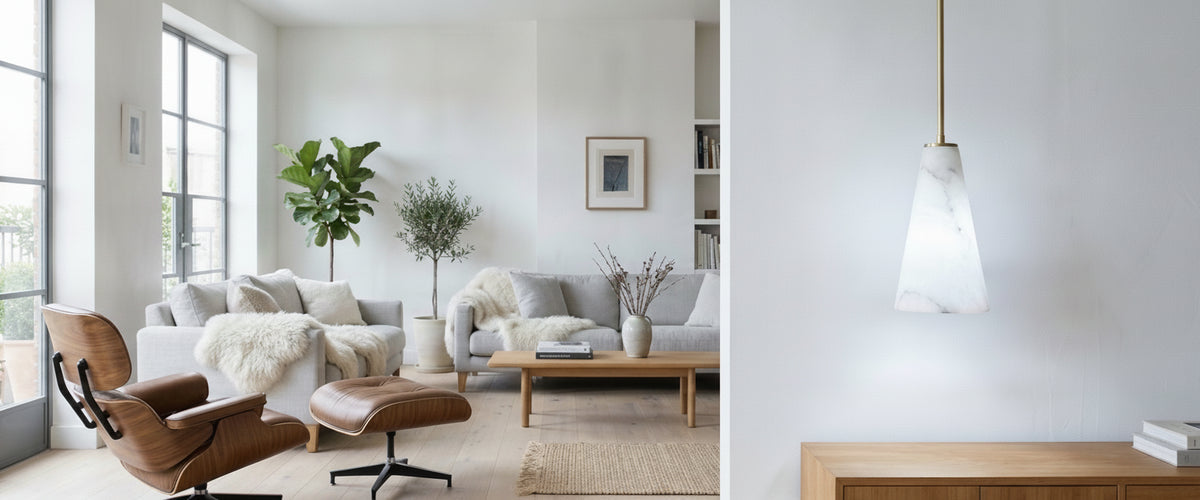

A good share of the pendants sold as mid century modern would have puzzled anyone who designed lighting in 1955. The label now covers almost anything with a brass stem, a globe or a tapered leg, and that is exactly why so many rooms that try for the look end up feeling like a furniture showroom rather than a home. At Niori we work mostly in alabaster and natural stone, materials the period used more than people remember. That gives us a particular view of what mid century modern lighting does well, and where modern interpretations lose the plot.

At a Glance
- The real period look is about clear geometry, honest materials and light that is shaded or diffused. Exposed glare is a later habit.
- Materials matter with LEDs: opal glass and alabaster soften modern bulbs well; polished spun metal can turn harsh if the bulb is visible.
- Proportion first: a correctly scaled fitting in the wrong finish looks better than a perfect finish at the wrong size.
- Keep colour temperature warm: 2700K is the safe default for teak, walnut and stone.
- The fastest way to date a room is a bare decorative filament bulb in a fitting that was designed to hide its lamp.

What Mid-Century Modern Actually Meant for Lighting
The movement, broadly the years after the Second World War into the late 1960s, was a reaction against fussy, heavy interiors. Lighting followed suit. Designers stripped fittings back to cones, discs, globes and arcs, and they cared intensely about where the light fell. A shade was there to direct or diffuse; it was rarely there simply to look pretty. Organisations such as the Twentieth Century Society, which campaigns to protect Britain's post-war buildings, are a good reminder of how much housing from this era was planned around open, flowing rooms, and those rooms work best with layered, lower-level light rather than one central bulb.
Where the label gets stretched past breaking is the bolt-on detail. A brass finish does not make a fitting mid-century. Nor does a cluster of globes on spindly arms if the globes are clear glass and the bulbs glare at you across the dinner table. If a fitting has no idea where its light is meant to go, it belongs to a later decade, whatever the product listing claims.
Spun Metal, Opal Glass and Teak Under Modern Bulbs
Original fittings were designed around incandescent bulbs, which were warm, dimmable and forgiving. LEDs changed the maths, and the period's signature materials respond very differently.
Spun aluminium and steel shades work beautifully when the bulb sits deep inside them, throwing a crisp pool downwards. Use a shallow shade with a bright LED and you get a hard ring of glare at the rim. Look for an internal diffuser or choose a bulb with a frosted or opal envelope.
Opal glass is the period's quiet hero. It spreads light evenly and hides the shape of the lamp inside, so good opal glass copes with almost any LED. The catch is that cheap reproductions often use thin glass, which shows a hot spot in the centre. Hold a lit sample at arm's length before you commit.
Teak and walnut rarely produce light themselves, but they react strongly to it. Put the same teak sideboard under a 2700K bulb and then a 4000K one, and the cooler light turns it a flat, slightly grey brown. Warm light brings back the depth in the grain.
Where Alabaster and Marble Fit In
Italian workshops in the 1950s and 1960s turned out a great deal of alabaster and marble lighting: carved bowl pendants, stone lamp bases, onyx table lamps with simple brass collars. Alabaster behaves much like a premium opal glass, but with natural veining that shifts as the light passes through, so an LED behind it reads soft and slightly honeyed rather than flat white. If you want mid century modern geometry with a richer surface, the shapes in our alabaster lighting collection sit very comfortably beside teak and wool bouclé. Marble works differently. It is opaque, so it suits bases and canopies, adding weight and stability to a floor lamp or table lamp while the shade does the lighting.
Proportion Beats Finish Every Time
Mid century modern fittings depend on silhouette. A cone, a disc or a dome is a simple shape, so any error in scale is obvious in a way it would not be with an ornate chandelier. A practical rule: over a dining table, a pendant's diameter should be roughly half to two-thirds the width of the table, hung so the bottom sits around 75 to 85cm (30 to 33in) above the tabletop. Go smaller and the fitting looks apologetic; go larger and it crowds the people sitting under it.
Floor lamps need the same discipline. An arc lamp should clear a seated head comfortably and land its shade over the reading spot, not over the coffee table. A column lamp in alabaster should be tall enough that the glowing section sits around seated eye level or just above, roughly 120 to 160cm (4 to 5ft 3in) to the top, so the light washes across the room rather than straight into your eyes.
A typical example: a beautifully finished brass pendant in a 1960s dining room that simply looks wrong. The finish is perfect. The problem is a 30cm shade over a 2.2m table. Swapping to a larger alabaster dome fixes the room in an afternoon, without touching anything else.
Rooms That Carry Mid Century Modern Lighting Naturally
Living rooms with low ceilings are the natural home of the look. Period houses rarely had soaring ceilings, so low floor lamps, table lamps and wall lights did most of the work. That layered approach still suits most British homes far better than one oversized ceiling fitting.
Dining rooms and kitchen-diners carry a single strong pendant well, especially over a round or oval table. Bedrooms suit paired wall lights or small table lamps with opal or alabaster shades, which give soft light without glare across the pillow.
The scheme details that quietly kill the effect are easy to miss. A grid of recessed downlights fighting the pendant is the usual culprit; it flattens everything and makes the statement fitting look like decoration. Cool white under-cabinet strips do the same in kitchens. Highly glossy, busy wallpaper can also compete with a fitting whose whole appeal is its clean outline.
Mixing Mid-Century Fittings Into a Contemporary Scheme
Rooms start to look like a period film set when every element comes from the same decade. A sunburst clock, a teak sideboard, a tripod lamp and a globe pendant all at once reads as costume rather than home. The fix is restraint: choose one or two mid century modern pieces as anchors and let the rest of the room be plainly contemporary.
Material is the bridge. Natural stone works well here because it has no fixed era. An alabaster pendant can hang in a minimal concrete kitchen and still nod to 1950s Italian design. Brass detailing helps tie it to warm timber, while a marble lamp base sits quietly on a contemporary oak console. Keep metal finishes to two at most and repeat each one at least twice so the choice looks deliberate.
How to Choose a Mid-Century Fitting: Buyer Checklist
Before buying, run through these points. When you are ready to compare shapes across pendants, wall lights and lamps, our full lighting range is organised by fixture type, which makes like-for-like comparison easier.
- Light direction: can you tell where the light will fall? Downward, diffused or upward washing should be obvious from the design.
- Diffuser quality: opal glass or alabaster should glow evenly, without a hot spot.
- Scale: measure the table, seating or wall first, then size the fitting to it.
- Bulb compatibility: check the lamp holder, maximum wattage and whether the fitting is designed for a frosted or opal bulb.
- Dimming: pair dimmable LEDs with a compatible dimmer. Mismatches cause flicker and hum.
- Weight and fixing: stone pendants are heavier than spun metal. Ceiling fixings must be rated for the load, and any hardwired pendant or wall light should be installed by a qualified electrician.
- Care: alabaster is soft and porous. Dust with a dry microfibre cloth and keep it away from water and household sprays.
Budget depends on material, scale, carving complexity, engineering and finishing. For larger or bespoke pieces, ask for a tailored quote rather than guessing from a photograph.
The Detail That Dates a Room Fastest
It is the bulb. Specifically, the oversized decorative filament bulb left bare in a fitting meant to hide its lamp. That look belongs to the industrial bar trend of the 2010s, and it ages a mid century modern scheme instantly. The original designers worked hard on shades, louvres and diffusers precisely so you would never stare at a glowing wire.
Choose warm 2700K LEDs with frosted or opal envelopes, keep them out of the direct line of sight, and let the shade, the glass or the stone do the work. Get that right and even a modest fitting reads as considered. Get it wrong and no amount of brass or walnut will rescue it.