
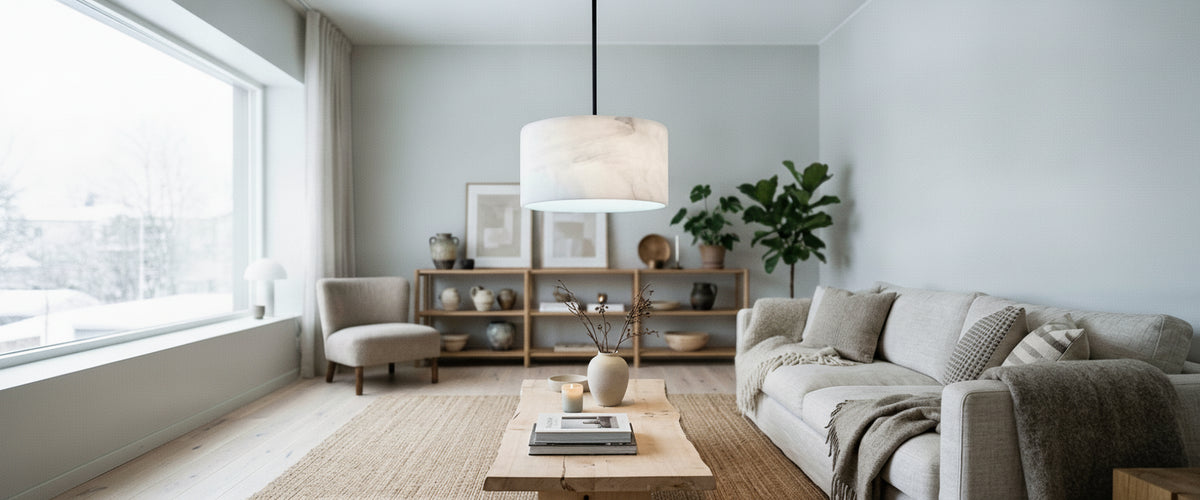

Most scandinavian style lighting fails in British homes for one reason: people copy the silhouette and forget the light. A pale globe pendant over a pine table looks right in a Copenhagen photograph taken at four in the afternoon in December. Hang the same fixture in a north-facing Victorian terrace with a cool LED bulb, and it reads as a bare bulb wearing a hat. The style is built on what the fixture does to a room after dark, and that is where the real decisions sit.

Quick Answer: What Makes Scandinavian Style Lighting Work
Diffusion first. The light source should be hidden or softened. You should never see a naked filament from a seated position.
Warm colour temperature. 2700K is the working default. Anything cooler flattens pale timber and white walls.
Several low sources over one bright one. Pendants, a table lamp and a floor lamp at different heights do more than a single ceiling fitting.
Honest materials. Timber, opal glass, steel and natural stone such as alabaster carry the look. Decoration does not.
Planned shadow. The gaps between pools of light are part of the scheme.

Restraint Is the Design Decision
Scandinavian style lighting grew out of long, dark winters and a cultural habit of spending a lot of time indoors. When daylight disappears by mid-afternoon for months at a time, glare becomes something you live with for hours every evening. The response was fixtures that shield the eye, bounce light off surfaces and keep illumination low and close to where people sit. The minimal look came from that practical problem. Nobody was chasing an aesthetic.
That matters for buyers because it changes the question you ask in the showroom. "Is this simple enough?" is the wrong test. "Where does the light go, and can I see the bulb?" is the right one. A plain fixture that throws harsh downlight onto a dining table fails the brief. A more sculptural piece that glows softly through its shade passes it easily. The Designmuseum Danmark collection is worth an afternoon if you want to see how consistently Danish designers treated glare as the enemy across the twentieth century.
Birch, Opal Glass, Raw Steel: Why Material Carries the Argument
With so little ornament, the material does all the talking. Birch and oak bring warmth and a visible grain. Opal glass turns a point source into an even glow. Powder-coated or raw steel gives a crisp line and a slightly industrial honesty. Each of these reads as Scandinavian because it is used plainly, with no applied pattern or gilding.
Natural stone belongs in that family more than people expect. Alabaster does what opal glass does, diffusing light through its body, but it adds something glass cannot: a soft, irregular veining that only shows when the lamp is lit. Hang an opal globe next to an alabaster pendant of a similar size and the difference is immediate. The glass reads as clean, the stone as warm, even when both are running the same bulb. That warmth is why alabaster sits so comfortably in Scandinavian style lighting schemes that would otherwise feel a little clinical. You can see how the material behaves across pendants, wall lights and lamps in the niori alabaster lighting collection.
Brass deserves a mention too. A thin brass stem or ceiling rose against pale stone or timber gives scandinavian design lighting fixtures a slightly richer accent without breaking the restraint. Keep it to one metal per room and keep the finish soft, brushed rather than polished.
The Colour Temperature Trap: Why 2700K Matters More Here
Busy, colourful interiors can hide a slightly cool bulb. Scandinavian style lighting cannot. White walls, pale floors and blond timber act like a reflector, so whatever colour the bulb emits gets amplified across the whole room. At 4000K, birch turns greyish and white plaster looks like a hospital corridor. At 2700K, the same surfaces turn honey-toned and soft.
Alabaster makes the effect even more obvious. Fit a cool-white bulb to a new alabaster pendant and the stone looks chalky and flat, enough to make you wonder whether the piece is faulty. Swap in a 2700K dimmable LED and the veining comes straight back. Translucent stone needs a warm bulb to show the depth of its colour.
Living rooms and bedrooms: 2700K, or 2200K to 2400K for lamps you use mainly in the evening.
Kitchens: 2700K for pendants over islands, with separate task lighting under cabinets if you need it brighter.
Dimming: choose dimmable LEDs and a compatible dimmer. Have a qualified electrician fit and check any hardwired dimmer or new circuit.
CRI: look for 90 or above so timber and stone keep their true colour.
Where a Spare Silhouette Reads as Considered (and Where It Reads as Unfinished)
A single minimal fixture looks deliberate when the room around it has texture: a wool rug, a linen sofa, a timber floor with visible grain. It looks unfinished when the room is also bare, because then nothing tells the eye that the simplicity was a choice. Scale matters as much as texture. A small pendant in a high-ceilinged period room looks lost, and lost reads as cheap.
Dining Rooms
Hang a pendant roughly 75 to 85cm (30 to 33 inches) above the table top so the shade hides the bulb from seated diners. For long tables, two or three smaller pendants in a row beat one large one. A diffusing material such as alabaster stops the light pooling as a hard circle on the tablecloth.
Scandinavian style lighting over a dining table: a diffusing stone pendant hung 75 to 85cm high hides the bulb from seated diners.
Living Rooms
Skip the central ceiling light as your main source. Build the room from a floor lamp beside the reading chair, a Scandinavian table light on a sideboard, and wall lights at around eye level to wash the walls. Three low sources will give the room the cosy evening glow Scandinavian style lighting is known for.
A stone table lamp, a floor lamp and wall lights at three heights replace a single ceiling fitting.
Bedrooms
Wall lights either side of the bed free up bedside tables and keep the light at pillow height. Choose shades that face the wall or diffuse fully so the light never hits your partner's eyes.
Hallways
Narrow British hallways suit a flush stone ceiling light or a pair of wall lights more than a dangling pendant, which can look like an afterthought at low ceiling heights.
Mixing Scandinavian Light Fixtures into Layered British Interiors
Few British homes are pure Nordic boxes. Most have cornicing, fireplaces, inherited furniture and a patterned rug or two. Scandinavian light fixtures mix well with all of it, as long as you let them be the calm element in the room rather than competing with the busier pieces.
The trick is to find a link in material or tone. A pale alabaster table lamp on a dark mahogany chest works because the stone picks up the cream in the walls and the warmth in the timber. A raw steel pendant in a room full of brass and velvet can feel like a stranger at the party. If the room is traditional, lean towards stone, glass and brushed brass over black steel. If it is modern, you have more freedom. The wider niori lighting range is organised by fixture type, which helps when you are building a layered scheme one source at a time.
The Forgotten Element: Shadow
Most Scandinavian style lighting schemes are planned as a list of light sources. Very few are planned around the dark. Yet the appeal of a Nordic room at night comes from the contrast between warm pools of light and the soft shadow between them. Light every corner evenly and you lose depth; the room flattens out like a stage set.
Think about where shadow will fall before you buy. A pendant with an open base throws a strong cone onto the table and leaves the ceiling dark, which feels intimate. A fully translucent stone globe lights the ceiling too, which feels more open. Wall lights that wash upwards create long, gentle gradients on plaster. Alabaster is particularly good here because the stone's uneven thickness throws a faintly mottled glow onto nearby surfaces, a quiet texture that plain glass cannot give you.
A Buyer's Checklist Before You Choose
Check the sightline. From a seated position, can you see the bulb? If yes, choose a different shade or hang it lower.
Match material to the room. Timber and steel suit modern spaces; alabaster, marble and brushed brass bridge into traditional ones.
Fix the colour temperature. Buy 2700K, dimmable, CRI 90+ bulbs before installation day.
Plan three heights. Ceiling, eye level and table level, so the room never depends on one fitting.
Size for the ceiling. Measure ceiling height and table length before choosing pendant scale.
Book a qualified electrician for any hardwired pendant, wall light or dimmer, and ask them to confirm the ceiling can carry the weight of a stone fixture.
Ask about budget early. Cost depends on material, scale, carving complexity, finishing and installation, so request a tailored quote for larger pieces or project orders.
Light Borrowed from the North
If Scandinavian style lighting appeals to you, a Scandinavia northern lights tour is a natural addition to the wish list. The same long winter nights that shaped Nordic interiors give northern Norway, Sweden and Finland their auroras. Anyone who has stood under a green sky in Tromsø or Abisko comes home with a fresh respect for low, shifting, indirect light. Visit Norway's northern lights guide covers the practical side if you are planning a trip. Back home, the lesson translates neatly: soft sources, warm tones and plenty of darkness around them. Niori designs alabaster and natural-stone lighting with exactly that kind of evening in mind.