
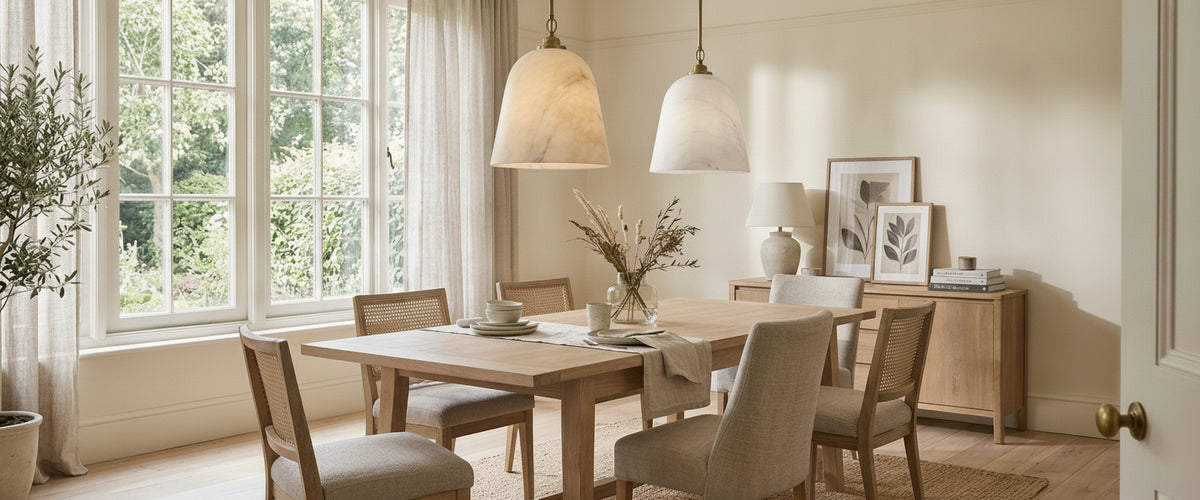

Natural stone lighting is beautiful because the stone shapes the light itself. Translucent alabaster and onyx soften a bulb into a warm, glare-free glow, and no two pieces share the same veining, density or color, so no two lamps glow alike. That individuality is the beauty natural stone brings to a room, and it is also the thing buyers most often fail to plan for. Last spring we unpacked two alabaster pendants in the studio, both turned from the same quarry block, and hung them side by side for a client photograph. One glowed the color of clover honey. The other read almost milk-white, with a gray thread of veining running through it like a pencil line. Same stone, same bulb, same day. If you expect a natural-stone fitting to behave like a glass shade with a predictable output, you will be surprised. If you understand why it varies, you can choose a piece that suits your room rather than fighting it.

At a Glance
Every piece is individual. Veining, density and color shift even within one block. That variation is natural stone beauty in action, so treat product photographs as a guide, not a promise.
Translucent stones diffuse; opaque stones direct. Alabaster and onyx glow from within. Most marble works best as a base or a reflector.
Thickness changes color. Thicker walls warm the light and lower the output, so plan your lumens accordingly.
Room conditions matter. North-facing rooms, cool palettes and low ceilings each call for a different stone character.
Care is simple but strict. Dry dusting, no sprays, and steady humidity keep alabaster at its best.

Why No Two Slabs Behave Identically
Stone is a record of how it formed. Alabaster grows as fine-grained gypsum in layers, and every pause in that process leaves a band of slightly different density or a trace of iron or clay. Cut across those bands and you get cloudy veining; cut along them and you get calmer, more even translucency. Our carvers decide the orientation of each piece at the block, which is why two lamps of the same design will never match exactly. That is natural stone beauty at its most literal.
Two pendants from the same quarry block: one honey-toned, one milk-white.
This is worth saying plainly to anyone specifying a pair. Bedside lamps or twin wall lights flanking a fireplace will be close relatives rather than identical twins. Most clients come to love that. The few who do not usually wanted porcelain all along. The long history of carved alabaster, from the medieval English altar panels carved in and around Nottingham between roughly 1350 and 1550 to Renaissance devotional pieces now held in the V&A sculpture collection, shows how makers have always treated natural stone beauty as something to work with, quirks included.
Translucency Versus Opacity: Choosing the Right Fitting
The single most useful question to ask of any stone is whether light passes through it. That answer decides the fitting type, and how natural stone beauty will show once the lamp is on.
Translucent Stones
Alabaster and onyx carry light through their mass. Switched on, an alabaster bowl pendant becomes a soft lantern with no visible bulb and no hard shadow line. Onyx is more dramatic: its bands of color light up in stripes of amber, green or cream, so it suits statement pieces where the pattern is the point. Both work best as shades, diffusers and bowls, the parts of a fitting where natural stone beauty is seen with the light behind it.
Opaque Stones
Most marble, travertine and limestone block light at any practical thickness. Their role is structural and sculptural: a heavy lamp base, a canopy, a carved arm on a wall light. Paired with a translucent shade, an opaque base gives weight and stability, and polished marble will throw a little reflected glow back onto the table beneath. Where buyers go wrong is expecting a marble shade to glow like alabaster. It will not. Here natural stone beauty lives in polish and heft instead.
How Mineral Density and Thickness Change the Color of Light
Put the same 2700K bulb inside three different stone shades and you will see three different colors on the wall. Denser, thicker stone absorbs more of the blue end of the spectrum, so the light that escapes reads warmer and lower. Thin, fine-grained alabaster passes a cleaner, creamier white. Iron-bearing veins push toward amber; gray inclusions can cool things noticeably. That shift is part of natural stone beauty too.
The practical consequences are easy to manage once you know them:
Size up your lumens. A stone shade loses a meaningful share of output compared with open glass, so choose a brighter bulb than you would for a fabric or glass shade, then dim down.
Start at 2700K. Warm white flatters alabaster. Going down to 2200K over thick stone can tip into orange; going up to 4000K makes most stone look chalky.
Use a dimmable LED and a compatible dimmer. LEDs run far cooler than old incandescent lamps, which matters for gypsum alabaster, a soft stone that does not like sustained heat.
This is the beauty natural stone offers that glass cannot: the material edits the light for you, softening glare and adding warmth that a frosted bulb alone cannot fake.
Matching Stone to the Room: Orientation, Palette and Ceiling Height
A stone that glows beautifully in a south-facing Bath drawing room can look flat in a north-facing Islington flat. We learned that from a client in exactly that flat, who came back to us asking why her pale, gray-veined pendant felt cold by four o'clock in November. We swapped it for a warmer, honey-toned piece from a denser cut, and the room settled immediately. Natural stone beauty always depends on the room around it.
Orientation. North-facing rooms receive cool, steady daylight. Pick warmer, cream-to-honey alabaster to counter it. South- and west-facing rooms already run warm, so paler, whiter stone keeps them from feeling syrupy in the evening.
Existing palette. Against limewash, oak and brass, warm stone looks settled and its natural stone beauty reads as part of the room. Against cool grays, crisp white joinery or blackened steel, choose milkier stone with fine gray veining so the fitting reads intentional rather than yellowed.
Ceiling height. Low ceilings in cottages and mansion flats suit flush or semi-flush alabaster, where the whole ceiling becomes a soft reflector. High Georgian ceilings can carry a deeper bowl pendant or a tiered chandelier, dropped low enough that the stone sits within the room rather than lost above it.
Where Pendants, Wall Lights and Floor Lamps Show Off Natural Stone Beauty
Each fitting type shows off stone differently, and the best schemes use more than one.
Pendants and Chandeliers
Over a dining table or kitchen island, an alabaster pendant lights the people as well as the surface, which is rare. As a common rule of thumb, hang the bottom of the shade about 30 to 36 inches (76 to 91 cm) above the tabletop so the stone glows at eye level without blocking the view across the table. The diffused glow removes the hard downlight shadows that make dinner guests look tired. In hallways and stairwells of period houses, a single generous bowl gives the whole volume a calm, even wash and shows natural stone beauty to everyone who walks in. Look through the alabaster lighting collection with your table length and ceiling height to hand; scale is easier to judge with numbers in front of you.
Wall Lights
Wall lights are where stone character is seen at closest range, so they reward careful choice. Fitted at roughly eye level in a bedroom or corridor, typically around 60 to 66 inches (152 to 168 cm) from the floor, a translucent stone sconce shows every vein, putting natural stone beauty at arm's length. Hotels and restaurants use them well, because they give warm, flattering light at face height without glare.
Table and Floor Lamps
Lamps are the most flexible way to enjoy the beauty natural stone brings to a room, and the easiest to move when the light changes with the seasons. A marble or onyx base with a stone or linen shade anchors a sideboard or reading chair; a floor lamp fills the dark corner that ceiling lights never quite reach. For a wider mix of materials and fitting types, the full lighting range is worth a look before you commit to a scheme.
An opaque marble base paired with a translucent onyx shade.
A Buyer's Checklist Before You Choose
Decide the job first. Ambient glow, task light or a focal piece? Translucent stone for glow, opaque stone for structure.
Note the room's orientation and palette. Warm stone for cool rooms; paler stone for warm ones.
Measure ceiling height and drop. Allow enough clearance for walking or for diners' sightlines; in walkways, aim for at least 7 feet (about 2.1 m) between the floor and the bottom of a pendant.
Plan the bulb. Dimmable LED, warm white, slightly higher output than you would otherwise buy.
Accept variation. It is part of natural stone beauty. Ask to see photographs of the actual piece if consistency across a pair matters to you.
Check weight and fixing. Stone is heavy. Confirm the ceiling or wall can carry it and have a qualified electrician install hard-wired fittings; in the UK, a registered contractor such as one listed with NICEIC is a sensible starting point.
Budget realistically. Cost depends on stone grade, scale, carving complexity, metalwork, finishing and installation. A tailored quote is the honest way to compare options.
Care Habits That Keep the Surface and the Glow Intact
Alabaster is soft, about 2 on the Mohs hardness scale, which means a fingernail can mark it, and gypsum is slightly soluble in water. That is the whole care brief in one sentence, but here is what it means day to day if you want to keep natural stone beauty intact.
Dust dry. A soft brush or clean microfiber cloth, switched off and cool. Never a damp cloth, never a spray polish, never glass cleaner.
Keep it out of steam. Bathrooms with showers and open kitchen cooktops are poor homes for gypsum alabaster. Onyx and marble cope better.
Handle with clean hands. Skin oils leave marks that show once the light is on. Lift shades by the metalwork where possible.
Avoid sustained heat. LED bulbs only, and keep them from touching the stone.
Leave scratches to a specialist. A light scuff can often be eased with very fine abrasive, but deep marks or cracks are a job for a stone restorer.
Look after it this way and the stone will mellow rather than tire. Many of the alabaster pieces in old houses have glowed for generations on little more than a feather duster. At Niori, that longevity is why we work in alabaster and natural stone: a fitting you choose carefully now should still be lighting the room long after the paint colors have changed. Start with the room you have and pick the stone that suits it. The variation, and the beauty natural stone brings with it, will do the rest.