
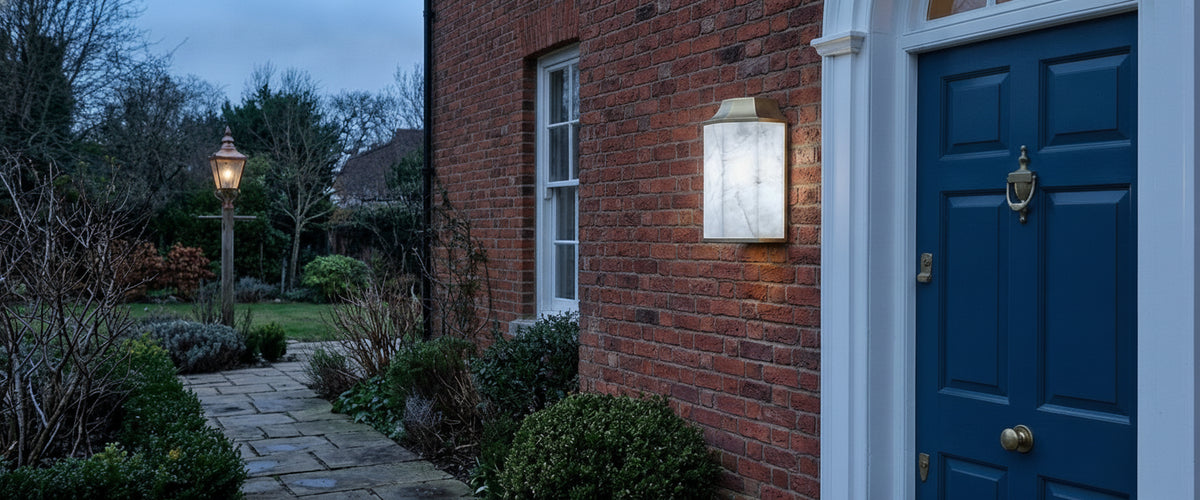

Most traditional outdoor wall lights fail long before the bulb does. The lantern goes up in autumn looking like it belongs on a Georgian door, and by March the lacquer has clouded, the glass has fogged and the beam has turned a hard, chilly white that flattens the brickwork. Very little of that comes down to bad taste. It comes down to specification, and a period facade has little patience for a wrong call.
At Niori we spend most of our time with alabaster and natural stone, materials that reward close attention to how light behaves. Traditional outdoor wall lights ask for the same discipline, just under harsher conditions. Here is how we would specify them.

Key Takeaways
- Finish: solid brass and copper weather gracefully. Lacquered brass-effect and thin powder-coat over steel usually do not.
- Rating: IP44 is fine under a deep porch. An exposed, weather-facing elevation needs IP65.
- Scale: most buyers go too small. Size the lantern against the door, not the wall.
- Colour: 2700K or warmer, with good colour rendering, keeps brick and stone reading as they should.
- Installation: exterior wiring is a job for a qualified electrician, every time.

Why the Lantern Still Shapes Traditional Outdoor Wall Lights
The classic wall lantern, a glazed box or hexagon under a ventilated cap, exists because it had to keep a flame alive in wind and rain. The cap shed water and let heat escape. The glazing protected the flame. The backplate held the whole thing clear of damp masonry. Strip away the candle and the oil, and those three functions still decide whether a modern fitting copes outside.
That history explains why the most convincing outdoor traditional wall lights are rarely the most ornate. A proper lantern has a cap with a real overhang, glazing set into the frame rather than glued to it, and enough body to house a gasket. When a design keeps the silhouette but loses the overhang, water sits on the top and finds its way to the lamp holder. You can usually spot this in the showroom by running a finger along the top edge: if it is flat and flush, expect trouble.
Brass, Copper and Powder-Coat After a Wet British Winter
Here is how the main finishes on traditional outdoor wall lights behave once they have spent a season or two on a real wall, rather than how they look in catalogue photography.
Solid Brass
Unlacquered solid brass darkens to a soft brown within a season or two, deepening unevenly where rain runs off the cap. On a Victorian or Edwardian house that unevenness looks earned. Polish it if you like the bright look, but most owners stop after the first winter and are glad they did. The trouble starts with lacquered brass: once the lacquer is breached, moisture creeps beneath it and you get blotchy patches that cannot be polished out without stripping the whole fitting.
Copper
A traditional copper wall light moves from bright salmon through brown to, eventually and especially near the coast, the blue-green verdigris familiar from old roofs and church spires. The Copper Development Association's guidance on natural copper finishes explains that this patina is a protective layer, not decay. Exposure drives the pace, so a lantern on a seaward or weather-facing wall can be greening while its twin in a sheltered corner is still mid-brown. Lovely on a granite cottage. Less lovely if you expected a pair to match.
Powder-Coat
Powder-coat over aluminium is a perfectly sound choice, especially in black or a heritage green. Powder-coat over mild steel is the one to question. It looks identical new, but a single chip at a fixing screw lets rust bloom underneath, and orange tears down a painted render take some explaining. Ask what the base metal is before you buy.
IP44 Versus IP65 on an Exposed Elevation
IP ratings come from an international standard, and the IEC's own explanation of IP codes is the clearest reference. The first digit covers solids such as dust; the second covers water. IP44 means protection against splashing from any direction. IP65 means dust-tight and protected against low-pressure water jets.
For traditional exterior wall lights, the practical reading is simple. Under a recessed porch or a deep canopy, IP44 is normally adequate. On a flank wall or gable that faces the prevailing south-westerly, where rain arrives sideways for days at a stretch, specify IP65. Period-style fittings make this trickier because glazed lanterns with open caps are harder to seal, so a genuine IP65 lantern will usually have a visible gasket and a more substantial back box. Gaskets perish, too. Check them every couple of years and you will save yourself a fogged lantern.
Matching Scale and Proportion to Facade Type
The most common mistake we see with outdoor wall lights traditional in style is undersizing. A lantern that looks generous in a box looks timid beside a 2.1m (7 ft) front door. As a starting point, aim for a lantern roughly a quarter to a third of the door's height, and set its centre just above eye level, which on most front doors means about 1.7 to 1.8m (5.5 to 6 ft) from the step.
Victorian Terrace
Narrow frontages and tight porches suit a single lantern beside the door or a slim pair flanking it. Hexagonal glazing and a simple bracket feel right; heavy scrollwork crowds the brick.
Georgian and Regency
Symmetry rules. Pair lanterns either side of the door, keep them square or tapered, and resist anything rustic. Black or dark bronze sits comfortably against stucco and stock brick.
Arts and Crafts Gable
Deep eaves and handmade detailing can carry a chunkier lantern in copper or aged brass with seeded or amber glass. This is the facade where patina helps rather than hinders.
Stone Cottage
Thick walls and low lintels call for a smaller, sturdier fitting mounted slightly lower, so the light washes across the stone texture instead of glaring at visitors.
Warm Colour Temperature and the Kerb Read
Get the colour temperature wrong and nothing else about traditional outdoor wall lights matters. A 4000K lamp in a period lantern makes red brick look grey and limestone look like concrete. Stay at 2700K as a ceiling, and consider 2200K to 2400K for a softer, almost gaslit read on older properties. Look for a colour rendering index of 90 or above so the warm tones in brick and timber survive after dark.
Brightness needs restraint as well. A front door lantern rarely needs more than a few hundred lumens, and frosted, seeded or opal glass will soften the source so the lantern glows rather than glares. Your neighbours, and the local bats and moths, will be better off for it.
The Five Specification Mistakes That Date a Period Property's Exterior Lighting
- Buying on silhouette alone. The shape looks right, but the brass-effect finish fails by the second winter.
- Going a size down. Small lanterns on a substantial door read as an afterthought.
- Cool white lamps. The single fastest way to make a Victorian frontage look like a car park.
- Mixing metals carelessly. A copper lantern beside chrome door furniture and a black letterbox tells three competing stories.
- Ignoring the backplate. An oversized modern mounting plate behind a period lantern gives the game away, especially on brick.
Where Alabaster Belongs in the Picture
A straight answer, because people ask: alabaster does not belong outside. It is a soft, slightly water-soluble stone, and rain will pit and dull it within months. Its natural home is just inside the threshold, where a warm alabaster wall light in the hallway picks up the glow of the lantern outside and carries it into the house. That handover from exterior lantern to interior stone is one of the nicest effects you can design into an entrance, and our alabaster lighting collection is built for exactly that role. If you want traditional wall sconce lighting that continues the period mood through hallway, stairs and landing, start there.
Where stone is not the right fit, the same principle applies to glass and metal on the inside of the door. These are interior fittings rather than exterior ones, but they decide whether the entrance reads as one scheme. In a hallway that needs a soft diffused glow rather than sparkle, an opal-shaded fitting such as the Antic 2 Light Opal Glass LED Wall Light, Gold carries the warmth of a lantern far better than clear crystal, which tends to scatter points of light. And if you have chosen copper lanterns for the front of the house, repeating that metal just inside, with an interior piece like the Blip 2 Light Wall Light, Copper, ties the threshold together and avoids the competing-metals problem described above.
For the traditional outdoor wall lights themselves, look for solid metals, proper glazing and an honest IP rating, and explore the wider niori lighting range to keep finishes consistent from the front step to the drawing room.
Buyer's Checklist for Traditional Outdoor Wall Lights
- Confirm the base metal: solid brass, copper, aluminium or steel.
- Decide whether you want patina or a stable finish, and choose accordingly.
- Match the IP rating to exposure: IP44 sheltered, IP65 exposed.
- Size against the door, then mock it up in cardboard on the wall before ordering.
- Specify 2700K or warmer, CRI 90 or above, with diffused glass.
- Check the backplate size against your brick courses or render.
- Use a qualified electrician for all exterior wiring, sensors and timers. In England and Wales, some outdoor electrical work is notifiable under Part P of the Building Regulations, and a registered electrician can self-certify it.
- Inspect gaskets and fixings every couple of years.
Budget for traditional outdoor wall lights depends on material, scale, glazing, engineering and finishing, so if you are lighting a full facade or a hospitality frontage, ask us for a tailored quote rather than guessing from a single fitting.