
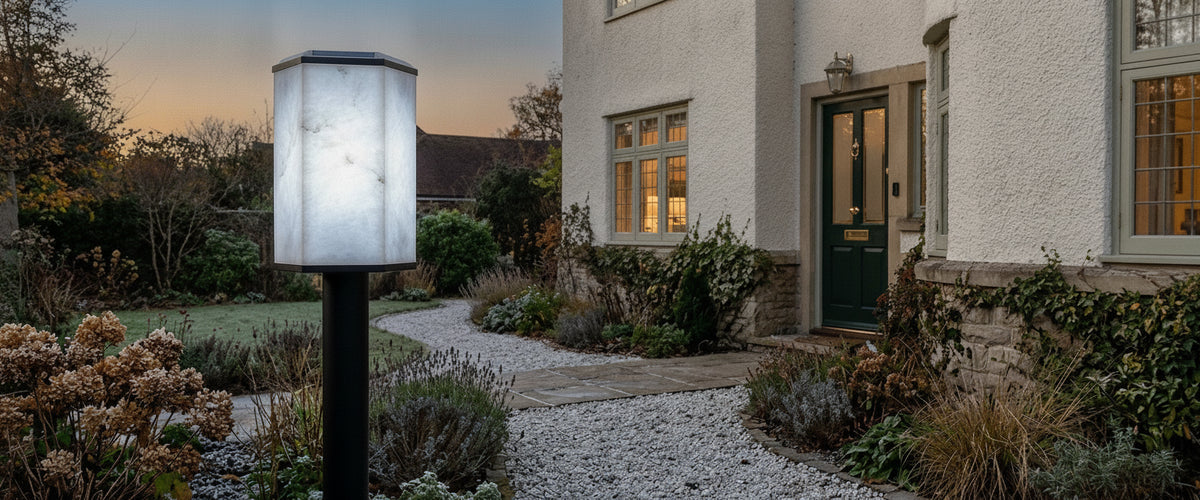

The solar lantern that looked charming on your terrace in July is often a faint gray smudge by the middle of November. Buyers tend to blame the bulb. The real problem is usually upstream: a small panel, a tired battery and a garden that gets about a third of the usable winter sun the product photos assumed. The good news is that you can find outdoor garden lanterns solar panels can still charge through a British winter, but only if you buy them for December rather than for June, and place them where the physics is on your side.
At Niori we spend most of our time with alabaster and natural stone, and the way those materials soften light shapes how we judge any fixture, indoors or out. An outdoor solar garden lantern can be judged the same way. Is the glow warm and diffused, or is it a cold pinprick behind frosted plastic? Does it still look good after one wet winter?
Key Takeaways
Panel size and position matter more than the LED; the outdoor garden lantern solar panel sets your winter run time.
Battery chemistry decides whether the lantern survives frost; lithium iron phosphate generally copes better than budget cells.
Powder-coated aluminum, stainless steel and glass outlast painted mild steel and thin plastic.
Solar suits accent and wayfinding light, not steps, doors or anywhere you need to see clearly.
Check lumens, IP rating and stated low-light charge time before you buy.

Why Solar Lanterns Turn Into Different Fittings Once the Clocks Go Back
An outdoor garden lantern solar setup is really a small energy budget. In midsummer, a southern English garden can see sixteen or more hours of daylight, much of it with the sun high in the sky. By late December you are working with roughly eight hours, a low sun angle and frequent cloud. The Met Office climate averages show how sharply winter sunshine hours drop, and Scotland and the north of England fall further still.
So the same fitting behaves like two different products. In summer it charges fully by lunchtime and glows past midnight. In winter it may start the evening half-charged and fade within a couple of hours, just as you most want light, around 5pm when it is already dark. If you judge outdoor garden lanterns solar performance on summer reviews, you are buying the wrong product for a third of the year.

Panel, Battery or Bulb: Which Part Decides the Light You Get?
Think of the three components as a chain. The weakest link sets the result, and on most outdoor garden lanterns solar panels are that link.
The Panel
Monocrystalline panels convert weak light more efficiently than polycrystalline ones, and on a cloudy British afternoon that difference shows. Size matters too. A small panel built into the lantern lid is convenient, but it is also tied to wherever the lantern hangs. Outdoor garden lanterns solar powered through a separate panel on a cable, mounted a few feet (around a meter) away in open sky, consistently do better in winter. One client in Harrogate moved the same set of lanterns from a shaded pergola to a fence with a remote panel, and the evening run time roughly doubled. Nothing else changed.
The Battery
Batteries lose usable capacity in cold weather, and repeated frost cycles shorten their life. Lithium iron phosphate cells generally tolerate cold and deep cycling better than cheap nickel-metal hydride packs. Ask whether the battery can be replaced. A sealed unit means the whole outdoor garden lantern solar unit becomes waste once the cell degrades, usually after a few seasons.
The LED and Diffuser
The LED rarely fails first in outdoor garden lanterns solar kits, but it decides the character of the light. Look for warm white, ideally 2700K to 3000K. Cooler 5000K-plus LEDs read harsh and bluish against planting and brick. The diffuser matters as much as the color temperature: seeded or frosted glass spreads the glow softly, much as alabaster does indoors, while clear plastic over a bare LED gives a glaring dot.
Finishes That See Out a British Winter, and the Ones That Blister by March
Rain is only half the threat. The bigger one is water getting into a finish, freezing, expanding and lifting it from beneath. That is why the cheap painted outdoor garden lanterns solar sellers discount every autumn often look fine in October and flaky by spring.
Powder-coated aluminum: light, rust-free and durable if the coating is thick and unbroken at the seams.
Marine-grade (316) stainless steel: a strong choice for coastal gardens where salt air attacks lesser metals.
Solid brass and copper: they will patina rather than fail. Choose them if you enjoy the aging; avoid them if you want the finish to stay bright.
Glass: tempered glass handles temperature swings better than thin annealed glass.
Painted mild steel and thin plastic: the usual culprits for rust bleed, clouding and cracked lids.
A note on stone, since buyers sometimes ask us. Alabaster is a soft, gypsum-based stone that is slightly soluble in water, so it does not belong in an open garden, however beautiful the idea. Its natural home is indoors, in pendants, wall lights and table lamps where it can soften light without weathering. If you love that glow and want to carry it through a garden room or onto a covered threshold, our alabaster lighting collection includes indoor pieces that sit close to the glazing and draw the eye outward.
Choosing Outdoor Garden Lanterns: Solar for Atmosphere, Mains for Safety
In outdoor garden lanterns solar power is best treated as atmosphere, not as task light. Put them where a soft glow is the whole point.
Positions That Work
Trees and pergolas: outdoor garden hanging lanterns clustered at varying heights, roughly 6 to 8 feet (1.8 to 2.4 meters), give a dining area a ceiling of light without wiring. Keep the panel clear of the canopy.
Path edges and borders: lanterns spaced every 6 to 10 feet (1.8 to 3 meters) mark a route without lighting it flat.
Ends of a vista: a single large outdoor garden lantern at the end of a lawn or beside a bench gives the eye somewhere to land.
Terrace corners: floor-standing lanterns frame seating and help a space read as a room after dark.
Positions Where Solar Falls Short
Steps and changes in level: you need dependable light every night, including the dark weeks. Where steps run down from a back door, a wall-mounted fitting that switches on as someone approaches, such as the Outdoor LED Half Wall Lantern With PIR, Black, does the job an outdoor garden lantern solar panel cannot promise in January.
Front doors and gates: a mains wall lantern with a photocell or PIR sensor is more reliable for security and keys-in-hand moments. For a porch that should glow from dusk without anyone remembering a switch, a half lantern with a photocell, like the Outdoor LED Half Wall Lantern With Photocell Sensor, Black, sits flatter to the wall than a full lantern and keeps the doorway lit through the shortest days.
North-facing walls and deep shade: without a remote panel, these spots barely charge from November to February.
For anything mains-powered, use a qualified electrician. Outdoor circuits in the UK carry specific protection requirements, and garden wiring is not a weekend job. Many of the gardens we see end up with a sensible mix: mains wall lanterns near the house, outdoor solar garden lanterns further out where trenching cable would disturb planting. On a period facade, a traditional black coach shape such as the Outdoor LED Wall Lantern, Black Traditional Coach Lamp IP54 keeps the house end of the garden in the same visual language as the hanging lanterns further out, so the two layers read as one scheme. You can compare fixture types across our wider lighting range.
What to Verify Before You Buy: Lumens, IP Rating and Low-Sun Charge Time
Product pages for outdoor lanterns garden buyers browse tend to lead with summer run times. Read past them. These are the numbers that tell you how outdoor garden lanterns solar charged in short daylight will behave in January.
Lumen Output
Most decorative outdoor garden lanterns solar brands make sit in the low tens of lumens, which is right for ambience. Large outdoor garden lanterns intended to light a seating area need more, and the higher the output, the faster the battery drains. A lantern with a dimmer or a low/high mode lets you trade brightness for winter run time, which is often the smarter choice.
IP Rating
The IP code tells you how well the enclosure keeps out solids and water. For an exposed garden position, IP44 is the realistic minimum and IP65 is better, especially for outdoor garden lanterns solar powered and sitting low where rain splashes back up. The Lighting Industry Association is a useful UK reference for product safety and compliance standards if you want to check what a rating should mean in practice.
Low-Sun Charge Time
Few listings state this clearly, so ask. You want to know how long the outdoor garden lantern solar battery runs after a full day of overcast winter light, not after eight hours of direct sun. If the seller cannot answer, assume winter performance is modest.
Pre-Purchase Checklist for Solar Garden Lanterns
Does the panel face south, with open sky, for most of the winter day? If not, is there a remote panel option?
Is the panel monocrystalline?
Is the battery lithium-based and replaceable?
Is the LED warm white (2700K to 3000K) behind a frosted or seeded diffuser?
Is the body powder-coated aluminum, stainless steel, brass or copper rather than painted mild steel?
Is the IP rating at least IP44, and IP65 for exposed or low positions?
Is there a brightness or mode setting to stretch winter run time?
Is the outdoor solar garden lantern going somewhere decorative, with mains lighting handling steps and doors?
Seasonal Care That Keeps Them Going
Wipe panels every few weeks through autumn; leaf film and bird droppings cut charging more than most people expect. In a hard frost spell, some owners switch lanterns off for a few days so the battery can build a reserve. Before spring, check seals and hanging chains, and replace any battery that no longer holds a winter charge rather than writing off the whole lantern. Cared for this way, with panels clean and batteries fresh, outdoor garden lanterns solar energy can keep topped up become a dependable layer of garden atmosphere, provided you ask them to do the job they suit.