
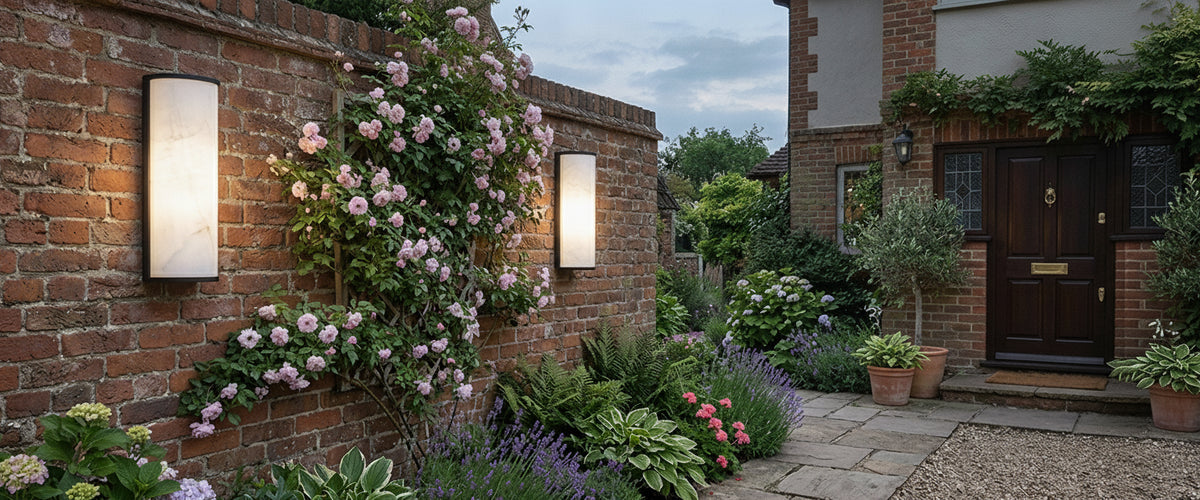

Most garden wall lights are chosen on a bright afternoon and judged on a wet November evening, which is exactly the wrong order. The fitting matters, but the wall decides whether it works. Its height, its texture, the way it faces and the planting against it all shape the result, along with whether there is a cable anywhere near it. Get the plan right and a modest pair of up/down lights can make an ordinary brick boundary look like architecture. Get it wrong and a beautifully made fitting becomes a glaring dot that lights nothing but the gutter.
Quick answer
Plan from the wall, not the catalogue. Measure its height, note what grows against it and check which way it faces before you choose a single fitting.
On a typical 6 ft (1.8 m) boundary wall, a mid-height fixing gives up/down beams room to open out. Beside a door, around 5 to 6 ft (1.5 to 1.8 m) is the usual starting point.
Wired garden wall lights outperform solar for anything you want lit properly in a British winter. Solar is fine for markers.
Exposed walls need IP65 fittings. Recessed fittings need depth and drainage planned in before the mortar goes on.
Keep colour temperature warm, at 2700K to 3000K, so the garden reads as an extension of the light indoors.
Any wired outdoor circuit is a job for a qualified electrician.

Why Most Garden Wall Lighting Fails at the Planning Stage
The usual mistake is buying the look first. Someone falls for a lantern or a sleek cylinder, orders four, and spaces them evenly along the wall. The result is flat and municipal, the visual equivalent of a supermarket car park. Even spacing suits a corridor. A garden wants rhythm: light where there is something to look at, shadow where there is not.
A typical version of this problem: four bulkheads lighting a pale rendered wall so evenly that every crack and patch of damp shows. The fix is usually subtraction. Take two away and set the remaining pair either side of a climbing rose with up/down beams. The wall goes back into the shadows, the rose becomes the event, and the garden suddenly has depth.
Two fittings framing one feature usually beat four spaced evenly along the wall.
The other planning failure is forgetting where the garden is actually seen from. For most of the year, garden wall lighting is enjoyed through glass, from a kitchen or sitting room. If the room is lit by the honeyed, diffused light of an alabaster pendant and the garden beyond is lit by cold 4000K spots, the glass becomes a hard line between two worlds. Stand inside at dusk, look out, and plan from there. If you are still shaping the interior scheme, our alabaster lighting collection is a useful way to judge the warmth you want the garden to echo.

Mounting Height and Spread: How One Wrong Decision Kills the Whole Facade
With garden wall lights, height is the decision that cannot be fudged later. Mount a fitting too high and the beam overshoots, throwing light into first-floor windows (yours and your neighbours') and leaving the base of the wall dark. Mount it too low and an up/down fitting produces two stubby scallops that never quite reach the coping or the ground.
Before drilling anything, take a strong torch out on a still evening and hold it against the wall at different heights. Mark the positions you like in chalk. It takes twenty minutes and saves a good deal of filling and repainting. If you want some margin for error once the fitting is up, adjustable heads help: a fitting such as the Outdoor Adjustable LED Up Down Wall Light IP65, Anthracite lets you tilt the beams to clear a window or reach the coping, which a fixed-beam cylinder cannot.
Texture changes everything too. Rough brick, flint and stone love a narrow beam fired close to the surface, because the grazing light picks out every ridge. Smooth render does the opposite: it exposes every hotspot and every uneven patch, so wider, softer beams and fewer fittings usually work better. The Institution of Lighting Professionals' guidance on obtrusive light is worth reading before you commit, especially on tight urban plots where a misjudged beam lands straight in a bedroom next door.
Solar versus Wired Garden Wall Lights on a British Elevation
garden solar wall lights are tempting because they skip the electrician. On a British elevation, though, the maths is unforgiving. December days are short and the sun sits low, and a north-facing wall gets almost no direct light at all. The panel charges poorly exactly when you want the light most, so output fades early in the evening.
That does not make solar garden wall lights useless. They are honest performers as markers: a low glow on a step, a shed wall at the bottom of a long garden, a gate post where trenching a cable would mean lifting a path. Choose models with a separate panel you can mount on the sunniest face, and expect a glow rather than proper illumination.
Wired fittings give you consistent output, dimming, timers and the option to put the garden on its own switch inside the house. The trade-off is installation. Outdoor circuits need suitable cable, RCD protection and careful routing, and new outdoor circuits are covered by Part P of the Building Regulations in England. Use a qualified, registered electrician; this is not a weekend project.
Recessed versus Surface-Mounted: When Flush Fittings Earn Their Keep on a Garden Wall
Recessed garden wall lights are at their best where a projecting fitting would be knocked, tripped over or simply look clumsy: steps cut into a retaining wall, narrow side returns, low walls alongside a path. They wash the ground rather than the wall, which is exactly what you want for safe footing.
Flush fittings light the treads, not the wall, which is what safe footing needs.
The catch is that flush fittings belong to the build, not the afterthought. They need a back box of the right depth, a route for the cable and somewhere for water to go. Retrofitting them into an old brick wall means cutting out bricks, and on lime-mortared walls that should be done by someone who understands the material. If your wall is already built and full of character, surface-mounted up/down garden wall lights are usually the better call. Where that wall has some shelter, under deep eaves or a covered terrace, a compact GU10 fitting such as the OBEX Outdoor Up/Down Wall Light IP55 GU10, Anthracite sits quietly against brick and lets you swap lamps later; on a fully exposed face, step up to IP65.
One caution: do not confuse interior trimless recessed lights with outdoor recessed fittings. Trimless fittings are designed to be plastered into an internal wall and have no business facing rain. Check for an outdoor rating on the product itself, not the category it happens to sit in.
What British Weather Does to Popular Finishes Over Five Winters
The finish on new garden wall lights looks crisp on delivery, which tells you very little. Five winters of rain, frost, salt air and sun on a south-facing wall tell you everything.
Matt black: good-quality powder coating holds up well, but thin coatings on south-facing walls can chalk to a dusty grey.
Anthracite: forgiving, because it hides water marks and the odd scuff better than true black.
Brushed chrome: sharp against modern render, but within reach of the coast it is prone to pitting and spotting. Wipe it regularly or choose something else.
Brass and copper: they will darken and eventually develop a patina. Buy them because you want that change, not in the hope it will not happen.
Marine-grade stainless steel: the sensible choice for seaside gardens.
The fittings that age worst are rarely let down by the finish alone. More often it is the cheap screws that rust first and stain the wall beneath. Look at the fixings and the gaskets, not just the body.
A word on alabaster, since people ask. It is a form of gypsum, soft and slightly water-soluble, which is why it diffuses light so beautifully indoors and why it should never be fitted outside, even under a porch. Damp British air will dull and roughen it. Keep alabaster for the rooms that look out onto the garden.
The Boundary Fence Trap: Why Garden Walls and Fence Posts Demand Different Placement Logic
A brick or stone wall can carry garden wall lights and be the feature in its own right. A fence cannot. Panels flex in the wind, timber moves as it wets and dries, and posts eventually rot or get replaced, taking your cabling with them.
Light raked across fence boards also tends to expose gaps, uneven stain and green algae. If a fence is your boundary, fix to the posts rather than the panels, and point the light at the planting in front of it so the fence recedes. Check who owns the boundary before you drill; a shared fence is a conversation with your neighbour first.
Choosing Garden Wall Lights: The Decision Checklist
Exposure: IP65 for exposed walls, IP44 only for genuinely sheltered spots.
Impact: an IK rating such as IK08 is worth having where children play football or bikes are wheeled past. For a busy side return, a toughened body such as the IK08 21W LED Outdoor Wall Light, Black IP65 CCT Adjustable makes more sense than a delicate lantern, and its switchable colour temperature lets you settle on warm white once it is up.
Beam: up/down for wall washing and drama, downlight only near doors and steps, recessed for paths.
Lamp type: replaceable GU10 lamps let you change colour temperature later; integrated LED fittings are slimmer but replaced as a whole.
Colour temperature: 2700K to 3000K for living gardens. Some fittings offer adjustable CCT if you are undecided.
Controls: put feature lighting and security lighting on separate circuits. A PIR that snaps on at full brightness ruins a quiet evening.
Finish: match it to your exposure and how much ageing you are happy to see.
Installation: agree cable routes with your electrician before the patio or planting goes in.
Budget depends on the material, the number of fittings, the engineering of the body and the installation work involved, so a scheme for a long walled garden and a small courtyard can differ widely. Our full lighting range is a good place to shortlist styles and finishes before you ask us for a tailored quote for your project.
Bulbs, Dimming and the View from Indoors
Outdoor fittings often ship with lamps that are brighter than a garden needs. Lower output almost always looks better after dark, because your eyes adjust and the contrast does the work. If your fittings take GU10 lamps, dimmable warm-white LEDs on a compatible dimmer let you set the garden a notch below the room inside, so the glass reflects less and the view carries through. That relationship between soft interior light and restrained garden wall lighting is the part most schemes miss, and it is the part people notice every single evening.
Start with the wall, then the view, then the garden wall lights themselves. Do it in that order and the garden stays usable long after sunset, all year round.