
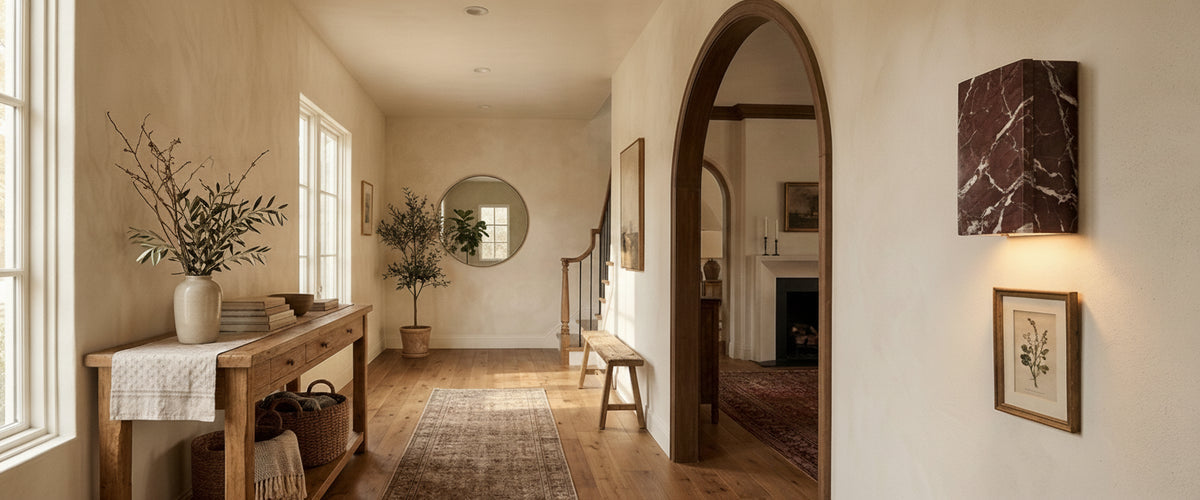

Switch on a red marble wall lights for the first time and it rarely does what the product photograph promised. Instead of a smooth, even glow, you get bright flares along the pale veins, deep wine-coloured islands where almost nothing passes through, and a pattern on the wall that looks closer to firelight than lamplight. That is not a defect. It is how red stone handles light. Once you understand why, you can pick a fitting whose pattern you will love rather than one you tolerate.

Key Takeaways
- A red marble wall light transmits light unevenly because iron-rich pigment absorbs light while pale calcite veins let it through.
- Veining density predicts the pattern: busy veining gives a flickering, broken glow, sparse veining gives a darker body with a few bright seams.
- A round marble wall light pools light softly in all directions; a rectangular one throws harder lines up and down the wall.
- Warm white walls, plaster and natural timber flatter red stone; cool greys and bright whites tend to fight it.
- Use warm, high colour-rendering LED lamps and a compatible dimmer, and have a qualified electrician fit the light.

Why Red Marble Glows in Patches Rather Than Washes
Most red and burgundy marbles get their colour from iron oxides, chiefly haematite, dispersed through the carbonate rock. The British Geological Survey catalogues many of these decorative stones, and what they share is a mineral that absorbs a large share of visible light. The red ground acts like a filter. Where the pigment is dense, light stalls. Where the stone is purer calcite, light passes through.
In practice that means the pattern of a red marble wall light is decided by geology far more than by the lamp inside. The white or pink veins become the light source you actually see, while the deep red body reads as a frame around them. Hold a white Carrara offcut and a burgundy offcut of similar thickness against a torch and the difference is stark: the white slab lights up almost edge to edge, while the burgundy shows a bright crackle of veins and very little else. Same torch, same thickness, completely different object.
This is the opposite of what happens with alabaster, which is softer, more uniform and far more translucent. Alabaster gives a broad, milky wash. Red marble gives drama, with contrast built in.
Veining Density: Predicting the Shadow Pattern Before You Buy
Because the veins carry the light, you can read a red marble wall light like a map before it is ever switched on. Ask for a photograph of the actual piece, ideally taken against a window or with a light behind it, and look at three things.
Vein Width
Fine, hair-thin veins produce a delicate lacework of light that softens from a metre or so away. Wide, ribbon-like veins create bold bright bands that stay legible across the room. If the light sits beside a sofa or a bed, fine veining is calmer. In a hallway or restaurant corridor, wide veining holds its own at a distance.
Vein Distribution
Brecciated red marbles, made of angular fragments cemented together, glow in a scattered, almost mosaic pattern. Stones with long parallel veins glow in stripes. Neither is better, but stripes make orientation matter: vertical veins on a wall light lift the eye, horizontal veins widen a narrow wall.
Pale Area Versus Dark Area
A rough rule we use: if less than about a fifth of the visible surface is pale veining, treat the fitting as a sculptural object that glows at the edges rather than a working light. That is fine, provided you have other light in the room doing the practical job.
Round Versus Rectangular: What Lands on the Wall
Silhouette changes what the wall receives, often more than buyers expect.
A round marble wall lights, whether a disc, a half-moon or a shallow bowl, lets light escape around its whole perimeter. The result is a soft halo on the wall behind, with the veined face glowing in the centre. Round forms forgive uneven plaster and suit period rooms, bedrooms and anywhere you want the light to feel gentle. They also sit happily in pairs either side of a mirror or headboard because the halos overlap without hard edges.
Rectangular and cylindrical forms are often open at the top and bottom, so they throw two defined beams up and down the wall, with the marble face glowing between them. This is more architectural. It emphasises ceiling height, shows off textured walls such as limewash or tadelakt, and works well in long corridors where a rhythm of uplight and downlight helps people find their way. The trade-off is that any bumps or poor filling in the plaster will be exaggerated by the grazing light.
What Grey and White Marble Reveal About Red Stone
Comparing a red marble wall light with grey or white marble explains a lot. White marble transmits light fairly evenly, so its glow looks clean and bright, and dark veins appear as shadows. Grey marble sits in between: dimmer, cooler, with veins that can read as either light or dark depending on their mineral content.
Red stone inverts the white marble logic. The veins are bright and the body is dark, so the eye reads the pattern in negative. It also shifts the colour of the light itself. Whatever passes through a burgundy shade comes out warmer and slightly amber, which is why red marble feels cosier than its white cousin even with the same bulb. If you want an even, ambient glow first and pattern second, white stone or alabaster is the more honest choice; looking at alabaster lighting alongside a red marble option makes that difference obvious very quickly.
Placing a Red Marble Wall Light: Height, Wall Colour and Combinations
For most living rooms and hallways, mount wall lights at roughly 150 to 170 cm (about 4 ft 11 in to 5 ft 7 in) from the finished floor, so the glowing face sits above seated eye level and the lamp itself stays out of direct view from most of the room. Beside a bed, drop lower so the glow sits near the pillow rather than washing the ceiling. On a stair, follow the pitch of the treads rather than a fixed height.
Wall Colours That Make Red Marble Sing
- Warm off-whites and bone: the halo picks up the amber tone and the stone looks deliberate.
- Clay, terracotta and plaster pinks: tonal and quietly rich, very good in dining rooms.
- Deep green or ink blue: a strong complementary contrast; the red glows almost jewel-like.
- Natural timber panelling: warm on warm, a classic library or bar look.
Combinations That Fight
Brilliant white walls lit with cool LEDs make red marble look brown and tired. Cool mid-greys flatten the colour. Busy patterned wallpaper competes with the veining, so one of them has to give way. Wall colour alone can make or break the result: a pair of burgundy fittings that looks muddy against a pale grey hall can come alive once the wall is repainted a warm chalky white, with no change to the fittings at all.
Brushed or aged brass detailing tends to suit red stone better than polished chrome, and pairing one red marble wall light with softer alabaster pendants or table lamps elsewhere in the room balances patterned glow with even ambient light. The wider niori lighting collection is a useful place to build that mix.
Bulbs and Dimming for Red Stone
A red marble wall light rewards warm colour temperature. A 2700K lamp is the safe default; 2200K to 2400K deepens the burgundy and works beautifully on a dimmer in the evening. Choose LEDs with a colour rendering index of 90 or above, since cheaper lamps are weak in the red part of the spectrum and make the stone look dull. LEDs also run far cooler than halogen, which is kinder to stone and to any adhesive or fixings behind it. Check that the lamp is dimmable and that the dimmer is compatible, and have a qualified electrician install the fitting, especially in bathrooms, where the correct IP rating for the zone matters.
Stone Specification Checklist Before You Commit
- Ask for a photo of the actual stone, backlit, not a stock image.
- Confirm whether the face is translucent at its supplied thickness or largely opaque, so you know if it will glow through or glow around.
- Check the vein orientation and whether you can choose it.
- For pairs, ask whether both pieces are cut from the same block so they match.
- Confirm the finish: polished stone shows reflections, honed stone looks softer and hides fingerprints.
- Check whether the stone has been sealed and what sealer was used.
- Confirm lamp type, cap, maximum wattage and dimming compatibility.
- Check the weight against your wall construction and ask your installer about fixings for plasterboard or old lath.
- Ask about lead times and request a tailored quote, since cost depends on stone, scale, engineering and finishing.
Long-term care is simple but specific. Marble is calcium carbonate, so acidic cleaners, vinegar and citrus will etch it. Dust with a soft dry cloth, use a pH-neutral stone cleaner sparingly, and refer to the technical guidance from the Stone Federation Great Britain if the surface needs resealing. Always switch off and let the fitting cool before cleaning.
Chosen well, a red marble wall light offers something white stone cannot: a glow with weather in it, shifting from bright seam to dark ground. At Niori we work with alabaster and natural stone every day, and the red pieces have a restless, living character the paler stones rarely match. Pick the veining you love, give it a warm wall and a warm lamp, and let the patches do their work.