
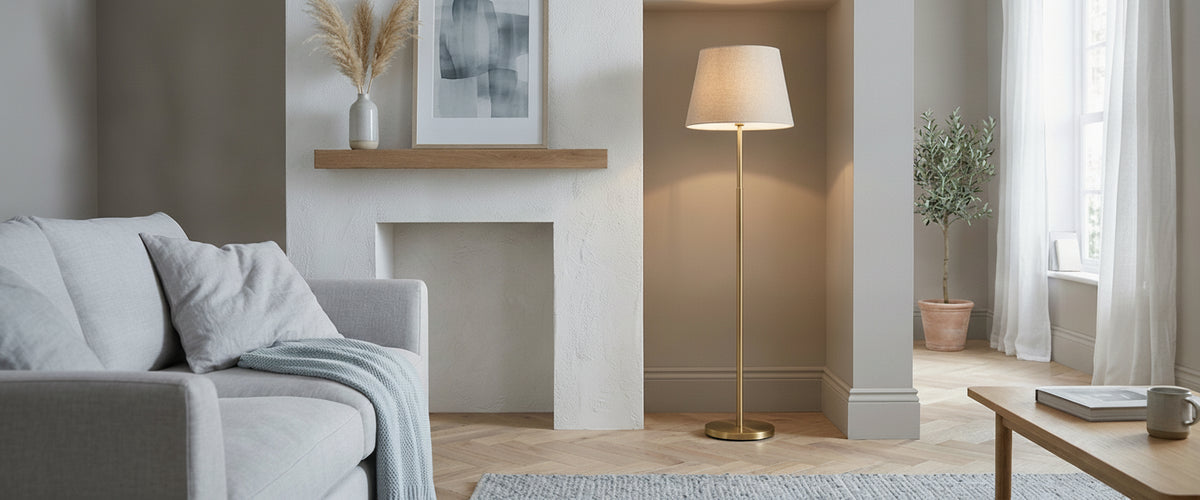

Most gold floor lamps fail before anyone switches them on. They get chosen for the finish, carried into a corner and left looking like a showroom prop, because nobody thought about where the eye lands first. A modern gold floor lamps usually stands 1.5 metres (about 5 feet) or taller, so it sits squarely in your view from the sofa, the doorway and the dining chair. The metal reads differently from each of those spots. Get the position right and almost any warm gold finish looks considered. Get it wrong and even good brushed brass starts to resemble a hat stand.

At a Glance
- Place for the view, not the socket. Decide where the lamp is seen from before you decide where it plugs in.
- The shade sets the colour of the gold after dark. Linen warms it, opal glass sharpens it, alabaster turns it to honey.
- Arcs need air. An arc lamp borrows floor and head space from the room; an upright stem keeps to its corner.
- Stay around 2700K in living spaces and choose lumens for the task, not the biggest figure on the box.
- Check the joint before the finish. The stem-to-base connection tells you more about build quality than any product photo.

Why Sightline Matters More Than Finish for a Modern Gold Floor Lamp
Gold is a reflective finish, which means it borrows from whatever sits behind and around it. Against a white wall, a slim gold stem looks thin and slightly tinny. Against deep green, oxblood or inky blue paint, the same stem reads richer and more solid. Before you worry about brushed versus polished, stand in the doorway and look at the corner you have in mind. What is the lamp going to be seen against?
Picture a modern gold floor lamp placed beside a bay window, simply because that is where the socket is. By day it becomes a dark silhouette against bright glass. After dark it reflects in the window, so the room appears to have two lamps and neither looks intentional. Move it to the alcove beside the chimney breast, where it is seen against a painted wall from both the door and the sofa, and the same lamp with the same bulb gives an entirely different result.
A useful rule: the lamp should be visible from the main entry point at a slight angle, roughly diagonal across the room, rather than head-on or hidden behind furniture. A diagonal view shows off the stem's profile, which is where good metalwork earns its keep.
What the Shade Does to the Gold After Dark
By day the finish carries a modern gold floor lamp. At night the shade takes over, and it changes how the metal looks more than most buyers expect.
Linen and Fabric
Linen filters light softly and casts a warm pool downward. The gold stem is lit from above and reads as a separate element, a warm line beneath a glowing drum. It is forgiving and familiar, though the shade can yellow over the years, and pale linen shows dust.
Opal Glass
Opal glass gives an even, milky diffusion with a slightly whiter cast. Next to it, gold becomes graphic: a crisp outline rather than a glow. On a design such as the Bubble LED Glass Floor Lamp in brushed gold, the glass sparkles and the metal acts as the frame. Lovely in a contemporary flat, a little cool in a period room.
Alabaster and Natural Stone
This is where gold behaves best. Alabaster is a fine-grained, translucent stone, and light passing through it picks up the warmth of the material and the movement of its veining. Put three lamps side by side with identical 2700K bulbs, one under linen, one under opal glass and one under alabaster, and the alabaster reads noticeably warmer, closer to candlelight. The brass beneath it seems to absorb that amber tone, so metal and stone look like one material. If you want the gold to glow rather than shine, look through our alabaster lighting and notice how the stone and brass detailing are paired.
The trade-off is care. Alabaster is soft and sensitive to water, so it wants a dry duster rather than a damp cloth, and it is not a material for steamy rooms. Where that level of care is not realistic, an amber-tinted diffuser such as the Briller LED Floor Lamp in amber acrylic and gold pushes the light in a similarly warm direction, though acrylic will never carry the depth and veining of real stone.
Rooms Where Gold Looks Deliberate and Where It Fights Back
Where it works: the living room corner beside a sofa or reading chair is the natural home for a modern gold floor lamp, especially where it fills a gap that ceiling lights leave dark. High-ceilinged rooms, such as an Edinburgh New Town flat or a converted chapel, suit tall gold stems because the vertical line answers the height. In hospitality, a pair of matching floor lamps in a hotel lounge or bar lobby gives rhythm to long walls where pendants would feel heavy. Bedrooms work too, as long as the lamp sits beside an armchair; beside the bed, a table lamp nearly always does the job better.
Where it fights back: kitchens dense with stainless steel and chrome, where gold looks like a mismatched afterthought. Small box rooms, where an arc dominates the space. And any room lit by cool 4000K downlights, which push gold towards a greenish brass. Floor lamps also have no place in bathrooms; freestanding mains lighting and water do not mix.
Arc Gold Floor Lamp or Upright Stem: Reading the Visual Weight
An arc gold floor lamps pulls visual weight out of the corner and drops it over the seating. That is its whole appeal: overhead light without a ceiling point, and a sweeping line that gives a large open-plan room a focal point. It needs a generous footprint, a heavy base (marble is common, and for good reason) and a clear path beneath the shade.
Clearance is the lesson most often learned the hard way. An arc can look perfect on a floor plan, then turn out to cross the route to the garden door, with the lowest point of the shade at forehead height for anyone over six foot. If an arc will overhang a walkway, keep its lowest point comfortably above head height, or position it so the shade only hangs over seating.
On an upright stem, a modern gold floor lamp keeps its weight vertical and close to the wall. It suits tight corners, symmetrical arrangements flanking a sideboard or fireplace, and rooms where the furniture moves around. For a reading chair where the light needs to angle towards the page, an adjustable upright such as the Funk Adjustable Floor Lamp in brass with a black base keeps the brass line slim while the dark base grounds it against pale floors. As a rough guide, the lower edge of a reading lamp's shade should sit at about seated shoulder height, around 100 to 110 cm (40 to 43 inches), so the bulb is screened from your eye.
Bulb Temperature and Lumens: The Numbers That Decide Glow or Glare
Colour temperature does more for a modern gold floor lamp than any finish upgrade. At 2700K, gold looks warm and rich. Drop to 2200K to 2400K in the evening, particularly under alabaster, and the effect turns close to firelight. Go above 3500K and gold drifts towards brassy or greenish. Keep 3000K for workspaces and hospitality settings that need a little more clarity.
Lumens tell you brightness, not watts. The Energy Saving Trust's lighting advice explains the switch from watts to lumens clearly. For ambient corner light, around 400 to 800 lumens is usually plenty; for reading, aim nearer 800 to 1,000. More than that through a translucent shade tends to create a hot spot rather than a glow.
- Choose a colour rendering index (CRI) of 90 or above so skin tones and timber look natural.
- Use dimmable bulbs with a compatible dimmer, and check whether an integrated LED lamp dims at all before buying.
- Sit in the chair beside the lamp and look up. If you can see the bare bulb, it will glare.
What to Examine on the Base and Stem Joint
Before you settle on a modern gold floor lamp, ignore the hero photo and look at where the stem meets the base. This joint carries every knock, every nudge from a vacuum and, on an arc, the full use of the overhang.
- Wobble test: a well-made lamp should not rock when you press gently on the stem. Movement at the joint gets worse, not better.
- Thread and fixings: machined threads and solid collars outlast push-fit sleeves. Ask how the sections connect.
- Finish at the seams: plating often thins at threads and edges. Lacquered or solid brass ages more evenly than a thin gold coating.
- Base weight and pads: stone or weighted steel bases resist tipping; felt or rubber pads protect timber floors.
- Cable and switch: look for a cable that exits through the base with proper strain relief, and a foot or inline switch you can reach easily.
- Marking and safety: check for UKCA or CE marking. If you plan to connect the lamp to a new floor socket, use a qualified electrician; floor sockets are not a DIY job.
A Quick Buyer's Checklist
- Pick the spot by sightline and backdrop, then sort the power.
- Choose the shade for the light you want at night, not the look in daylight.
- Measure arc reach and clearance against walkways and doors.
- Plan for 2700K, 90+ CRI and a dimmer.
- Inspect the joint, base weight and cable exit before committing.
- Factor care into the material: alabaster wants dry dusting, brass wants a soft cloth and no abrasives.
Budget depends on material, scale, engineering and finishing more than on the colour of the metal, so for stone and larger pieces it is worth requesting a tailored quote. If you are weighing up gold metalwork against stone-shaded designs, our wider lighting collection lets you compare both side by side. Niori works in alabaster and natural stone because those materials make gold behave at its best after dark, and a well-placed modern gold floor lamp should look as good at eleven at night as it did in the photograph.