
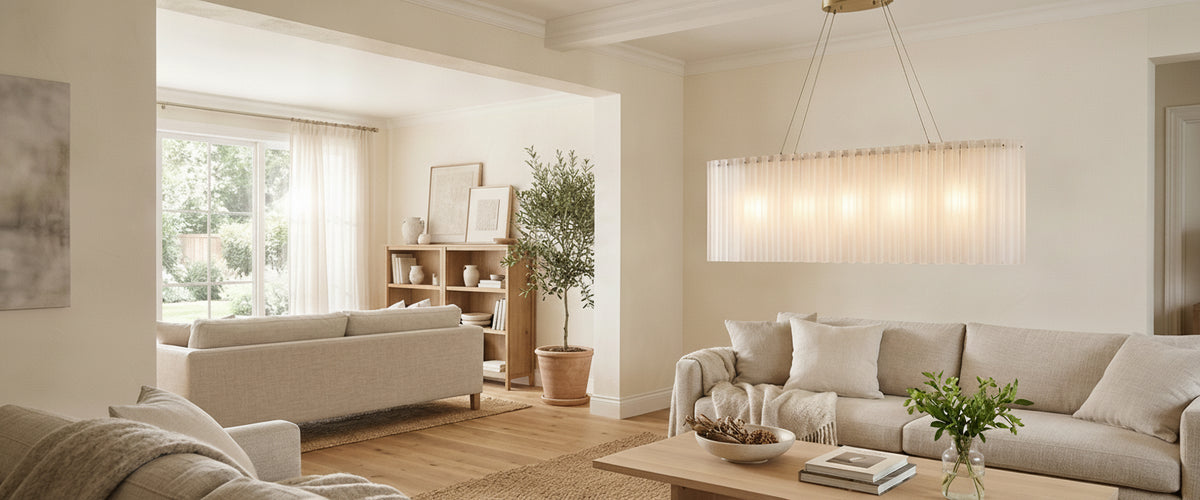

Most living room chandeliers are hung in the wrong place for a simple reason: the electrician put the ceiling point there decades before anyone chose a sofa. A modern crystal chandeliers makes that mistake very visible. Crystal throws sparkle in every direction, so if it hangs over empty floor while the seating huddles by the fireplace, the room looks like it is waiting for a different layout. Choosing the fixture is the easy part. Placement, bulb and backdrop decide whether it reads as considered or accidental.
Key takeaways
- Hang the chandelier over the seating group or coffee table, not wherever the ceiling rose happens to be.
- Use 2700K to 3000K bulbs on a compatible dimmer; cooler light turns crystal clinical.
- Frame finish matters as much as the crystal. Brass and gold warm up at night, while chrome and nickel stay cool.
- Wall colour and ceiling height change how the fixture looks before it is switched on.
- In rooms under about 2.4 metres (7 ft 10 in), a flush fitting or wall lights usually beat a hanging chandelier.

Why a Living Room Exposes Sightline Errors a Dining Room Hides
A dining room is forgiving. The table sits under the light, everyone faces inward, and the chandelier has an obvious job. A living room has no single anchor. People sit on a sofa facing a television, a fireplace or a window, and they look across the room rather than up at it. A modern crystal chandelier therefore sits in the peripheral view for most of the evening, and an off-axis hang shows up straight away.
Sit in your main seat and look at the ceiling point. If the fixture would cut across your view of the fire, or crowd the top of the TV, you will notice it every night. Ask that question before you buy, not after the installer has left.

Crystal Cut and Frame Finish: Daylight Versus Dimmer
The same modern crystal chandelier can look like two different objects across a day. In afternoon light from a south or west window, faceted crystal splits daylight into small flecks of colour that scatter across walls. The frame barely registers. After dark, with the dimmer turned down, the light source moves inside the fixture and the frame suddenly carries the look.
That is where finish choice pays off. Polished chrome and nickel stay crisp and slightly cool at low light, which suits pared-back rooms with pale oak and white walls. Gold, natural brass and oxidised bronze pick up warmth from a dimmed lamp and make the crystal look amber rather than icy. Cut matters too. Tube and rod crystals give a linear, architectural shimmer, while faceted drops and prisms throw more scattered sparkle. Dense faceting can feel busy in a smaller room; cleaner rods tend to sit better with contemporary furniture. Where you want that linear shimmer with some warmth after dark, a gold-framed tube design such as the Allora 12 Light Crystal Tube Chandelier is closer to the right design language than a cascade of faceted drops.
This is also where crystal parts ways with stone. Crystal refracts, so you see the light as points. Alabaster and onyx diffuse, so the whole surface glows evenly from within. Many of our clients mix the two: crystal for the statement piece and alabaster wall lights or table lamps for the soft layer underneath. Our alabaster lighting collection is a good place to see how translucent stone handles that lower, calmer layer.
Bulb Colour Temperature Decides Glow or Glitter
After placement, bulb choice changes a modern crystal chandelier more than any other decision. At 2700K, crystal gives a candle-like warmth that flatters skin and soft furnishings. At 4000K it turns sharp and faintly blue, closer to a shop display than a sitting room. We see this in the studio every time a new crystal piece arrives: under the neutral-white work lights it looks like dental equipment, and swapped to warm-white filament LEDs it looks like the piece in the catalogue.
Good habits for living rooms:
- Stay at 2700K to 3000K for evening use.
- Choose bulbs with a high colour rendering index (CRI 90 or above) so fabrics and timber stay true.
- Use clear rather than frosted lamps if you want crisp sparkle. Frosted bulbs soften crystal but dull it.
- Check that bulbs and dimmer are compatible. Mismatched LED drivers flicker, and crystal magnifies flicker.
The Lighting Industry Association publishes guidance on LED quality and dimming compatibility, which is worth reading before you buy a box of bulbs on price alone.
Placing a Modern Crystal Chandelier Over Seating, Not Ceiling Centre
Centre the fixture on the seating group or the coffee table. That is the zone where people gather, and a chandelier above it pulls the furniture together visually. In open-plan spaces, treat each zone separately: one fixture over the sitting area, a separate piece over dining, rather than one compromise in the middle.
Take a typical Georgian drawing room: a fine original ceiling rose sits a good metre away from a sofa arrangement set by the fireplace and tall windows, and moving the furniture would block a door. The answer is a new point run to the true centre of the seating, with a plain rose added in the old position so the plasterwork still makes sense. Depending on the scope of the work and where you live, moving a ceiling point may need certification or notification, so use a registered electrician rather than treating it as a weekend job.
Rough rules for height and scale:
- Keep at least 2.1 metres (about 7 ft) of clearance wherever people walk underneath.
- Over a coffee table that nobody crosses, you can drop a little lower, provided seated views stay clear.
- For diameter, add the room's length and width in feet and read the total as inches. A room of 15 ft by 18 ft suggests a fixture around 33 inches (84 cm) across.
- If the chandelier sits over a coffee table, aim for roughly half to two-thirds of the table width.
Scale cuts both ways. Over a modest coffee table in a smaller sitting room, a three-light crystal piece such as the Bellini 3 Light Crystal Chandelier in oxidised bronze will sit in proportion where a twelve-light statement would crowd the seating, and the bronze frame keeps the crystal warm once the dimmer comes down.
The Backdrop Effect: Wall Colour and Ceiling Height
A modern crystal chandelier is partly a mirror. Before it is switched on, it reflects whatever surrounds it. Against deep green, inky blue or warm plaster, crystal stands out as clear, bright points. Against brilliant white walls and a white ceiling, it can disappear in daylight and only come alive at night.
Ceiling height shifts the effect again. A tall Georgian or Victorian ceiling gives the fixture room, so a larger, more open frame works and the sparkle spreads over a wide surface. Under a lower modern ceiling, the light bounces back quickly and the ceiling itself becomes bright and busy. A painted ceiling in a soft warm tone, rather than flat brilliant white, calms that reflection noticeably. Historic interiors such as those at the Wallace Collection show how well chandeliers sit against rich wall colours and high ceilings, which is worth remembering before you hang one in a white box.
When a Modern Crystal Chandelier Fails in a Low or Narrow Room
A modern crystal chandelier needs vertical space to read as a chandelier. In rooms of 2.4 metres (7 ft 10 in) or lower, which covers a great many new builds and converted flats, a hanging piece either forces people to duck or gets shortened until it looks squashed. Narrow rooms cause a different problem: the fixture fills the width and the sparkle lands on walls a short arm's length away, so the room feels cramped and glary.
Better options in those rooms:
- Crystal or stone flush ceiling lights keep the shimmer without the drop.
- Wall lights at roughly 1.5 to 1.7 metres (5 ft to 5 ft 7 in) light a narrow room from the sides and make it feel wider.
- Alabaster table and floor lamps give warm, diffused light at eye level, which is where low rooms need it most.
- A compact pendant over the coffee table, scaled down rather than shortened, if you want one hanging moment.
In a narrow room where you still want some sparkle, a single-light crystal sconce such as the Vela 1 Light Crystal Wall Light in polished chrome keeps the glitter at the walls, where it widens the space, rather than overhead, where it would crowd it. You can compare these options across our full lighting range, from crystal pendants to stone wall lights.
A Buyer's Checklist Before You Order
- Map the seating group and mark its centre on the ceiling.
- Measure ceiling height and the clearance you will have underneath.
- Work out fixture diameter from room size, then check it against the coffee table.
- Pick a frame finish that suits the room at night, not just in the photo.
- Choose warm-white, high-CRI bulbs and a matching dimmer.
- Consider the wall and ceiling colour behind the fixture.
- Check the weight against the ceiling structure and book a qualified electrician.
- Plan the supporting layer of wall lights or lamps so the chandelier is never the only source.
Cost depends on material, scale, complexity, installation and finish. If you are planning a larger project or a bespoke size, request a tailored quote from Niori and we will advise on scale and placement for your room.