
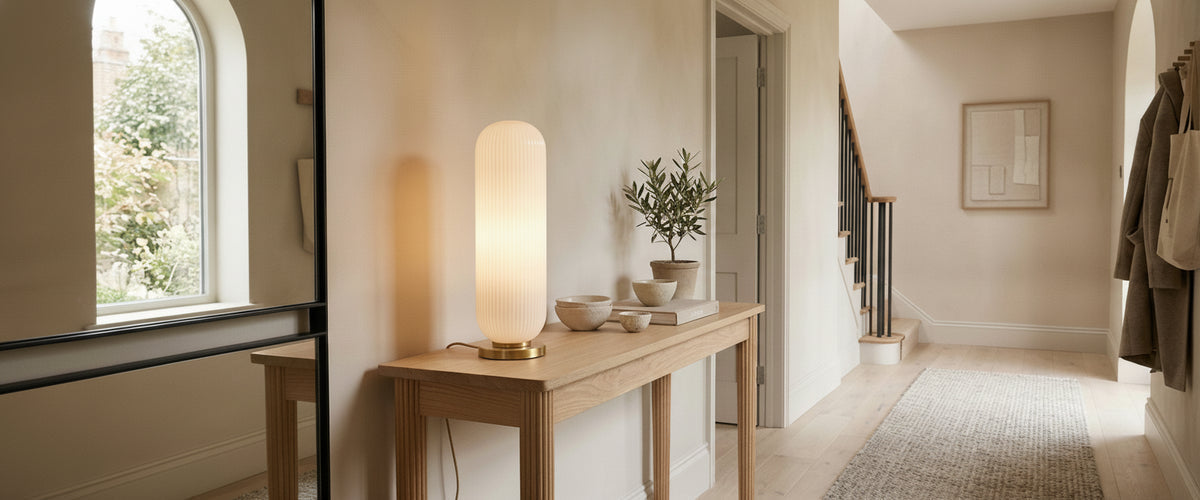

A glass table lamps is the most honest light you can buy. It shows the bulb, the flex, the fingerprints and the room exactly as they are, which is why the same lamp can look considered on one console and like a forgotten jam jar on the next. Choosing a glass table lamp well comes down to understanding how the glass handles light, and then putting it somewhere that light can do some work.
At Niori we spend most of our time with alabaster and natural stone, materials that soften light by scattering it through their mass. Glass works on the opposite principle, so it makes a useful foil. Many of the best rooms we help light use both.

Quick Answer
- Clear glass shows the bulb, so the bulb becomes the design. Use a good filament LED or a shade.
- Opal glass diffuses evenly and behaves closest to alabaster, without the veining.
- Smoked glass looks dramatic switched off and dims the output noticeably when lit.
- Coloured and stained glass tint the whole room. Use them as accents, not as reading lights.
- Check base weight, seam quality and the lampholder before anything else.

Clear, Opal, Smoked and Coloured Glass Behave in Opposite Ways
Clear glass transmits almost everything and diffuses almost nothing. Light passes straight through, so a clear base reads as a sparkle of reflections rather than a glow. That is lovely beside a mirror or on a dark lacquered sideboard, and fairly pointless on a pale table in a pale room where there is nothing for it to catch.
Opal glass has particles suspended in the melt that scatter light, giving an even, milky surface with no hot spot. It is the glass most often compared with alabaster, and fairly so. The difference is texture: opal is uniform, while alabaster carries veins and cloudier areas that make the glow uneven in a way the eye reads as natural. If you like the softness but want something cleaner and more graphic, opal is the answer.
Smoked glass is the one buyers misjudge most often. In daylight a smoked sphere looks nearly black and very handsome. Lit at night, the same globe can lose a large share of its output to the tint. Treat a smoked glass table lamp as a mood piece and plan your useful light elsewhere. A dark sphere such as the Lucia LED Table Lamp in black smoked glass belongs on a console or bookshelf where its silhouette matters more than its output, not beside the chair where you actually read.
Coloured glass shifts the colour of everything it lights, including skin. Amber and honey tones flatter a room; blues and greens cool it sharply. A stained glass table lamps takes this further, breaking the light into segments of colour held in lead or copper foil. The V&A's stained glass collection is worth an hour if you want to see how much the technique depends on light behind it: the same panel looks dull in shade and jewel-like when backlit.
How the Base Silhouette Shapes the Glow Pool
The base does more than hold the shade up. Its shape decides how much light lands on the table itself.
- Column bases are slim and vertical, so almost all light comes from the shade. You get a tidy, defined pool on the surface below and very little stray glow at the base.
- Globe bases act as a second light source if they are lit or translucent. Expect a wide, soft halo around the lamp and reflections on any glossy surface nearby.
- Vessel bases, the generous urn and gourd shapes, collect and bend light through their curves. Clear vessels throw caustic patterns onto the tabletop, which is charming on oak and distracting on marble with strong veining.
That last point matters for anyone putting a lamp on a glass table. A glass table for a lamp doubles every reflection: the bulb appears twice, the base appears to float, and a clear vessel lamp can become visual noise. On glass furniture, choose an opal or solid-shaded lamp with a column base, and let the table stay quiet.
Where a Glass Table Lamp Feels Considered, Room by Room
Living Rooms
Glass earns its place on a sideboard or console set against a dark or textured wall, where reflections have a backdrop. Pairs of opal globe lamps either side of a fireplace or sofa read as deliberate; a matched pair of something like the Soul Table Lamp with copper and opal glass globe gives that symmetry a warmer metal note than chrome would, and the opal keeps the glow even rather than sparkly. On a side table between two armchairs, a clear lamp often disappears into the general clutter of books and glasses.
Bedrooms
Opal and frosted glass are good bedside companions because they give a low, even light that will not glare across the pillow. For a bedside table that needs warmth without a visible bulb, a single opal shade such as the Vetra 1 Light Opal Glass Table Lamp in matt black makes more sense than a clear base. An exposed filament sits right at eye level when you are lying down, and you will see the bulb every night.
Halls and Landings
A single coloured or stained glass lamp on a hall table works as a signal light: something warm to see as you come through the door. It does not need to light the space, and it should not try to.
Hospitality and Restaurants
In restaurants and bars, the usual brief is table lamps that guests notice but do not stare into. Clear glass with an exposed bulb tends to fail that test quickly, because diners end up moving the lamp to get the glare out of their eyes. Opal glass on the tables, with alabaster wall lights around the perimeter, gives a room depth without any visible bulbs. Venue owners should also think about weight: a light glass lamp on a busy table will be knocked over.
Where It Simply Disappears
White kitchens, bright conservatories and minimal offices tend to swallow clear glass. With nothing dark behind it and plenty of daylight, the lamp has no edge. In those rooms a material with body, such as stone, ceramic or opal, reads far better.
Pairing a Shade With a Glass Table Lamp Base
Some combinations agree immediately. Others look like two lamps fighting over one table.
- Clear base with linen or silk shade: the classic. The shade does the diffusing, the base adds sparkle.
- Opal base with alabaster shade: a quiet, layered pairing where both materials glow, one smooth and one veined. If you want to see how carved stone shades handle light, look through our alabaster lighting collection before deciding on a glass partner.
- Smoked base with brass or metal shade: strong and architectural, with light directed hard downwards. Good for reading, less good for ambience.
- Coloured base with patterned shade: usually a fight. Let one element carry the colour or pattern and keep the other plain.
- Stained glass base with stained glass shade: works only when they were designed together. Mixing pieces from different sources almost always clashes.
Bulb Choice: Warm Filament LED or Frosted A-Shape?
With glass, the bulb is often visible, so it is part of the design. A warm filament LED (around 2200K to 2700K) in a clear globe gives a candle-like point of light and lovely reflections, but it also creates glare if it sits at eye level. A frosted A-shape bulb in the same globe spreads light across the whole surface, so the globe looks evenly lit and far calmer.
Our rule of thumb: filament LEDs for clear glass you look at from a distance, frosted bulbs for anything near a sofa, bed or dining table. For opal glass, a frosted bulb avoids the faint hot spot that a filament can still show through thinner walls.
On dimming, check that both the bulb and the dimmer are marked as compatible. Cheap pairings flicker at low levels, and flicker is very noticeable through glass. Keep colour temperature consistent across a room so a glass lamp does not look cooler than the alabaster pendant above it.
What to Check Before You Buy a Glass Table Lamp
Glass lamps tend to let you down at the same few points. Run through this list before committing.
- Seams. Mould-pressed glass shows a fine line. That is acceptable, but it should be smooth, not sharp, and should not catch the light in a bright stripe. Mouth-blown pieces have no seam but may show small bubbles, which are a sign of the process rather than a flaw.
- Base weight. Glass lamps can be top-heavy once a shade is fitted. Ask for the weight, and favour designs with a stone, metal or weighted foot if children, pets or busy hospitality tables are involved.
- Lampholder and switch. These fail first. Look for a metal lampholder rather than thin plastic, and a switch on the cable or base that feels positive when pressed.
- Cord grip. The flex should be clamped where it leaves the base. A loose cable rubbing on a glass edge will wear through over time.
- Felt or rubber pads. Essential on marble, timber or a glass table, both to protect the surface and to stop the lamp sliding.
- Replacement parts. Ask whether the shade, harp and fittings can be replaced individually. A chipped shade should not mean a new lamp.
- Electrical compliance. Any lamp sold in the UK should carry a fused plug and appropriate safety markings. If anything needs rewiring, use a qualified electrician.
Glass or Stone? Choosing for the Room
A glass table lamp suits rooms that give it something to reflect and a reason to sparkle. Where you want warmth that holds up in daylight and changes gently at night, stone usually does the better job, because the light lives inside the material rather than passing through it. Many of our clients settle on both: glass for accent and reflection, alabaster for the steady glow. You can compare fixtures side by side across our full lighting range, and for larger projects we are happy to help plan placement and provide a tailored quote based on material, scale and finishing.