
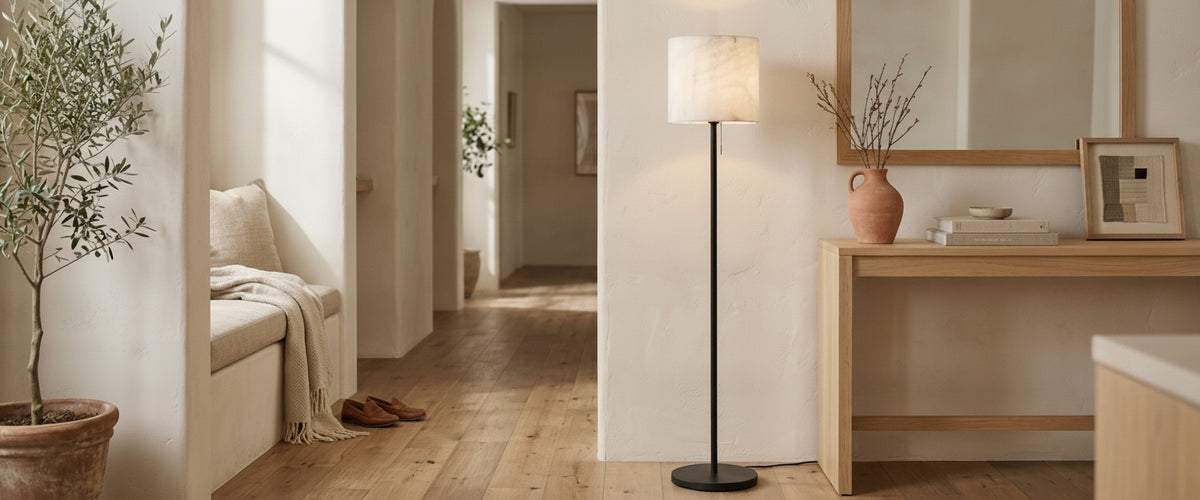

Most people buy a black led floor lamps for how it looks switched off, then live with how it behaves switched on. Those are two very different objects. Off, it is a crisp graphic line in the corner. On, it is a directional light source with a dark shell that throws light only where the shade lets it. Get the finish, the angle and the position right and it reads as a confident anchor. Get them wrong and you have a glare spot at eye level and a corner that still feels dim.
At a glance
Matte black gives a clean, defined pool of light. Gloss black adds reflections and can show a hot spot on the shade.
A tilt of around 10 degrees moves the light by roughly 10 inches (25 cm) at seated head height, so small adjustments matter.
2700K looks warmer in a black fitting than in a white or brass one, because nothing pale around the source dilutes it.
Black works best against mid-tone and pale walls. Against charcoal or ink-blue, it needs a lighter companion source.
Do the sightline check from every seat and the doorway before you commit to a position.

Matte Black and Gloss Black Do Not Light the Same Way
On a product page, two versions of a black LED floor lamp with the same shape and the same LED module can look identical. In a room they are not. Matte black absorbs stray light, so the edge of the beam stays crisp and the shade itself almost disappears once the lamp is on. You see the pool on the floor or the book, not the fitting.
Gloss black behaves more like a dark mirror. It picks up reflections from windows, pendants and the screen across the room, and a lacquered shade often shows a bright streak where the LED sits closest to the rim. That is not a defect. It does, however, make gloss a decorative choice rather than a task-light choice. If the lamp lives beside a reading chair, choose matte. If it stands in an entrance hall where it mostly needs to look sculptural, gloss can carry a bit of sparkle.
The inside of the shade matters even more than the outside. A white or brushed-metal interior bounces light out and gives a broader, brighter pool. A black interior keeps the beam tight and moody. Some designs use a wood-veneer or brown inner face, which tints the reflected light a few degrees warmer. That is a useful trick in a room with cool daylight: where a north-facing room needs the black outline but not the chill, a fitting that brings wood veneer into the mix, such as the Ginger LED Floor Lamp in black and wood veneer, is closer to the right design language than an all-black shade.

The Shade Angle Problem
A black LED floor lamp with an adjustable head is only as good as the person who sets it. Here is the simple geometry: at a seated head height of about 5 feet (1.5 m) above the floor, tilting the shade by 10 degrees moves the center of the light by roughly 10 inches (25 cm). That is the difference between light landing on the page and light landing on your knee, or worse, shining past your ear into the eyes of the person opposite.
Decide who the lamp serves before you angle it. For a reader, the bottom edge of the shade should sit just below seated eye level (usually 38 to 42 inches, or 97 to 107 cm, from the floor), with the head tipped so the pool falls across the lap from behind one shoulder. For conversation lighting, angle the head toward a wall or into the corner so the light bounces back softly and nobody looks straight into the source. Arc lamps add another variable: the further the arm reaches, the more a small tilt shifts the pool, so set them with someone sitting in the seat. For a lounge chair that floats away from the wall, a long-reach design such as the Ginger LED Large Arc Floor Lamp makes more sense than an upright stem squeezed in beside the arm, provided you check the base footprint and do that seated test.
Rooms Where a Black LED Floor Lamp Anchors the Corner
A black LED floor lamp earns its place where it has contrast to work against and a clear job to do.
Pale Living Rooms
In a room with chalk, stone or warm white walls, a black lamp is the full stop in the sentence. One slim black stem beside a sofa gives the eye somewhere to rest, especially in open-plan spaces where everything else is soft and low.
Reading Corners and Studies
This is where a matte led black floor lamps does its best work. LEDs run cool at the shade compared with old halogen heads, which means you can sit close without feeling the heat, and the integrated modules last for years (the US Department of Energy's LED guidance covers why they waste so little energy as heat).
Matte black keeps the beam edge crisp, so the pool lands on the page rather than in your eyes.
Hotel Rooms and Hospitality Lounges
Venue owners like black because it hides fingerprints and scuffs and reads the same in every room. In a guest suite, a black arc lamp over a lounge chair gives a clear focal point without adding visual clutter to the bedside.
Rooms Where It Vanishes
Put a black LED floor lamp against a charcoal wall, a dark oak panel or a navy library shelf and it disappears. You lose the outline in the daytime and, at night, you only see a floating pool of light with nothing holding it. Some people want exactly that. Most do not, and they notice the problem only after delivery.
Bedrooms with dark headboard walls and media rooms are the usual trouble spots. In those rooms consider a black lamp with a contrasting element: a brass joint, a wood-veneer shade, a marble or alabaster base. Against a dark wall, a black frame picked out in warm metal, such as the Funk Industrial Floor Lamp in black and gold, keeps an outline where a plain black stem would dissolve. A designer we supplied for a basement snug in a converted warehouse flat solved it another way, by standing a black LED floor lamp beside an alabaster table lamp on a low side table. The stone glowed; the black stem finally had something to stand in front of.
A glowing stone source gives a black stem something to stand in front of on a dark wall.
Pairing It With Dark Finishes Without Building a Cave
Dark rooms are having a long moment, and a black LED floor lamp seems the obvious fit. The risk is that every light source in the room becomes directional and every surface absorbs it. You end up with bright islands and black gaps between them.
The fix is to give the room at least one source that glows rather than points. This is where natural stone earns its keep. An alabaster pendant or table lamp spreads soft light through the stone itself, so the walls and ceiling get a gentle wash while the black floor lamp handles task light. Our alabaster lighting pieces are designed to do exactly that job, and the warm veining reads beautifully next to matte black metal.
A few more rules that keep a dark room inhabitable:
Keep one pale or reflective surface within the floor lamp's pool: a cream rug, a pale marble side table, a light linen throw.
Repeat the black once more in the room (a picture frame, a chair leg) so the lamp looks intentional, not stranded.
Use brass or warm metal detailing to break up large areas of black and catch the light.
Color Temperature: Why 2700K Reads Warmer in Black
Buyers often tell us their new black LED floor lamp looks more orange than the same 2700K bulb elsewhere in the house. They are not imagining it. In a white or brushed shade, some of the light bounces off a neutral surface and mixes with the room's cooler light. In a black shade, nothing pale surrounds the source, so you see the pool against a dark frame. Warm light against black always looks warmer, the way a candle looks more golden in a dark room than on a sunny windowsill.
For most living rooms and bedrooms, 2700K is still the right call. If the room is already full of warm wood, terracotta or brass, consider 3000K in the floor lamp so the whole space does not drift toward amber. For hospitality schemes where the lamp also lights a menu or a desk, 3000K reads cleaner. Check the color rendering too: a CRI of 90 or above keeps skin tones and fabrics looking natural, which matters more than brightness when the lamp sits beside a sofa.
Dimming is worth confirming before you buy. Many integrated LED floor lamps have built-in touch or inline dimmers; others need a compatible wall dimmer. If you plan to put the lamp on a switched socket or a smart circuit, ask a qualified electrician to confirm compatibility rather than swapping dimmer modules yourself.
The Sightline Check Before You Plug It In
This takes five minutes and catches most bad placements. We do it in the studio with every floor lamp we photograph, and it regularly moves a lamp 12 inches (30 cm) from where it looked right on paper.
Stand the lamp where you think it belongs, unplugged.
Sit in every main seat in the room. If you can see inside the shade from any of them, the light will glare once it is on.
Stand at the doorway. The first thing you see should be the lamp's outline, not the underside of the shade.
Shine a phone torch up into the shade from where the module sits and note where the pool lands. Adjust the tilt until it falls where the person needs it.
Check the cable route. A black lamp with a cable crossing a walkway is a trip hazard and an eyesore.
Look at the lamp against the wall behind it in daylight. If the outline disappears, add contrast or move it.
Buying Checklist for a Black LED Floor Lamp
Product titles vary (you will see 'LED floor lamp black', 'black LED floor lamp' and every word order in between), so use these criteria to narrow the choice before comparing styles:
Finish: matte for task light, gloss for decorative presence.
Shade interior: white or metallic for a wider pool, black for a tight beam, wood veneer for warmth.
Adjustability: tilting heads and arc arms for reading; fixed shades for ambient corners.
Integrated LED or replaceable bulb: integrated modules are slimmer; replaceable bulbs let you change color temperature later.
Color temperature and CRI: 2700K to 3000K, CRI 90+.
Base weight and footprint: arc lamps need a heavy base; ask for the weight and footprint before ordering.
Contrast plan: know which pale surface or stone source will sit near it.
Budget depends on material, scale, engineering and finishing, especially for marble bases or large arc designs. If you are specifying for a hotel or a multi-room project, request a tailored quote. You can explore the wider niori lighting range to see how black floor lamps sit alongside our alabaster and natural-stone pieces.
Care for Black Finishes
Matte black shows dust in raking light, so wipe it weekly with a dry microfiber cloth. Avoid polish and household sprays, which leave a sheen that never fully buffs out of a matte surface. Gloss black can take a barely damp cloth, dried straight away. If the lamp has a stone base, treat the stone separately: dry dusting for alabaster, and a pH-neutral cleaner for marble. Always switch off and unplug before cleaning, and leave any repairs to the module or wiring to a qualified electrician.
A good black LED floor lamp is a disciplined object. It does one job, in one direction, and looks sharp doing it. Give it contrast, angle it for a specific person, and pair it with a softer stone glow elsewhere in the room, and it will hold the corner for years.