
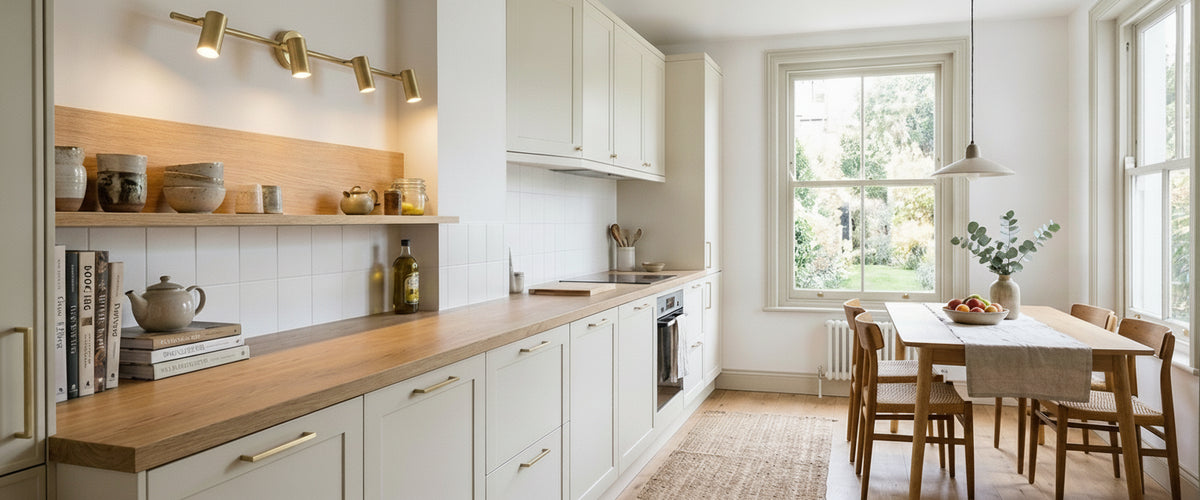

Most spotlight bars are bought by counting. Six heads sounds like more light than four, so the longer bar goes in the basket, and three weeks later someone in a narrow galley kitchen is squinting at overlapping hot spots on the worktop. A 4 spotlight ceiling bar is often the better choice, but only when it is sized to the room's width and finished to suit the ceiling. After that, each head needs aiming properly while the ladder is still up. This piece covers those decisions in the order you will face them.
At a Glance
Size by room width, not by how many people use the space. Narrow rooms rarely need more than a 4 spotlight ceiling bar.
Finish changes how the ceiling reads. Matte black punctuates, brass warms, brushed chrome recedes.
Beam angle matters more than wattage. Pick it for the job each head is doing.
Aim every head before the installer leaves. Re-aiming later means a second visit or a wobbly stepladder.
Let your 4 spotlight ceiling bar do task work. Leave the ambient glow to softer sources such as alabaster wall lights or pendants.

What a Ceiling Spotlight Bar Does That Fixed Downlights Can't
A grid of recessed downlights lights the floor. That is its whole personality. Each fitting points straight down, and if your worktop, artwork or reading chair sits off the grid, too bad. You either live with it or you cut more holes in the plasterboard.
A ceiling spotlights bar works from a single electrical point and lets each head swivel and tilt on its own. One head can wash the splashback, another can pick out open shelving, a third can sit on the sink. That flexibility is the reason to buy one. It also means renters and owners of period homes can get directional light without disturbing a lath-and-plaster ceiling, which matters a great deal in older UK housing stock where recessed fittings are disruptive to install.
The trade-off is visibility. Downlights disappear into the ceiling; a bar is an object you see every day. So the finish and length of a 4 spotlight ceiling bar need the same thought you would give a pendant.

Room Width, Not Head Count: Choosing a 4 Spotlight Ceiling Bar or Six
Here is the rule we give clients: measure the width of the zone you want lit, then count how many separate jobs live in it. In a galley kitchen around 8 feet (2.4 m) wide, there are usually two runs of worktop and a walkway between. A 4 spotlight ceiling bar covers that comfortably, with two heads pointed to each side. Add two more and they have nowhere useful to aim, so they end up crossing beams and doubling the brightness in the middle of the floor, which is the one place nobody needs it.
Two heads per side: four targets, four heads, no crossed beams.
We saw exactly this with a client in a Victorian terrace kitchen in Bristol. She had ordered a 6 spotlight ceiling bar on the logic that more heads meant better light. Once it was up, two of the six were pointing at each other's pools. She swapped to a 4 spotlight ceiling bar, kept the same circuit, and the room looked calmer and brighter at once because every head had a clear target.
A 6 spotlight ceiling bar earns its place in wider or longer spaces: an open-plan kitchen with an island, a studio with a long run of hanging rails, a hotel corridor with art on both walls. The test is simple. If you cannot name a distinct target for every head, you have too many. The same test works in the other direction: in a small kitchen or utility room with only three jobs to do, a tighter cluster such as the Triple Spotlight Ceiling Plate in brushed chrome makes more sense than a 4 spotlight ceiling bar with one head aimed at nothing.
Black, Brass and Chrome: What Each Finish Does to the Ceiling
You will look up at your 4 spotlight ceiling bar more often than you think, particularly from a sofa or dining chair. The finish decides whether it reads as a line drawn across the ceiling or as something that quietly gets out of the way.
Matte black reads as deliberate when the room already has dark accents.
Matte black. A black ceiling spotlight bar on a white ceiling is a graphic statement. It works in rooms with other dark accents (black window frames, iron hardware, dark joinery) and looks deliberate there. On its own in a pale room, it can read as a stripe. In our studio photos, black heads always show up first in the frame, so expect the same in real life.
Brass. Warmer and softer against plaster, and the natural partner for alabaster and marble. If the room already has brass detailing on stone wall lights or a pendant, a brass 4 spotlight ceiling bar ties the ceiling into that family instead of introducing a new metal.
Brushed chrome. The most recessive option on white or pale gray ceilings. The brushed surface avoids the mirror glare of polished chrome, which can throw small reflections when the heads are lit. For a kitchen that already has stainless appliances, a brushed chrome quad bar such as the Quad 4 Light Bar Spotlight is the safe choice: it picks up the steel without adding a new metal to the room.
One honest observation: finish choice should follow the room's other metals, not the spotlight catalog. If you are planning the whole scheme, browse the wider niori lighting range with the 4 spotlight ceiling bar in mind so the brass on your wall lights and the metal overhead belong to the same conversation.
Aiming Angles and Beam Spread Before the Electrician Leaves
Most ceiling bars, including the typical 4 spotlight ceiling bar, take GU10 lamps, which makes beam angle easy to change. That is useful, because the bulb shapes the light more than the fixture does.
Narrow beams (around 24 degrees) suit accent work: a single painting, a stone sculpture, a niche.
Medium beams (around 36 to 40 degrees) are the everyday choice for worktops and desks. On a 4 spotlight ceiling bar in a galley, all four heads usually run at this angle.
Wide beams (60 degrees and up) give broader, softer coverage, good for a low ceiling where a narrow beam would leave tight, harsh circles.
For wall-washing, angle the head so the pool lands on the wall rather than hitting it straight on; the beam should graze the surface. For worktops under a 4 spotlight ceiling bar, aim slightly in front of where you stand so your head and shoulders do not cast a shadow over your hands. Where only one painting or niche needs a narrow beam, a single adjustable head such as the Single Adjustable GU10 Spotlight in matte black does the job without running a whole bar for one target. Choose a warm color temperature (2700K is a good default for homes) and dimmable LED lamps paired with a compatible dimmer. The Energy Saving Trust's lighting advice is a sensible reference on LED efficiency and choosing lamps.
Do the aiming with the lights on and, ideally, at dusk. Then ask the installer to check every head is locked. A qualified, registered electrician should handle the connection itself; in the UK, the NAPIT register is one way to find an approved installer. Swapping lamps later is a homeowner job. Wiring the fixture is not.
Low Ceilings and Long Bars
On ceilings around 8 feet (2.4 m), which covers a lot of new-build flats and loft conversions, a ceiling spotlight bar is often better than a pendant. It sits close to the plaster, keeps headroom clear, and still gives directional light. A compact 4 spotlight ceiling bar is the most comfortable size here.
Long bars on low ceilings are where things go wrong. A six-head run dominates the plane above you, and because the heads are close to eye level, you are more likely to catch glare from an exposed lamp. If the ceiling is low and the room is small, choose a 4 spotlight ceiling bar, use lamps with deep-set or anti-glare optics, and resist tilting heads toward seating.
Tall ceilings give you more freedom. In a double-height hall or a converted barn, a longer bar can cope with the scale, though at that height you may be better served by two shorter bars, or a chandelier for the ambient layer with spots reserved for art.
How a Spotlight Bar Sits Alongside Alabaster Light
This is where Niori's view comes in. Spotlights are task and accent tools. They make hard-edged pools of light. Alabaster does the opposite: the stone diffuses light through its body and gives off an even, warm glow with no visible source. The two work well together when each does its own job.
The one mistake we see repeatedly is aiming a spot straight at an alabaster pendant or table lamp. It flattens the stone. Alabaster looks best lit from within, where its veining shows as tone and depth; hit it from outside with a hard beam and it looks like painted plaster. Aim the 4 spotlight ceiling bar at worktops, shelves and art, and let alabaster wall lights and pendants carry the room's mood. Put the two on separate circuits or dimmers so you can run the spots at full for cooking and turn them down in the evening while the stone stays lit.
Layout Mistakes to Settle Before the First Screw Goes In
Fixing the bar to the existing ceiling rose position by default. If the old pendant point is off-center for the worktops, ask your electrician whether relocating it is practical before you buy.
Running the bar the wrong way. In a galley, the bar usually runs along the length of the room so heads can split toward both sides. Across the width, half your heads point at the walkway.
Buying six heads for four targets. List the targets first. Buy heads to match; if there are four, a 4 spotlight ceiling bar is the right buy.
Ignoring the dimmer. Check LED lamp and dimmer compatibility before installation, not after the flicker starts.
Mixing color temperatures. A 4000K spot next to warm alabaster looks clinical. Match everything at around 2700K unless the room has a specific reason to differ.
Forgetting bathrooms need rated fittings. Near water, use fixtures with the right IP rating and get a qualified electrician to confirm the zone.
Skipping the aiming session. Book it into the install. It takes minutes with the installer present and much longer without.
Quick Buyer Checklist
Width of the zone measured and targets listed
Head count matched to targets (a 4 spotlight ceiling bar for most narrow rooms)
Finish chosen to match the room's existing metals
Beam angle chosen per head, warm dimmable LED lamps
Separate control from ambient and alabaster lighting
Qualified electrician booked, aiming done before they leave
A well-chosen 4 spotlight ceiling bar does a clear job and then gets out of the way. Size it to the room and its targets, aim each head with care, and save the glow for the stone.