
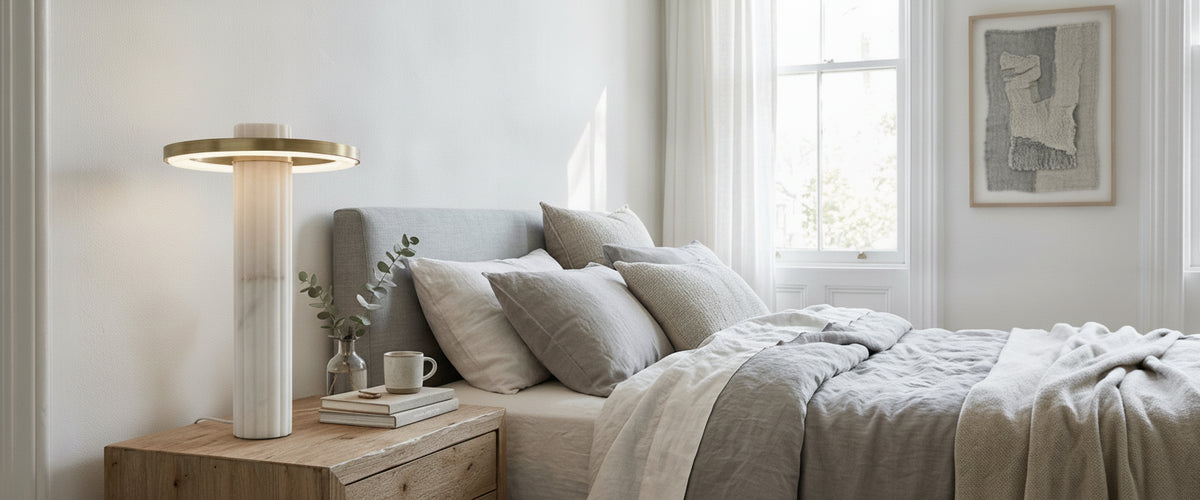

Most bedside lamps are chosen under bright showroom lights. You first see them properly at eleven at night, with every other light off and nothing else competing. That is when a warm white bedside lamps shows what it really does. It either fills the room with a low, honeyed glow, or it turns the pillow a slightly sickly yellow and throws a hard white disc onto the ceiling. The bulb is only part of the answer. The shade material, the height of the lamp, the colour of your walls and the dimmer behind the switch all affect the result.

At a Glance
- 2700K suits a bedside that is mostly for winding down. Choose 3000K if you read seriously in bed or your walls lean cool grey.
- The shade acts as a colour filter. Alabaster and unbleached linen warm the light, opal glass keeps it neutral, and glazed ceramic mostly directs it.
- Aim for the bottom edge of the shade to sit near chin height when you are sitting up against the headboard.
- Use dimmable LED bulbs with a trailing-edge dimmer. Any hard-wired switching should be fitted by a qualified electrician.
- For a pair of lamps, buy identical bulbs from the same box. Then judge the stone.

Why 2700K and 3000K Feel Like Different Rooms Once the Overhead Light Goes Off
On paper, 300 kelvin is a small gap. With a ceiling pendant on, you will barely notice it, because your eyes adjust to the brightest source in the room. Switch the pendant off and the bedside lamp becomes the only reference. At that point 2700K reads as candlelit and close, while 3000K reads as clean, calm and slightly more awake.
There is also a long-observed quirk of perception. At low light levels, most people find warmer colour temperatures more comfortable, and cooler light starts to look grey and clinical. A bedside lamp spends most of its life dimmed, so it lives exactly in that zone. Evening light also affects rest: the Sleep Foundation's overview of light and sleep explains why blue-rich light late at night works against winding down. For most bedrooms, that makes 2700K the sensible default for a warm white bedside lamp.
Choose 3000K when the lamp is a reading light first, or when the decor fights a very warm source (more on finishes below). Whichever you pick, look for a colour rendering index of 90 or above. Low-CRI warm white flattens skin tones and makes cream bedding look nicotine-stained.
Shade Material as a Colour Filter: Linen, Glass, Ceramic and Stone
A shade does more than hide the bulb. It changes the colour of the light before that light reaches you. The same 2700K bulb in a warm white bedside lamp will look noticeably different depending on what surrounds it.
Linen and Fabric
White linen passes light fairly neutrally and spreads it well. Oatmeal or unbleached linen pulls the light a little warmer, which can nudge a 3000K bulb towards 2700K territory. A dark fabric with a white lining sends almost everything up and down, so you get two pools of light and very little glow.
Glass
Clear glass changes nothing. You see the bulb's true colour plus whatever glare the filament adds. Opal glass diffuses evenly but stays colour-neutral, so it can feel slightly cool next to stone or fabric. Amber or smoked glass warms the light heavily, which makes for good atmosphere and poor reading light.
Ceramic
Ceramic bases and shades are opaque. The light comes out of the openings, and its colour depends on the glaze inside the shade. A white interior glaze bounces light cleanly. An unglazed or tinted interior warms it a little.
Alabaster, Onyx and Marble
This is where natural stone behaves differently from every other material. Alabaster is translucent, so the whole shade lights up from within rather than leaking light at the rim. Its creamy, honey-veined body filters the light towards amber. Side by side, the same 3000K bulb in a thin, pale shade and in a deeply veined one can look like two different colour temperatures. Onyx is more translucent again and carries stronger colour. Marble is denser, so it usually appears in bases rather than glowing shades. If you want the stone itself to be the light source, explore the alabaster lighting collection with that filtering effect in mind. A pale piece suits a 2700K bulb; a richly veined piece can take 3000K without tipping into orange.
Height and Scale: When a Warm White Bedside Lamp Washes the Ceiling Instead of the Pillow
A tall lamp with an open-topped shade sends a bright, warm patch onto the ceiling. That is lovely as background light and frustrating if you are trying to read page 200 of a novel. The fix is geometric. When you sit up against the headboard, the lower edge of the shade should sit roughly at chin height. That puts the bulb out of your eyeline and drops the light onto the page.
For most standard beds and bedside tables, this works out at a total lamp height of around 55 to 70 cm (about 22 to 28 in). Measure from your own mattress, though. Tall divans and low platform frames move that figure considerably. For scale, the shade should look settled on the table rather than overhanging it. A shade wider than the tabletop gets knocked every time you reach for your glasses.
Where tables are too small for a substantial lamp, a slim floor lamp beside the bed or a pair of alabaster wall lights can give you the same warm glow without taking surface space. Wall lights are wired fittings, so plan them before plastering and have a qualified electrician install them.
Bedroom Finishes That Amplify Warm White, and the Ones That Quietly Kill It
A warm white bedside lamp needs warm surfaces to bounce off. Limewash, chalky plaster, warm whites with a red or yellow undertone, oak, walnut, aged brass and natural linen all pick up a 2700K glow and send it back softer. Terracotta and rust tones work especially well with alabaster.
Cool greys with a blue undertone have the opposite effect. Under very warm light they look muddy, almost green. A common example is honey-toned alabaster lamps set against dove-grey walls: the lamps glow, but the walls look tired. Switching both bulbs to 3000K usually cleans the grey up without making the stone look cold. Deep navy and charcoal absorb so much light that you may need a brighter bulb than you expect. High-gloss paint and lacquered headboards throw back hot spots, so matt and eggshell finishes are kinder at the bedside.
Dimming at the Bedside: Why Trailing-Edge Dimmers Matter More Here Than Anywhere Else
No other light in the house runs as dim as a warm white bedside lamp. That low end is exactly where LED bulbs on the wrong dimmer flicker, buzz or snap off without warning. In a quiet bedroom at midnight, a faint hum you would never hear in the kitchen becomes impossible to ignore.
Trailing-edge dimmers are designed for the low loads and electronic drivers of LED bulbs, and they generally dim more smoothly and quietly than older leading-edge types. Check three things: that the bulb is marked dimmable, that the dimmer's minimum load suits the wattage you are running, and that the bulb maker lists the dimmer as compatible. The Lighting Industry Association publishes useful guidance on LED and dimmer compatibility. An inline cord dimmer on a plug-in lamp is a simple swap. Dimmed switched sockets or new wall switches are electrical work and should go to a qualified electrician.
Bulb choice matters as much as the dimmer. Many alabaster table lamps take a small E14 fitting, so a warm white candle or golf ball LED is the usual match. Opal golf balls give the most even glow through stone; clear filament bulbs can show a bright line through thinner alabaster. In a pale, thin-walled shade, an opal-finish bulb such as the E14 Golf Ball 6W Filament Opal LED Bulb keeps the stone glowing evenly rather than revealing the filament behind it. Output is the other half of the decision. Around 470 lumens is plenty for a wind-down lamp, which is where a low-wattage candle like the E14 Candle LED Bulb 3.4W 470lm sits, while a dedicated reader is better served by something nearer 800 lumens, such as the E14 Candle 6.5W 806lm LED Bulb. Whichever you choose, confirm it is marked dimmable before pairing it with a dimmer, and stay within the lamp's stated maximum wattage. Dim-to-warm LEDs, which drop in colour temperature as you dim them, come closest to the way an old incandescent bulb behaved.
The Paired-Lamp Problem: Matching Warmth Across Two Fittings That Will Never Be Identical
Natural stone does not come in identical pairs. Two alabaster lamps cut from the same quarry will carry different veining, slightly different wall thickness and their own tone. Lit up, one will often glow a shade warmer than the other. That variation is part of the reason people choose stone, but it helps to control everything else.
Start with the bulbs. LEDs are sorted into colour bins, and two bulbs from different batches labelled 2700K can look visibly different side by side. Buy both from the same box. If the lamps still look mismatched, swap the bulbs between them. If the difference moves with the bulb, it was the bulb. If it stays with the lamp, it is the stone. For hotels and other projects where pairs matter, it is worth matching pieces on a lightbox and ordering bulbs from a single batch. Even then, put the thinner, brighter-glowing shade on the side where someone is most likely to read.
How to Choose a Warm White Bedside Lamp: A Buyer's Checklist
- Purpose first: wind-down lamp (2700K, lower output) or reading lamp (2700K to 3000K, more output, directed light).
- Shade material: alabaster or unbleached linen for warmth, opal glass for neutral light, ceramic for directed pools.
- Height: lower edge of the shade near chin height when sitting up; measure from your mattress.
- Walls and bedding: warm undertones suit 2700K; blue-grey schemes usually suit 3000K better.
- Bulb: correct cap (often E14 for stone table lamps), dimmable, CRI 90+, opal where the shade is thin.
- Dimming: trailing-edge, LED-compatible, installed by a qualified electrician if hard-wired.
- Pairs: bulbs from one batch, and accept that natural stone will vary.
- Care: alabaster is soft and porous. Dust it with a dry, soft cloth, avoid water and sprays, and keep it out of steamy en-suites.
Budget for stone lamps depends on the material, scale, carving complexity, wiring and finish, so it is worth requesting a tailored quote for larger or bespoke pieces. If you are still weighing up fixture types, the full niori lighting range covers table and floor lamps alongside the pendants and wall lights that often share a bedroom scheme. Get the kelvin, the shade and the dimmer right, and your warm white bedside lamp will look its best at the time of night you actually use it.