
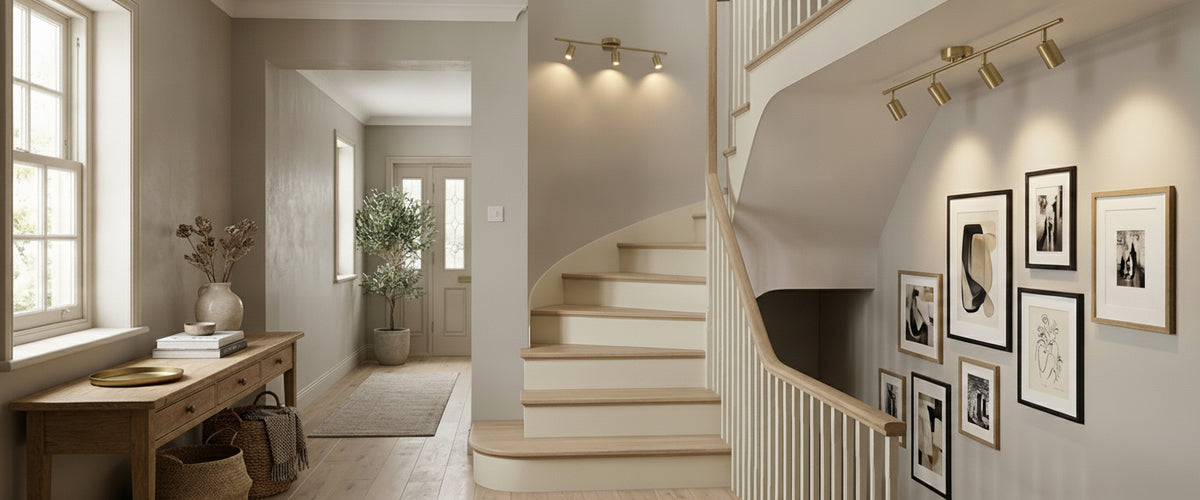

Most disappointing ceilings we see did not start with a bad fixture. They started with a good fixture in the wrong place. A gu10 spotlights bar is the clearest example. Placed with intent, it throws light exactly where a room needs it: an island, a picture wall, a stair return. Placed as a shortcut, it hangs in the middle of the ceiling like a question nobody answered. This guide covers where a GU10 spotlight bar belongs, how big the room has to be before it looks purposeful, and how to pair its hard, directional light with the soft glow of alabaster and natural stone.

Quick Answer
- Use a bar for direction. It aims light at surfaces. It will not light a whole room evenly.
- Check the ceiling first. Below roughly 2.3 m (7 ft 6 in), a bar reads heavy unless it sits close to a wall or over a defined zone.
- Match the bar to the room's width. A triple bar suits a room or zone about 2.5 m to 4 m (8 to 13 ft) wide. Wider rooms usually need two fixtures, not one longer one.
- Pick beam angle by target. Narrow for art and objects, medium for worktops, wide for a general wash.
- Keep colour temperature warm. 2700K to 3000K sits comfortably next to alabaster; 6500K daylight does not.
- Settle positions before the electrician arrives. Moving a ceiling feed afterwards means a second visit and a patched ceiling.

A Spotlight Bar Does Different Work From a Downlight Grid
A downlight grid spreads light across a ceiling plane so that every part of the floor gets a share. A bar does the opposite. It gathers two, three or four adjustable heads onto one backplate and lets you point each one somewhere specific. That is its strength, and it is also why it fails when people expect it to do a grid's job.
Hang a single GU10 spotlight bar in the centre of a 4 m by 5 m living room and aim all three heads down, and you get three bright pools on the rug with dim corners and a flat, lifeless ceiling. Angle the same heads at a bookcase, a painting and a fireplace, and the room suddenly has depth. The fixture has not changed. The job has.
The best schemes treat the bar as one layer among several. In the rooms we light, the bar handles accent and task work, while an alabaster pendant or a pair of stone wall lights carries the ambient glow. Translucent stone diffuses light through its body and softens shadows; the bar adds edges and focus. Without the soft layer, spotlights alone tend to make a room feel like a shop floor.
Ceiling Height and Room Width: Sizing a GU10 Spotlight Bar
Two measurements decide whether a bar looks purposeful or cramped: the height of the ceiling and the width of the space it is serving.
Ceiling Height
Most UK homes sit somewhere between 2.3 m and 2.5 m (7 ft 6 in to 8 ft 2 in) floor to ceiling, with period properties often higher. On a standard modern ceiling, a GU10 spotlight bar sits close to eye level for anyone tall, and its heads are visible from almost everywhere in the room. That is fine over a kitchen island or along a run of units, where the fixture has an obvious reason to be there. In the middle of a low bedroom ceiling it simply looks like hardware.
Higher ceilings change the maths. At 2.7 m (around 8 ft 10 in) and above, the bar recedes visually and the light has more distance to spread, so a medium beam covers more floor or wall. In Victorian and Edwardian rooms with deep cornicing, we generally steer clients away from mounting a bar on the central rose; that spot belongs to a pendant or chandelier, and a spotlight bar there competes with the plasterwork.
Room Width
As a working guide, a gu10 triple spotlights bar suits a room or a defined zone roughly 2.5 m to 4 m (8 to 13 ft) across. Narrower than that, the heads end up aimed at walls only a step away, which produces harsh hotspots. In a corridor or alcove that tight, a single adjustable head such as the Single Adjustable GU10 Spotlight in matt black usually does the job more cleanly than a bar. Wider than that, one bar cannot reach the edges, and the temptation is to buy a longer four-head version. Two well-placed fixtures almost always look better than one oversized one. The exception is a long galley run or a generous island, where a four-head fitting like the Quad 4 Light Bar Spotlight in brushed chrome follows the length of the worktop rather than trying to reach across the whole room.
Where a GU10 Triple Spotlight Bar Earns Its Keep
Three heads is the most flexible configuration because it maps neatly onto how people actually use a zone: two heads for the main surface, one for something to look at.
Kitchens
Over an island or a galley run, a three-head GU10 spotlight bar mounted parallel to the worktop gives clean task light without a forest of downlight holes. Keep the heads aimed slightly forward of where you stand, or your own head will shadow the chopping board. If there is a dining end, let an alabaster pendant take over there so the eating area feels calmer than the prep area.
Halls, Landings and Stairs
A GU10 spotlight bar mounted near the top of a stairwell can wash the treads with one head and pick out a picture on the half landing with another. One client in a narrow Bristol townhouse had a dark turn on the stairs that no ceiling light could reach; a triple bar fixed on the wall above it solved the problem in a single fixture, and a small alabaster wall light below gave the landing its glow at night.
Living Rooms and Art Walls
Mount the bar roughly 60 to 90 cm (2 to 3 ft) out from the wall you want to light, and the heads will hit artwork at a comfortable angle without glare on the glass. Then let a stone table lamp or floor lamp handle the seating area, where pools of soft light matter more than precision.
Sloped Ceilings and Hospitality
Loft rooms with pitched ceilings are where bars do something recessed downlights cannot: the adjustable heads can correct for the slope. In bars, restaurants and boutique hotel corridors, a bar is a practical way to light displays, menus or a reception desk while the decorative fixtures set the mood.
Where It Overwhelms
Bedrooms are the usual mistake. Directional light over a bed shines straight into the eyes of anyone lying down. Small bathrooms and WCs are another, partly because the bar fills too much of a small ceiling and partly because fittings near water need the correct IP rating. Any room where the ceiling is already busy with beams, a rose or a statement chandelier will also struggle to absorb a bar.
Finish and Housing: The Bar When Every Bulb Is Off
For most of the day, your GU10 spotlight bar is unlit. That is when its finish does all the talking.
- Brushed chrome softens reflections and suits kitchens with stainless appliances or cool-toned stone.
- Polished chrome reads crisper and more reflective, which can feel busy on a low ceiling.
- Matt black gives the bar a graphic, deliberate outline. It works on white ceilings in industrial or contemporary rooms, but it never disappears.
- White housings fade into a white ceiling, which is the right call when you want the light and not the fixture.
Look at the backplate as well as the heads. A slim plate that covers the ceiling feed neatly looks considered; a wide plate that barely covers the old fitting's scar looks like a repair. Where the heads need to sit close together over a single zone, a compact round plate such as the Triple Spotlight Ceiling Plate in brushed chrome keeps the footprint small while still giving three independently aimed beams. If the room already has brass detailing on alabaster pendants or wall lights, a bar in a neutral finish usually sits better than trying to match brass across two very different fixture types.
Beam Angle and Colour Temperature
These two choices separate a sharp scheme from a flat one, and they are easy to get wrong because GU10 lamps look identical in the box.
Beam Angle
- Around 24 degrees: art, sculpture, a single vase on a console. Tight and dramatic.
- Around 36 to 40 degrees: worktops, desks and most general accent work. The safe default.
- Around 60 degrees or wider: a softer wash across a wall or shelving. Less punch, fewer hotspots.
Mixing angles on one bar is perfectly sensible. A kitchen bar with two 40-degree lamps over the worktop and one 24-degree lamp on open shelving looks far more intentional than three identical beams.
Colour Temperature and Quality
Alabaster glows warm because the stone filters and softens whatever lamp sits inside it. A GU10 LED spotlight bar running cool 6500K daylight lamps in the same room will make that stone look grey and the spotlit areas look clinical. We recommend 2700K for living spaces and 3000K for kitchens, with a colour rendering index of 90 or above so that food, timber and stone look true. The Energy Saving Trust's lighting advice is a useful plain-English reference for comparing LED output in lumens rather than watts.
If you want to dim, buy dimmable lamps and confirm the dimmer is compatible with low LED loads. Many older dimmers were designed for halogen and will flicker or hum with a three-lamp LED bar.
How to Choose: Decision Criteria
Before buying a GU10 spotlight bar, answer these in order. If you cannot answer the first, a bar is probably the wrong fixture.
- What exactly will each head light? Name the surface or object for every head.
- What provides the ambient layer? A pendant, wall lights or lamps should already be planned. Browsing our alabaster lighting alongside the bar helps you judge the two together.
- Does the ceiling height suit a visible fixture? If not, consider wall mounting or a recessed alternative.
- Will the finish sit quietly with the rest of the room when switched off?
- Do you need dimming? Decide now, because it affects both lamps and switch gear.
Before the Electrician Arrives: A Checklist
All fixed wiring should be installed by a qualified electrician. In England and Wales, some electrical work in homes falls under Part P of the Building Regulations; the Planning Portal's guidance on electrics explains when it is notifiable. Your job is to make the decisions that let them finish in one visit.
- Mark the exact bar position on the ceiling, measured from two walls.
- Confirm the existing feed sits where you want the bar. If it does not, agree the move now.
- Check what is above the ceiling: joists, pipework, or a bathroom floor.
- Decide orientation. A bar parallel to the island and one at right angles to it light very differently.
- Buy the lamps in advance, with beam angles chosen, so heads can be aimed on the day.
- Confirm the dimmer model and its minimum LED load.
- Agree switching: should the bar share a circuit with the pendant, or switch separately? Separate switching is almost always worth it.
The decisions that force a second visit are predictable: a feed in the wrong place, the wrong dimmer, and lamps that arrive after the bar is up. We once had a London kitchen where the bar went up perfectly centred on the room and badly off-centre on the island, because nobody had measured from the island itself. Measure from what you are lighting, not from the walls.
Making the Bar Part of the Room
A GU10 spotlight bar is a working fixture, and it looks best when it is allowed to stay one. Give it precise jobs, keep its finish quiet and its colour temperature warm, and let natural stone do the atmospheric work around it. If you are planning the full scheme rather than a single fitting, our wider lighting collection is a good place to see how directional and diffused pieces sit together. Niori specialises in alabaster and natural-stone lighting for exactly that reason: the glow is what makes a well-aimed spotlight feel like part of a home.