
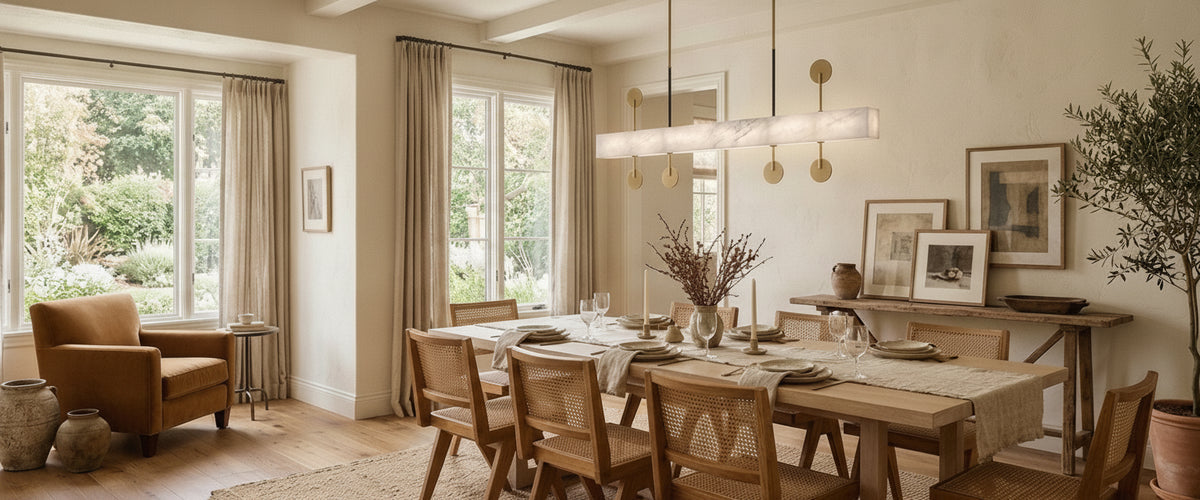

Most advice on modern chandeliers dining room buyers find online starts at the ceiling. Start at the table instead. Pick a fixture about half to two-thirds the table's width and hang it 30 to 36 inches (75 to 90 cm) above the top. Then use warm, dimmable light behind a shade that softens glare. The table also decides whether you need one light or three, and how low the light can hang before it blocks faces across the table. Below, we work through each decision in the order that matters: table size, layout, shade material, drop height and color temperature after dark.
At Niori we make and supply alabaster and natural-stone lighting. With the modern chandeliers dining room clients buy from us, style is rarely the first question. Homeowners and designers want to know about proportion and drop height, and what color the light turns after 8pm.
At a glance
Size modern dining room chandeliers from the table. A fixture roughly half to two-thirds the table's width, sitting at least 6 inches (15 cm) in from each edge, is a reliable start.
Round and square tables want one fixture. Long rectangular tables usually want a row or a linear piece.
Hang the bottom of the fixture about 30 to 36 inches (75 to 90 cm) above the tabletop, then adjust for ceiling height.
Use warm white (2700K or lower) with a high color rendering index (CRI 90+) and put it on a dimmer.
Alabaster and opal glass soften light on faces. Clear glass and bare brass add sparkle but can glare at seated eye level.

Start With the Table, Not the Room
You will find a formula online that tells you to add the room's length and width in feet and use the total, in inches, as the chandelier diameter. That works for an empty hall. For the modern chandeliers dining room owners actually live with, it is the wrong reference point, because the fixture lights the table rather than the room. A 14-foot room with a compact four-seater needs something far smaller than the formula suggests.
Measure the table's width first. For a 36-inch (90 cm) table, a modern dining room chandelier between about 18 and 24 inches (45 and 60 cm) across usually feels right. Go wider and diners on either side end up sitting partly under the light rather than beside its glow, which flattens faces and puts glare on the rims of glasses. Length matters too. On a rectangular table, a linear fixture or a row of lights should cover roughly two-thirds of the table's length, so both ends of the table get light without the fixture overhanging anyone's chair.
Of all the modern chandeliers dining room owners regret, oversized ones top the list. If you have an extending table, size the fixture for the length you use most nights rather than the Christmas-lunch length. Lighting the full extension all year leaves a fixture that looks oversized for 300 nights out of 365.

One Centerpiece or a Disciplined Row?
The table's shape answers this before your taste does. Round and square tables have a single natural center, so one modern dining room chandelier sits right over it and spreads light evenly to every seat. A cluster of opal globes or a generous alabaster bowl both work well here because they read the same from every chair. Over a larger round table seating six or more, a dense globe cluster such as the Ivy 18 Light Opal Globe Chandelier in brass fills that single center with soft, even light without the glare of exposed bulbs.
Rectangular tables longer than about 6.5 feet (2 m) are where single fixtures struggle, and where the modern chandeliers dining room designers specify tend to come in rows. One large fixture lights the middle well and leaves the head and foot of the table in comparative gloom. A row fixes that, but it needs discipline. Space the fixtures evenly, keep matching drop heights, and inset the end lights so they sit over the end place settings rather than past them. Our view: on a table seating eight or more, three smaller fixtures usually beat two larger ones. A pair leaves a dark patch in the middle, which is where the serving dishes and the conversation tend to end up.
Three evenly spaced pendants keep both ends of a long table lit.
Oval tables sit between the two. A single elongated modern dining room chandelier follows the table's shape, or a pair can work if the table is long enough to give each one breathing room.
How Material Changes What Lands on Faces and Food
This is where the modern chandeliers dining room buyers compare differ most, and where many choose on looks alone. The shade material decides whether the light reaching the table is soft and wrapping or sharp and sparkling.
Alabaster lets light pass through the stone and come out evenly diffused, with the veining glowing faintly when the fixture is lit. Faces look warm and shadows stay soft, which is exactly what you want from the modern chandeliers dining room hosts rely on every night. Onyx is more translucent and richer in color, so it glows deeper and reads more decorative. Marble is denser and passes far less light, so it works better as a canopy, base or accent than as a diffusing shade. If you want to compare how these stones look lit and unlit, the alabaster lighting collection shows the range of veining and tone you can expect from natural material.
Under warm light, alabaster diffuses evenly and keeps faces soft.
Opal glass gives a similar softness to stone with a cleaner, more uniform look. Clear glass globes and branching brass frames with exposed bulbs deliver sparkle and crisp shadows, which looks lively over a bar-style table but can glare straight into the eyes of seated diners unless the fixture is dimmed or hung higher. If that sparkle is what you want, a branching design like the Galaxy 12 Light Branching Chandelier with clear glass globes is best kept on a dimmer and hung toward the 36-inch end of the drop range, so the bulbs sit above seated eye level.
Amber glass tints everything honey-gold. It flatters skin and wood but turns white tablecloths and pale food noticeably yellow, so a piece such as the Tree 7 Light Branching Chandelier in gold with amber glass suits a dark timber table and candlelit suppers better than a crisp white setting. Bare brass arms reflect warm light up onto the ceiling, which adds glow to the room rather than the table.
The Drop Problem
A correctly sized modern dining room chandelier hung at the wrong height still looks wrong. The usual guide is 30 to 36 inches (75 to 90 cm) from the tabletop to the bottom of the fixture, based on a ceiling of about 8 feet (2.4 m). For each additional foot of ceiling height, raise the fixture by around 3 inches (7.5 cm) so it stays in proportion with the room as well as the table.
Hang it too high and the light drifts away from the table, the ceiling picks up a bright patch, and the fixture floats like an afterthought. Hang it too low and it cuts straight across sightlines; people end up talking around it. The simplest test: pull the chairs in, sit down, and check that you can see the face of the person opposite without leaning.
A hard-won lesson from our studio, and one we pass on with all the modern chandeliers dining room clients order from us: order more suspension than you think you need. A client in an Edinburgh tenement flat with a ceiling of about 11 feet (3.4 m) had a stone pendant fitted at its standard length, and it hung so high it looked like a smoke alarm. Shortening a rod or chain on site is easy. Adding length after delivery is not.
Why Modern Dining Rooms Get Color Temperature Wrong After Dark
Open-plan kitchen-diners are the usual culprit. The kitchen gets crisp 4000K downlights for prep work, and the modern chandeliers dining room owners chose for warmth get the same bulbs for consistency. By evening the food looks gray, skin looks tired, and the room feels like an office at closing time.
In the studio we see this most clearly with stone. Under 2700K, alabaster reads creamy and slightly honeyed. Put a 4000K lamp inside the same shade and it turns chalky, almost gray-green, and the veining loses its depth. For a modern dining room chandelier, use 2700K as a ceiling and consider dim-to-warm LEDs that drop toward 2200K as you dim. Look for CRI 90 or above so food and wine keep their real color.
Wire the dining fixture on its own circuit and dimmer so the kitchen downlights can go off while the table stays lit. LED lamps need a compatible dimmer, and any new circuit or switch change should be done by a qualified electrician rather than as a weekend project.
Period Ceilings, Contemporary Fittings
A clean modern dining room chandelier under Victorian or Georgian plasterwork can look superb. The contrast pays off when the fixture is simple in outline, scaled to the ceiling rose, and hung from it. A plain alabaster bowl or a calm cluster of opal globes lets the cornice stay the decoration.
The contrast backfires in two situations. First, spidery, many-armed black and brass fixtures, the busiest of the modern chandeliers dining room shoppers see online, compete with ornate plaster and the ceiling ends up looking busy rather than layered. Second, the historic rose is rarely centered over where the table actually sits. Moving the electrical point is usually better than living with an off-center fixture, but in a listed building, altering original plasterwork may need listed building consent, so check before anyone cuts into the ceiling. Low-ceilinged cottages are a separate case: a semi-flush stone fitting usually serves better than any hanging chandelier.
How to Choose Modern Chandeliers for a Dining Room: Decision Criteria
Once the rules above are clear, buying modern dining room chandeliers becomes a short, practical shortlist exercise:
Table dimensions: width sets diameter, length sets whether you need a row.
Ceiling height: sets the drop and how much suspension to order.
Material and light quality: stone and opal for soft, flattering light; clear glass and brass for sparkle.
Other light in the room: wall lights or lamps on a sideboard let the chandelier run dimmer and warmer.
Weight and fixing: natural stone is heavy, so the ceiling fixing must be rated for it. Ask your electrician to confirm the support before ordering.
Budget: this depends on material, scale, the complexity of carving or engineering, installation and finishing. For larger or bespoke pieces, ask for a tailored quote rather than guessing.
If you are still weighing stone against glass and metal among the modern chandeliers dining room designers shortlist, browsing the wider lighting collection side by side helps you see how each material reads at a similar scale.
Before You Order: A Short Checklist
Measure the table width and the length you use most nights.
Measure floor-to-ceiling height and work out the drop, then order extra suspension length.
Check whether the existing ceiling point sits over the table center.
Confirm the ceiling can support a stone fixture's weight.
Choose 2700K or warmer, CRI 90+, dimmable lamps.
Book a qualified electrician for installation and any dimmer or circuit work.
Plan care: dust stone shades with a soft dry cloth, never water or chemical cleaners.
Get the table measurements, drop and color temperature right, and almost any well-made modern dining room chandelier will look considered. The modern chandeliers dining room guests remember are the ones that light their faces well. Get the basics wrong and even the most beautiful piece looks borrowed from another room.