
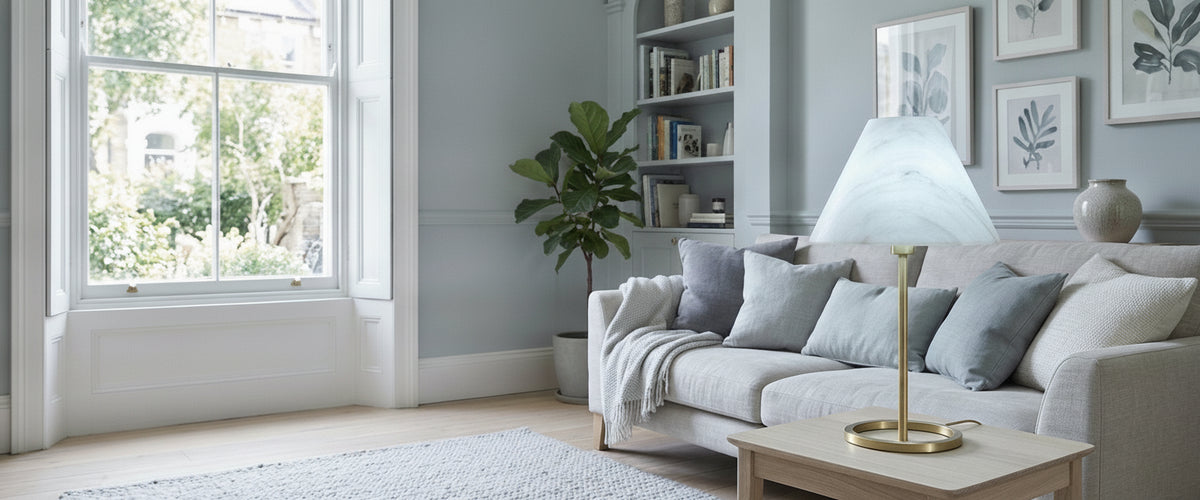

The right lamp shades table lamps need are chosen by how they move light, not by looks alone. Shape decides where the light lands: a drum splits it between ceiling and table, an empire pushes it down, and a cone focuses it tightly. Material decides how it glows, size decides whether the lamp looks balanced, and the lining decides whether it fills the room or stays on the table. As a quick rule, make the shade height about two-thirds of the base height, keep the diameter wider than the widest point of the base, and use a warm-white LED around 2700K. This guide shows how to choose lamp shades for table lamps across drums, empires and cones, fabric against alabaster, sizing ratios that hold up in real rooms, and the bulb choice that keeps stone honey-toned. Get the geometry right and the lamp shades table lamps rely on stop being an afterthought. Get it wrong and someone squints at glare every evening.
At a glance
Shape sets direction: drums share light between ceiling and table, empires push it down, cones focus it tightly.
Material sets mood: linen and cotton diffuse, silk glows, alabaster and onyx turn the whole shade into the light source.
Proportion: table lamp shade height is usually about two-thirds of the base height, and the diameter should be wider than the widest point of the base.
Lining shapes the evening: a white lining lights the room, a dark lining lights the task.
Bulb: a warm-white LED (around 2700K) keeps fabric cool and stone honey-toned.

Shade Geometry Decides Where the Light Lands
Before you think about lumens, look at the two openings on the shade. The top aperture sends light to the ceiling and the bottom aperture sends it to the surface below. The ratio between them shapes the character of the lamp more than anything else. A shade with equal top and bottom openings splits the output evenly. A shade that narrows sharply at the top throws most of its light down onto the table and keeps the ceiling dark.
That matters because a table lamp is rarely the only light in a room, so its shade has to fit a wider plan. In a sitting room with low ceilings, which describes a great many Victorian terraces, an open-topped shade bounces useful light off the ceiling and makes the room feel taller. In a dining room with a strong pendant overhead, you probably want the lamp to keep its light low and leave the ceiling alone.
Drum, Empire and Cone: How Each Silhouette Splits the Light
Drum
Straight sides with matching apertures. The drum is the safest of all the lamp shades table lamps can take because it is the most even: roughly as much light up as down, and a broad, soft band glowing through the sides. It suits traditional and contemporary bases equally well, and it forgives a slightly off-proportion base better than any other shape.
Empire
Narrow at the top, flared at the bottom. The empire concentrates light onto the table and the floor around it, which makes it a natural reading shade beside a sofa or armchair. Because the top is small, it does very little for the ceiling, so pair it with other sources if the room is otherwise dim.
Cone and Coolie
A steeper version of the empire. Cones are the most tailored lamp shades table lamps can wear; they give a crisp, defined pool of light and a sharp outline, so they work on desks, console tables and in hallways where you want a pattern of light rather than general glow. On a desk or narrow console, where the shade has to stay out of the way of a laptop or a stack of post, a compact opaque cone such as the Matt USB LED Touch Table Lamp with Cone Shade keeps the footprint small and the light pointed at the surface. Use cones carefully on a bedside table: the narrow top can leave the bulb visible when you look down from standing.
Linen, Cotton, Silk and Stone: How Translucency Shifts the Glow
Every material in the lamp shades table lamps use behaves differently as you raise and lower the brightness, and this is where many buyers get caught out after checkout.
Linen shows its weave when lit, which gives a textured, slightly rustic glow. At low dimming levels it can look flat and gray, so it suits rooms where the lamp runs near full brightness.
Cotton is smoother and more even. It holds a consistent color across the dimming range and is the most practical choice for family rooms.
Silk glows richly and looks its best dimmed low, which makes it lovely in bedrooms and formal sitting rooms. It is also the most delicate fabric to clean.
Alabaster and onyx change the logic entirely. The stone becomes the shade, and light travels through the crystal structure rather than through a weave.
Stone deserves more detail, because it behaves like no fabric does. Alabaster is a fine-grained form of gypsum, soft and translucent, and it has been carved for lamps and window panes for centuries. Hold a slab up to a light and you see the character of the finished shade: thinner sections glow a warm honey color, thicker veins read as darker drifts, and no two pieces come out the same. At full brightness an alabaster drum lights a room generously; dimmed to a third, it looks lit from inside by candlelight. Fabric does not do that. If you want a lamp shade for a table lamp that stays beautiful when switched off as well as on, look through our alabaster lighting collection and notice how the veining changes from piece to piece.
Sizing Lamp Shades for Table Lamps: The Proportion Buyers Misread
The most common mistake we see is a shade that is too small. On a product page, a 12in (30cm) shade looks plenty wide, but on a 24in (60cm) base it looks like a hat that does not fit. The shades supplied with many table lamps as standard are often a size too small, so use these working ratios as a starting point rather than as law:
Shade height: roughly two-thirds of the base height, measured from the table to the shade fitting.
Shade diameter: at least 1in (2.5cm) wider than the widest point of the base on each side, and often close to the base height for a classic drum.
Coverage: the bottom edge of the shade should hide the bulb holder and fitting when seen from a seated position.
Then check the furniture. Measure the table for lamp shade clearance before you measure anything else. A wide drum on a narrow side table will overhang the edge and get knocked every time someone puts down a mug. As a rule, the shade diameter should not exceed the depth of the table it sits on.
How to Measure an Existing Shade
Measure the top diameter across the opening.
Measure the bottom diameter.
Measure the slant height along the side, not the vertical drop.
Note the fitting. Most UK lamps use a ring or duplex fitting that sits on the bulb holder, while some use a spider fitting on a harp. A table lamp shade with the wrong fitting will not sit level.
Bedside Tables
By the bed, the lamp shades table lamps use follow their own rule: the bottom of the shade should sit roughly at chin height when you are sitting up in bed, so the light falls on the page and not into your eyes. A typical misjudgment is a pair of tall alabaster lamps on low antique bedside tables. The shades end up too high, and glare from the open bottom catches whoever is lying down every time they turn over. A shorter base with a slightly wider shade usually solves it. It is worth five minutes with a tape measure before you order.
White Lining Versus Dark Lining After Dark
Lining is the decision most people skip when buying lamp shades for table lamps, yet it shapes the whole room once the curtains are drawn. A white or ivory lining reflects light back out through both openings, so the lamp adds to the general glow of the room. An opaque lining, typically black or gold, stops light passing through the sides and sends a tighter, more dramatic beam up and down.
Gold linings warm the light noticeably and flatter skin tones, which is why you see them in hotel bars and restaurant booths. Black linings make a lamp read as a sculptural object with a glow at each end, useful in a deliberately moody snug. Tinted glass reaches a similar mood without any lining at all: where a snug or bar corner needs a low, smoky glow rather than a beam, a sphere such as the Lucia LED Table Lamp in black smoked glass is closer to the right design language than a lined drum. None of these options suits a room where the lamp is the main light source in the evening. If you are planning a whole scheme rather than a single lamp, the Society of Light and Lighting publishes useful guidance on layering light and controlling glare.
Alabaster is the exception among the lamp shades table lamps can wear: stone has no lining, and that is part of its appeal. The outer surface is the glowing surface, so the lamp lights the room evenly and still has presence when switched off.
Bulbs, Dimming and Heat
Choose LED for any fabric table lamp shade. It runs far cooler than incandescent and removes the risk of scorching silk or yellowing cotton over time. A warm white around 2700K suits most living spaces and shows alabaster at its best; cooler temperatures make the stone look chalky.
For dimming, check that the bulb is marked dimmable and that it matches the dimmer switch or inline dimmer on the lamp. Mismatched combinations cause flicker and buzzing. If you are rewiring a vintage base, adding a switch or converting a fitting, use a qualified electrician rather than attempting it yourself.
A Buyer's Checklist Before You Order
Run through this list before you order lamp shades table lamps will live with for years.
Decide the job first: reading, ambient glow or a decorative accent.
Pick the silhouette that sends light where that job needs it.
Measure base height, widest point of the base, and the depth of the table.
Confirm the fitting type and that the shade will hide the bulb holder.
Choose the lining by whether the lamp is a room light or a task light.
For stone lamp shades on table lamps, ask how thick the material is; thickness changes both glow and weight.
Match bulb color temperature across lamps in the same room.
Where to Buy Lamp Shades for Table Lamps
Buy from a retailer who can tell you the exact dimensions, fitting type and material thickness, and who will answer a question about proportion before you commit. For stone pieces, ask for photographs of the lamp lit and unlit, because the veining varies. Cost depends on material, scale, carving complexity and finishing, so for larger or bespoke pieces request a tailored quote. You can see stone, glass and brass designs side by side across the full niori lighting range, which makes comparing the lamp shades table lamps can carry easier than scrolling through shade-only listings.