
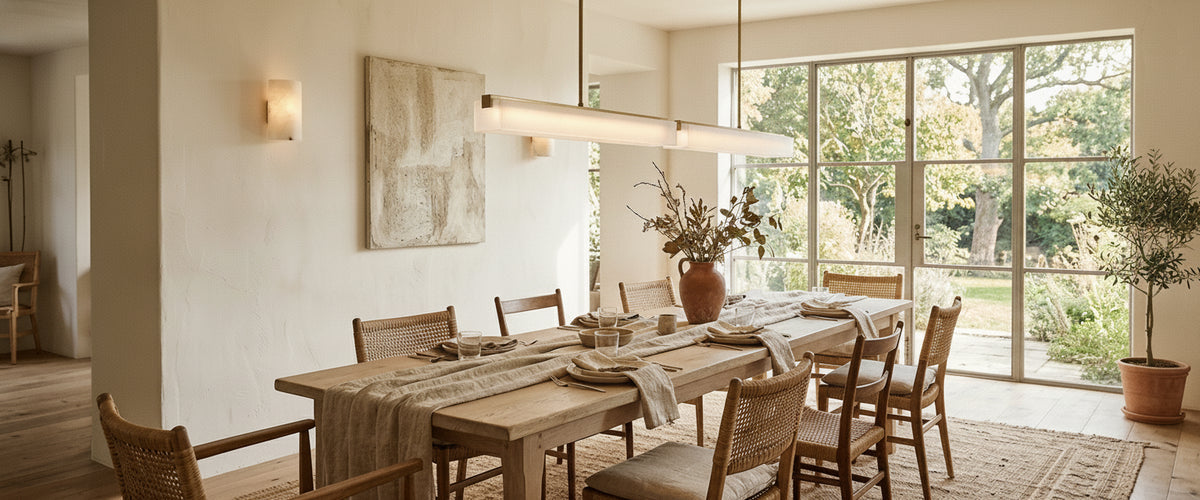

Linear crystal chandeliers tend to fail in one of two ways. They arrive, they go up, and they are either too long for the table or so busy with sparkle that nobody can hold a conversation underneath them. A linear crystal chandeliers is one of the most demanding fittings you can hang over a dining table. It is long, it is reflective and it sits in every guest's line of sight, so small decisions about crystal, span and drop have an outsized effect on the room.
At Niori we spend most of our days with alabaster and natural stone, materials that soften and diffuse light. Crystal does the opposite: it splits and throws light. Understanding that contrast is the quickest route to buying well.

Quick Answer: What Makes a Linear Crystal Chandelier Work
- Span: aim for roughly half to two-thirds of the table length, leaving clear space at each end.
- Drop: the base of the fitting usually sits around 75 to 90 cm (30 to 36 in) above the tabletop.
- Crystal: sharper cuts and higher clarity give controlled sparkle; dense, low-grade drops give glare.
- Bulbs: clear, warm-white lamps around 2700K bring out fire; frosted lamps flatten it.
- Finish: choose metal that frames the crystal rather than competing with it.

Why a Linear Crystal Chandelier Throws Light Along an Axis
A traditional round chandelier radiates outwards from a single centre, so its sparkle lands evenly around the room. A linear crystal chandelier stretches its light sources along a bar. The result is a band of brightness that follows the length of the table and fades quickly to either side.
That is precisely why it suits long dining rooms, kitchen islands and boardroom tables. It is also why it can feel awkward in a square room, where the walls at the short ends stay noticeably darker. If your dining room is close to square, a linear piece will need help from wall lights or lamps to balance the space. If you want those end walls to pick up some of the chandelier's sparkle rather than introduce a new material, a single crystal sconce such as the Vela 1 Light Crystal Wall Light in Polished Chrome keeps the language consistent without creating a second centrepiece.
This is where we often suggest pairing crystal with a softer material. An alabaster wall light on the long wall adds a glow that crystal cannot give, filling the gaps the linear fitting leaves without adding more glitter. Browsing our alabaster lighting next to a crystal centrepiece is a useful way to picture the two working together.
Cut, Grade and Density: How Crystal Choice Shifts the Sparkle
Crystal is glass with a high refractive index, which is what lets each facet bend light into small spectral flashes. Traditional lead crystal gained its brilliance from lead oxide; many modern crystals reach a similar effect with other formulations. The Corning Museum of Glass is a good place to read about how glass composition changes clarity and refraction.
Three variables shape how linear crystal chandeliers lighting actually feels in a room:
- Cut. Crisp, precisely polished facets produce clean points of light. Soft or rounded facets on cheaper drops give a hazy shimmer.
- Clarity. Hold a drop up to daylight. Bubbles, a grey or green tint, or ripples in the glass all dull the sparkle.
- Density. This is the one buyers underestimate. A frame packed with hundreds of drops looks generous on a product page, then reads as relentless glare across a dinner table.
The classic mistake is a heavily dressed crystal bar in a narrow dining room. Lit at full power, it bounces light straight into every guest's eyes. Thinning the drops, where the design allows it, and switching to warmer lamps can make the same fitting feel calm. Fewer, better crystals almost always beat more crystals.
The Span-to-Table Ratio Most Buyers Get Wrong
The instinct is to match the chandelier to the table length. It looks logical on a floor plan and wrong in real life. A fitting that runs the full length of the table visually caps the room and leaves diners at the ends sitting directly under the hardware.
As a working rule, keep the chandelier to roughly half to two-thirds of the table length, and leave at least 30 cm (about 12 in) of clear table at each end. A 2.4 m (8 ft) table generally sits well under a fitting of around 1.2 to 1.6 m (4 to 5 ft 3 in). Narrow tables need narrower fittings too; the crystal should not overhang the table edge, or guests will knock it when they stand.
If someone has sent you a reference image such as a Mallory crystal linear chandelier, look past the styling and check the proportions in the photograph. Showroom tables are often longer than domestic ones, which makes a fitting look more restrained than it will be in your room.
Drop Height in a Typical UK Dining Room
Many UK homes have ceilings around 2.4 m (just under 8 ft), with period properties often higher. A table is usually about 75 cm (30 in) tall. With the base of the chandelier 75 to 90 cm above the tabletop, that leaves limited room for the body of the fitting and its suspension, so measure before you fall for a deep, multi-tier design.
Clearance and Sightlines
Sit at the table and look across it. The lowest crystals should sit above eye line for most seated adults, so faces stay visible. If you find yourself peering around a drop, the fitting is too low or too deep.
The Drama Threshold
There is a point, usually a few centimetres below the comfortable height, where a crystal chandelier starts to feel theatrical. In a high-ceilinged Victorian dining room or a restaurant, dropping slightly into that zone can be a deliberate choice. In a modest family dining room it tends to feel crowded. If the table is short or round rather than long, a compact multi-light fitting such as the Terzani Stream Mini 5 Light Chandelier in Nickel may suit the room better than a full linear bar. Adjustable rods or chains let you fine-tune the height once the fitting is up, so ask about them before you order.
Metal Finishes: Let the Crystal Lead
The frame on a linear crystal chandelier is mostly visible as a long horizontal line, so its colour carries more weight than it would on a compact pendant.
- Polished nickel and chrome extend the cool brilliance of the crystal. They suit contemporary interiors, though they can feel clinical under cool-white lamps.
- Brushed or natural brass warms the crystal and pairs well with alabaster, marble and timber. It is our usual recommendation for period homes. To see how natural brass reads against clear, textured glass on a smaller scale, look at the Winslow 3 Light Chandelier in Natural Brass, which pairs the finish with seeded glass.
- Matt black or bronze draws a strong graphic line. Effective in industrial or modern settings, but the frame starts to compete with the crystal.
- Heavy gilt or ornate finishes combined with dense crystal tend to turn the fitting into a contest. One of the two should be quiet.
Look at the other metals in the room too. Door furniture, tap finishes and picture frames all sit in the same field of view as the chandelier. If you want to compare finishes across fixture types, our wider lighting collection is a practical starting point.
Bulbs and Dimming for Crystal
Crystal needs a small, bright point of light to refract. Clear lamps give that; frosted or opal lamps spread the source and flatten the sparkle. Colour temperature matters as much: put a 2700K lamp next to a 4000K one and the difference is obvious. Warmer light makes crystal look rich, cooler light makes it look icy.
A dimmer is close to essential. Full output suits cleaning and homework; dinner usually wants a fraction of that. Check that your LED lamps are rated as dimmable and that the dimmer is compatible with them, as mismatches cause flicker and hum.
Quality Signals to Check Before You Approve a Lead Time
Long linear fittings are heavy and awkward, so the hidden engineering matters as much as the crystal. Before you sign off an order, work through this list:
- Ceiling fixing: confirm the fitting's weight and whether your ceiling needs a reinforced fixing or noggin between joists.
- Number of suspension points: longer fittings should hang from more than one point to avoid sagging and twisting.
- Frame rigidity: ask what the bar is made of and how it resists bowing over time.
- Crystal attachment: pins and connectors should be secure and corrosion-resistant, with spares supplied or available.
- Optical quality: request close-up photographs of individual drops to check clarity and cut.
- Dimming compatibility: confirm the lamp type and any driver requirements.
- Cleaning access: a design you cannot reach or dismantle easily will lose its sparkle within months.
Installation should always be carried out by a qualified electrician working to the current wiring regulations, which the IET publishes as BS 7671. Heavy linear fittings also call for someone who can assess the ceiling structure, not just the wiring.
Living With Crystal Over Time
Crystal shows dust and fingerprints quickly, and dull crystal looks worse than no crystal at all. Switch off and let lamps cool, then wear cotton gloves and wipe drops with a soft, lint-free cloth. For a deeper clean, remove drops in sections, wash them in lukewarm water with a little mild detergent, and dry thoroughly before rehanging. Photograph the layout before you start; rebuilding a long linear arrangement from memory is harder than it sounds.
The cost of any linear crystal chandelier depends on crystal quality, length, frame engineering, finishing and installation complexity, so a tailored quote is the only reliable figure. If you are planning a dining room around crystal and want the softer counterpoint of alabaster or natural stone elsewhere in the space, Niori's team is happy to help you balance the two.