
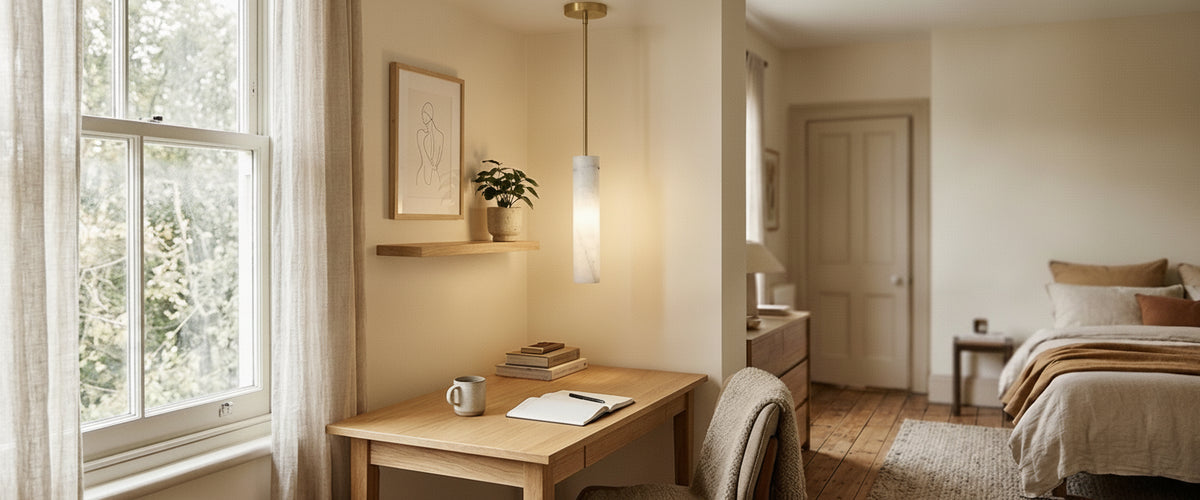

The spare bedroom looked fine as a guest room: one ceiling pendant, a bedside lamp, a dimmer by the door. Then it became the office. By mid-afternoon in November the monitor is the brightest thing in the room, your face on video calls is lit from straight above, and your eyes are tired before the last meeting starts. Most home office lighting ideas fail because they begin with a fixture someone likes rather than the work the room has to do. Start with the work. The fixtures follow.

At a Glance
Set the desk side-on to the window, never facing it or with your back to it. Every other home office lighting idea depends on this.
Light the work surface with a directional task lamp at 3500K to 4000K, placed opposite your writing hand.
Keep ambient light warmer (2700K to 3000K) and diffused. Alabaster and natural stone are very good at this.
Add a low bias light behind the monitor to soften the contrast between screen and wall.
Aim for roughly 300 to 500 lux on the desk surface for screen and paper work.
Put ambient and task lights on separate controls, with any hard-wired dimming fitted by a qualified electrician.

Why the Spare-Bedroom Lighting Plan Fails the Moment Work Starts
Bedroom lighting is designed for winding down. One central fitting, warm lamps at low level, nothing aimed at a surface. Sit at a desk under that scheme and the problems arrive at once. The overhead light sits behind or above you, so your head throws a shadow across the page. The lamps are too warm and too dim to read fine print without effort. And the screen, glowing in a dim room, forces your eyes to adjust every time you look away from it.
None of this is solved by a brighter bulb in the ceiling, though that remains the most common of the weak home office lighting ideas. Good lighting for a home office comes in layers that each do one job, and the first decision has nothing to do with fixtures at all. It comes from the window.
North-Facing Versus South-Facing: Let the Window Write the Brief
North-Facing Rooms
North light is steady and cool. It rarely glares, which is why painters have always liked it, but in winter it fades early and leaves the room gray rather than dark. Here your artificial light has to add warmth and depth, so the best home office lighting ideas for this orientation lean on diffused stone. A soft stone pendant or a pair of alabaster wall lights on the wall opposite the window balances that cool daylight and stops the room feeling like a waiting room by three o'clock.
The usual complaint about a north-facing box room turned study is that it feels cold even with the heating on. Darkness is rarely the real issue. Two warm, glowing sources at eye level will often fix what three extra downlights would not.
South-Facing Rooms
South light is generous and unruly. Strong sun across a screen makes it unreadable, and the swing between a bright midday and a dark late afternoon is wide. Home office lighting ideas for a south room should prioritize control: blinds or sheers first, then a task lamp you can adjust as the light changes, then ambient lighting you can dim. East and west rooms sit between the two, with morning or evening glare to plan around.
Whatever the orientation, place the desk so the window is to your side. Facing the window puts you against bright glare; sitting with your back to it bounces the window straight off the screen.
Desk Lamp Position: The Angle That Kills Glare Without a Shadow
The task lamp is the hardest-working of all home office lighting fixtures, and its position matters more than its wattage. Put it on the side opposite your writing hand (on the left for right-handers) so your hand never casts a shadow across what you are writing. Set the lamp head slightly forward of your shoulder and angle it down onto the work surface, so the light strikes paper at an angle rather than bouncing back into your eyes.
Two quick tests, and of all the home office lighting ideas here they cost nothing. Sitting normally, you should not be able to see the bulb itself. And with the lamp on, look at the monitor: if you see a bright spot reflected in it, lower the head or pull the lamp back. The Health and Safety Executive's guidance on display screen equipment makes the same point for workplaces: glare and reflections on screens are a common cause of discomfort. In our experience they are usually a placement problem rather than a product problem.
4000K Versus 2700K: What Color Temperature Does to Focus
At 2700K, light is the color of a traditional incandescent bulb: amber and soft. It is right for living rooms and evenings. On a desk it makes text look slightly muddy and, for many people, nudges the body towards rest. At around 4000K, light is a neutral white with more blue in its spectrum. Research on light and alertness suggests cooler, brighter light during the day supports attention, and in practice most people find fine detail easier to read and screen-to-paper switching less tiring.
The catch is atmosphere, and this is where plenty of home office lighting ideas go wrong. A room lit entirely at 4000K feels like an office in the bad sense. Keep the cooler light where the eyes do the work (the desk) and the warmer light everywhere else. If you work late, a task lamp with adjustable color temperature lets you warm the desk down after dark.
One observation from our studio: a 3000K lamp inside an alabaster shade reads warmer than the same lamp behind clear glass, because the stone filters the light through its own honey and cream tones. That works in your favor for ambient lighting. It is also why we would not rely on a stone fitting as the main task light; that job wants a directional, neutral beam.
Overhead Options Compared: Pendant, Flush Mount or Track
Pendant
A pendant is one of the more decorative home office lighting ideas, and it earns its place in a room with decent ceiling height, ideally hung over a meeting table or reading chair rather than directly above a screen. A diffused alabaster pendant lights the room softly from above without the hot spot of an exposed bulb. Keep the bottom of the fitting high enough to clear heads in walkways, and avoid hanging it where it will reflect in the monitor from your seated position.
Flush Mount
For the low ceilings common in new-build apartments, attic conversions and garden offices, a flush or semi-flush fitting is the sensible home office lighting idea. A stone or alabaster flush mount spreads light across the ceiling, which bounces back down as gentle, even illumination. It will not light the desk on its own, and it is not supposed to.
Track
Track is the most flexible of the ceiling ideas for home office lighting and the easiest to get wrong. Adjustable heads are excellent for washing a bookcase or lighting artwork on a call backdrop, but aim them carelessly and they produce exactly the screen reflections you are trying to avoid. Use track to light walls, not people. If you are weighing ceiling options across materials and fixture types, our full lighting collection puts pendants, flush fittings and wall lights side by side, which makes scale and ceiling clearance easier to judge.
Task, Ambient and Bias Lighting: Home Office Lighting Ideas for Calls and Deep Work
The best home office lighting ideas treat the room as two rooms: one for heads-down work and one for being on camera. Three layers cover both.
Task: the desk lamp, neutral white, aimed at the work surface.
Ambient: diffused, warmer light that fills the room and stops the screen being the only bright object. Alabaster wall lights, stone pendants and table lamps belong here.
Bias: a low, soft light behind the monitor (an LED strip or a small lamp) that reduces the contrast between a bright screen and a dark wall during long sessions.
For video calls, the most useful home office lighting idea is simple: light in front of your face, interest behind it. A soft source just behind or beside the camera evens out your features. Behind you, a glowing alabaster table lamp or wall light gives the frame depth and warmth without competing with your face. It is the same logic a well-run hotel applies to a suite desk, where guests otherwise end up dragging the bedside lamp across the room for evening calls.
How to Choose Home Office Light Fixtures: Decision Criteria
Whether you are fitting out one study or forty serviced apartments, run every fixture and every home office lighting idea through these questions:
Which layer is it for? Task lights need direction and adjustability. Ambient lights need diffusion. A fitting asked to do both will usually do neither well, which rules out a lot of all-in-one home office lighting ideas.
Can you see the light source when seated? If yes, expect glare. Stone, frosted glass and deep shades all help.
Does the material suit the room's daylight? Warm alabaster and onyx balance cool north light; in a bright south room, lean on dimming and control.
What is the ceiling height? It decides between pendant and flush mount before style does.
How will it be controlled? Separate circuits or smart controls for task and ambient make the room far more usable.
Who maintains it? In commercial settings, choose fittings with accessible lamp holders and finishes that tolerate regular cleaning.
Budget for any of these home office lighting ideas depends on material, scale, carving complexity, engineering, installation and finishing. For multi-room or hospitality projects, request a tailored quote rather than pricing piece by piece; specification often changes once ceiling heights and circuits are confirmed.
Home Office Lighting Checklist
Desk side-on to the window
Task lamp opposite your writing hand, bulb hidden from eye level
3500K to 4000K on the desk, 2700K to 3000K for the room
No ceiling fitting reflecting in the screen from your chair
Bias light behind the monitor
Soft front light and a warm background source for calls
Task and ambient on separate controls
Any new circuits, switching or hard-wired dimmers installed by a qualified electrician
Stone shades dusted with a soft dry cloth; no water or sprays on alabaster
Where Stone Belongs in a Working Room
Natural stone will not do every job in a home office, and pretending it could would do you no favors. Where it earns its place is the layer that makes the room bearable at the end of a long day: the soft, warm, glare-free light that sits around the edges of the work. The home office lighting ideas that hold up all year pair a good neutral task lamp with an alabaster wall light or table lamp, so the room works for spreadsheets at ten in the morning and a client call at five. If that is the balance you are after, start with whichever layer the room is currently missing, and look to our alabaster lighting for the ambient one.