
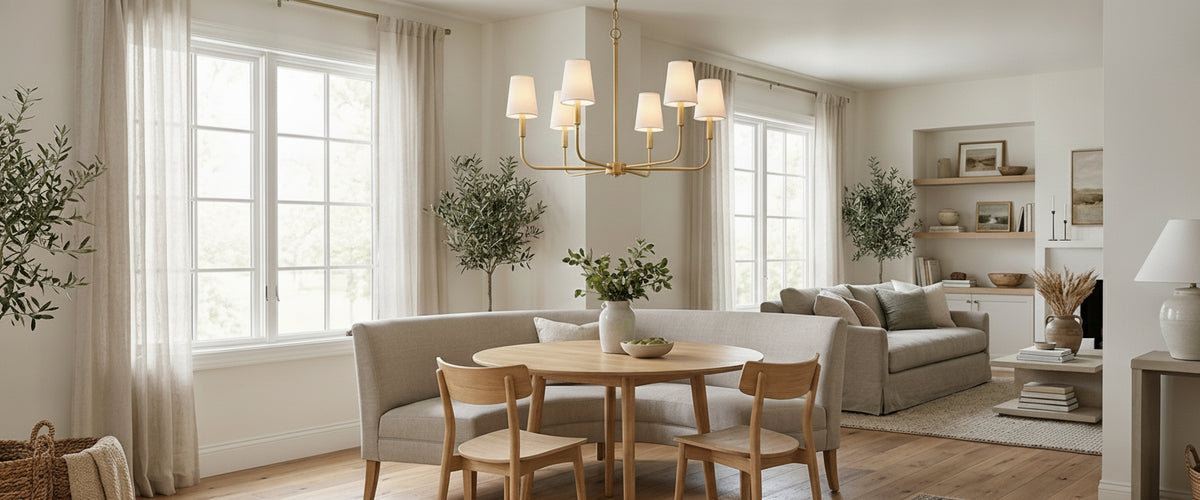

Switch a gold chandelier on at dusk and the shades take over. Choose the wrong white and the brass looks thin and cheap. Choose well and the whole ceiling glows like candlelight seen through paper. Gold chandeliers white shades are one of the most dependable pairings in decorative lighting: classic, forgiving in daylight, and surprisingly easy to misjudge once the sun goes down. At Niori we work with alabaster, natural stone, glass and brass every day. When a shaded piece disappoints, the cause is almost always a detail nobody checked before ordering.

Quick Answer
- Shade material sets the colour of the glow more than most people expect. Fabric warms, opal glass reads slightly cooler, and alabaster adds a soft honeyed cast that suits gold.
- Ceiling height decides the mood. Shaded chandeliers feel intimate between roughly 2.4m and 3m (8 to 10ft). Above that, small shades can look fussy unless the piece is scaled up.
- Wall colour can flatten or sharpen the contrast. Cool brilliant white walls flatten it. Warm whites and deep colours make it richer.
- Use 2700K or warmer bulbs with a CRI of 90 or above, and an LED-compatible dimmer.
- Confirm drop, weight, shade fitting and bulb type before you buy a piece that is awkward to send back.

What White Shade Material Does to a Gold Frame at Night
In daylight, a white shade is just white. At night it becomes the light source, and its material decides what colour the room turns.
Linen and cotton soften the light and pick up warmth from the bulb, so a lit linen shade reads cream rather than white. The weave shows when lit, which gives texture but also shows every dust mark. Pleated silk gives a gentler glow with a faint sheen that echoes polished gold. It suits traditional rooms but marks easily and discolours near heat.
Opal glass gives the most even, clean diffusion. It also reads slightly cooler than fabric. Next to polished brass that cool edge can make the gold look yellower than it did in the showroom. With brushed or satin-finish gold it looks crisp and modern.
Alabaster works differently. It is a fine-grained form of gypsum, translucent enough that light passes through the stone and brings out its veining. Lit from inside, white alabaster moves from chalky in daylight to pale apricot under a warm bulb. That shift sits in the same colour family as brass, so the shade and frame look as though they belong together. The same piece of stone can look almost grey under a cool 4000K lamp and glowing under 2700K, which is why seeing a shade lit in person tells you more than any product photo. If you want gold chandelier white shades to read as one warm piece rather than two competing finishes, white shades on a brushed frame, such as the Ramses 9 Light Chandelier in White & Brushed Brass, are closer to the right design language than polished brass with cool glass. You can compare similar shapes across the alabaster lighting collection.
The trade-off is weight and variation. Stone shades are heavier than fabric or glass, and no two are identical. For most buyers who want the warmest result from a gold chandeliers with shades, that variation is the point.
Ceiling Height Decides Whether Shades Feel Intimate or Fussy
Shades pull light downward and keep it close. Under a standard UK ceiling of around 2.4m (8ft), that is exactly what you want over a dining table or in a living room. A compact three- or five-arm piece fills the space without crowding it. Over a small round table or in a cosy snug, a three-arm design such as the Ramses 3 Light Chandelier in White & Brushed Brass makes more sense than a wide multi-arm fixture that eats into the room.
With lower ceilings the problem becomes glare. In a walk-through room you need at least 2.1m (about 7ft) of clearance under the lowest point. Otherwise the shade hems sit at eye level and you see the bare bulb as you pass.
Tall ceilings cause the opposite problem. A common mistake in Georgian rooms with ceilings close to 3.6m (12ft) is a nine-arm chandelier with small drum shades. Hung high, it looks like a row of little white hats perched on a cake stand. The fix is fewer, larger shades on a longer drop, so the fixture sits in the lower third of the room's height where it reads as one object. As a rough sizing guide, add the room's length and width in feet and use that number as the chandelier diameter in inches. A 4m by 5m room (about 13 by 16ft) suggests a diameter near 29in (74cm).
The Backdrop Problem: Wall Colour Can Make or Break the Contrast
A gold chandelier with white shades needs something to stand out against. Cool brilliant white walls give it very little. The shades blend into the plaster, the brass looks thin, and the fixture seems to hover without weight.
Warm whites, putty, soft plaster pink and pale stone colours do the opposite. The shades read as lit objects with edges, and the gold picks up the warmth bouncing back off the walls. In practice this is the safest backdrop for gold chandelier white shades in period homes.
Deep walls in navy, forest green or oxblood give the strongest contrast. The shades become lanterns and the gold glints at every joint. The catch is that dark walls absorb light, so the chandelier cannot do the job alone. Plan wall lights or table lamps as well.
Look at the ceiling too. Open-topped shades throw light upward, and a bright white ceiling bounces it back as a broad wash. A ceiling painted to match warm walls keeps that wash softer and lets the shades stay the focus.
Room by Room: Where Gold Chandelier White Shades Work Best
Dining Room
This is where the combination shines. Hang the lowest shade roughly 75 to 85cm (30 to 33in) above the tabletop, and choose a diameter about half to two-thirds the width of the table. Warm-glowing shades flatter faces and food in a way bare bulbs never manage.
Living Room
A shaded chandelier makes a strong centrepiece but a poor single source. Pair it with lamps at seated height so the ceiling piece can be dimmed low in the evening. The wider lighting collection includes table and floor lamps in matching brass and stone finishes.
Bedroom
Shaded pieces suit bedrooms because they hide the bulb from anyone lying down. Avoid hanging directly over the bed. Centre the fixture on the open floor space instead.
Hallways and Stairwells
Tall voids are where shaded chandeliers most often compete with themselves. From the floor below, you look straight up into the shades and catch the bulbs. Tiered designs or fittings with closed-bottom stone or glass shades handle this better.
Kitchens and Bathrooms
Fabric shades collect grease in kitchens and moisture in bathrooms, so choose glass or sealed stone if you want the look here. Bathrooms also bring zone and IP rating rules, and any fitting there needs a qualified electrician.
Restaurants and Hotels
For hospitality, the deciding factor is cleaning. Fabric discolours under constant use and kitchen air. Alabaster and glass wipe clean and age better across years of service.
Bulb Temperature and Dimming for Gold Chandelier White Shades
The bulb is where most good fixtures are let down. Here are the numbers that stop white shades washing out:
- Colour temperature: 2700K for general use. For evening dining rooms and bedrooms, 2200K to 2400K brings the gold out further. Avoid 4000K and above; it turns white shades blue-grey and flattens brass to a harsh, greenish yellow.
- Colour rendering: CRI 90 or above, so skin tones, timber and stone look natural.
- Bulb finish: frosted or opal bulbs inside thin shades. Clear filament bulbs leave a bright hot spot visible through fabric and thin stone.
- Brightness: several lower-output bulbs give a more even glow than a few bright ones.
- Dimming: use dimmable LEDs with a trailing-edge dimmer rated for the total LED load, since mismatched dimmers cause flicker and buzzing. Dim-to-warm bulbs suit shaded pieces especially well.
Changing a dimmer means working on mains wiring. Have it fitted by a qualified electrician, and see Electrical Safety First for guidance on choosing one.
Five Things to Confirm Before Ordering a Shaded Chandelier
A large shaded fixture is awkward to pack, ship and return, so confirm these before you buy:
- Drop and adjustability. Measure from ceiling to the lowest point you want, then check the chain or rod length and whether it can be shortened on site.
- Weight and ceiling fixing. Stone shades add real weight. Ask for the total weight and have an electrician confirm the ceiling can carry it, fixing into a joist or brace where needed.
- How the shades attach. Check whether shades clip, screw or sit on a gallery, and whether individual replacements can be ordered if one is damaged.
- Bulb cap and maximum wattage. Confirm the lamp holder (E14, E27 or G9, for example), the maximum rating, and whether the fitting is dimmable.
- The exact gold finish. Brushed brass, polished brass and gold leaf behave very differently under warm light. Ask for photos taken under 2700K, or a finish sample, before you commit.
Caring for gold chandelier white shades is simple but specific. Dust fabric with a soft brush. Wipe glass with a barely damp cloth. Clean alabaster only with a dry, soft cloth, since water and cleaning sprays mark the stone. Budget depends on material, scale, engineering, finish and installation, so for larger or bespoke pieces it is worth requesting a tailored quote. Choose the right shade, then the right bulb, and a gold chandelier with white shades will look as good at 10pm as it does at noon.