
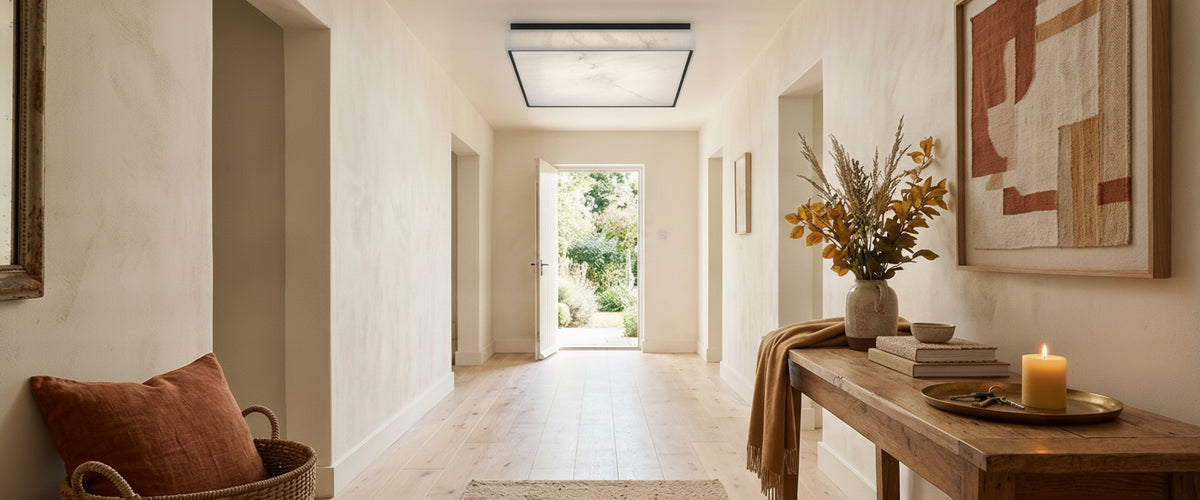

Hallways are where good ceiling lights go to look bad. A flush mount hallway fitting sits closer to your eye than almost anything else in the house. You see it from both ends at a long, raking angle, and the walls are close enough to bounce every flaw in the light straight back at you. Choose badly and you get a glowing dinner plate stuck to the roof of a tunnel. Choose well and the corridor sets the tone for every room that opens off it.

At a Glance
- Size to the corridor: as a rule of thumb, aim for a diameter of roughly a third of the hallway width.
- Diffuser first: the material decides whether the light reads warm and soft or flat and glary at close range.
- Long hallways need a run: past about 3.6 m (12 ft), two matching fittings usually beat one bright one.
- Spec matters more here: pick a colour temperature that matches the rooms either side, and a CRI of 90 or above.
- Confirm the details: lumen output, backplate size and lampholder type, before you order.

Why Hallways Expose Flush Mount Mistakes That Larger Rooms Forgive
In a living room, a ceiling light competes with lamps, windows and furniture. In a hallway it is usually the only light, and the space is long and narrow, so your eye lands on it every time you walk through the door. That is why flush hallway ceiling lights deserve more care than their modest size suggests.
Three things work against you. The ceiling is often lower than in the main rooms, especially under stairs or in converted flats. The walls are close, so a hard, directional light leaves scalloped bright patches on the paint. And people pass straight under the fitting, so any glare from an exposed bulb or a thin, cheap diffuser is right in their line of sight. A larger room forgives all three. A hallway flags them at once.
The Diameter Rule for a Flush Mount Hallway Ceiling
The most common complaint we hear about a flush mount hallway installation is that the fitting looks mean. Usually the buyer has chosen something sized for a cupboard. Our starting rule is that diameter should be roughly a third of the hallway's width. A typical 1.07 m (3 ft 6 in) hallway suits something around 30 to 36 cm (12 to 14 in) across. A generous 1.5 m (5 ft) entrance hall can take 46 cm (18 in) or more without crowding.
Go much smaller and a flush mount hallway fitting looks like an afterthought against a long, unbroken ceiling. Go much larger and it starts to feel heavy, particularly where the ceiling drops below 2.4 m (8 ft). Depth matters too. A flush mount that projects several centimetres can still feel tight in a low corridor, so check the overall drop as well as the diameter. If you have a little more height to play with, a semi-flush design with a short stem lets the light spread across the ceiling instead of pooling directly underneath.
Diffuser Material and Finish Against White Ceilings and Strong Walls
This is where hallway flush ceiling lights succeed or fail. Each diffuser material reads differently at the close range typical of a flush mount hallway:
- Alabaster: a mineral form of gypsum, soft enough to be carved and turned thin so it glows with a warm, even light (Mindat's gypsum entry covers the mineralogy). The natural veining shows when lit and fades back to a quiet cream when off.
- Onyx and marble: denser, with more dramatic banding. Lit, they cast a richer, slightly honeyed tone. They suit entrance halls where the fitting is meant to be noticed.
- Opal glass: clean and uniform, but cooler and more clinical up close.
- Clear or textured glass: sparkle, yes, but often glare when you walk directly beneath.
One thing surprises clients every time. Against brilliant-white ceiling paint, an unlit alabaster disc reads distinctly cream, almost parchment. That is a strength if your ceiling is a warm white or your walls are a deep colour, because the stone ties the two together. Against a stark, cool white it can look slightly yellowed by day. If that bothers you, warm the ceiling white a shade or choose a piece with paler stone.
Strong wall colours change the equation again. In a hallway painted a deep bottle green, an opal glass fitting tends to turn the green muddy and grey by evening, while alabaster gives the walls back their depth. Brass trims help here too; they pick up warm wall tones in a way chrome rarely does. The same logic holds for copper: in a small entrance or a vestibule painted in a deep, saturated colour, a warm-metal body like the Pulcra Tube Flush Ceiling Light in copper echoes the wall tone, though its tighter, downward pool of light suits a short space or a doorway better than a whole corridor. You can compare stone finishes side by side across our alabaster lighting collection.
When One Flush Mount Is Not Enough
A single flush mount hallway light in the middle of a long corridor leaves both ends in shadow and makes the centre feel like a spotlight. As a rough guide, once a hallway passes about 3.6 m (12 ft), or bends round a corner, a run of two matching flush mounts gives far more even light than one brighter one.
Space them so each sits roughly a quarter of the way in from either end, rather than crowding the middle. Keep them identical in size and stone. Mixing an alabaster disc with an onyx one sounds interesting but reads as a mistake in a space this linear. For very long corridors, three fittings at regular intervals work, or you can pair ceiling lights with wall lights, which put light at eye level and make a narrow hall feel wider. If you want the ceiling and walls to share one design language, a fitting rated for both positions, such as the Bloom LED Wood Drum Flush Wall & Ceiling Light in ash, lets the same drum repeat overhead and at eye level, and its pale timber sits comfortably beside oak floors and painted joinery. Put the whole run on one circuit with a dimmer, and fit two-way switching at each end so nobody walks half the length in the dark. Any new switching or circuit work should be done by a qualified electrician.
Colour Temperature and CRI in a Transitional Space
A hallway is the space you see in the same glance as the rooms around it. If the living room glows at 2700K and the hallway is lit at 4000K, the corridor looks blue and institutional through every open door. Match your flush mount hallway lighting to the colour temperature of the rooms either side. For most homes that means 2700K, or 3000K if you want a crisper feel. Alabaster and onyx warm the light slightly as it passes through, so a 2700K bulb behind stone can read closer to candlelight.
Colour rendering index (CRI) describes how faithfully a light source shows colour, and the Lighting Research Center's explainer is a useful primer. Hallways are where people check their coats, their faces and the art on the walls on the way out. A bulb with a CRI of 90 or above keeps skin tones, paint colours and the natural veining in the stone looking true. A cheap bulb at CRI 80 flattens all three, and behind a translucent stone diffuser the difference shows.
Lumens, Backplate and Lampholder: What to Confirm Before You Order
Hallways rarely need blazing light, but they do need enough for safety on stairs and thresholds. As a working guide, a flush mount hallway fitting on its own usually wants somewhere around 800 to 1,200 lumens from its bulbs, reduced per fitting in a run of two. Stone absorbs some light, so a thick alabaster or onyx diffuser will need a little more output than a thin glass one to deliver the same brightness. Pair it with a dimmer and you can drop it right down at night.
Then check the hardware:
- Backplate size: it needs to cover the existing ceiling box and any patched plaster. A small backplate over a large hole is a common and avoidable eyesore.
- Lampholder type: B22 and E27 are common in the UK, E27 and E14 across Europe, and E26 is standard in the US. Because Niori ships worldwide, confirm the lampholder suits bulbs you can easily buy locally.
- Bulb dimensions: flush fittings leave little room, so check maximum bulb length and wattage.
- Dimmer compatibility: make sure your LED bulbs and the dimmer are rated to work together, or you will get flicker and hum.
- Ceiling structure: stone is heavier than glass, so a qualified electrician should confirm the fixing point can carry the weight.
Buyer Mistakes We See Most Often
- Choosing a diameter by eye from a product photo rather than measuring the corridor.
- Fitting a cool-white bulb because it seemed brighter in the shop.
- Centring one fitting in a long hall instead of planning a run.
- Ignoring how an unlit diffuser looks against the ceiling by day.
- Buying a striking pendant for a low ceiling where only a flush or semi-flush design will clear heads.
Pre-Order and Care Checklist
- Measure hallway width, length and ceiling height.
- Sketch fitting positions if the corridor is long or turns a corner.
- Decide on stone or glass based on your ceiling white and wall colour.
- Pick 2700K or 3000K to match neighbouring rooms, with CRI 90 or above.
- Confirm lumens, lampholder, backplate and dimmer compatibility.
- Book a qualified electrician for installation and any new switching.
- Clean alabaster with a soft, dry cloth only. Gypsum stone dislikes water and chemical cleaners, so skip sprays entirely.
- Use LED bulbs, which run cooler and keep heat off the stone over the long term.
Budget for a stone flush mount depends on the material, the diameter, how thin the stone is turned, the metalwork and finishing, and the installation itself, so the clearest route is a tailored quote. If you are planning a full flush mount hallway run, or matching hallway fittings to wall lights and lamps elsewhere in the house, explore the wider niori lighting range and ask us to specify the set together. A properly lit hallway is the first thing guests notice and the last thing you have to think about, which is exactly how it should be.