
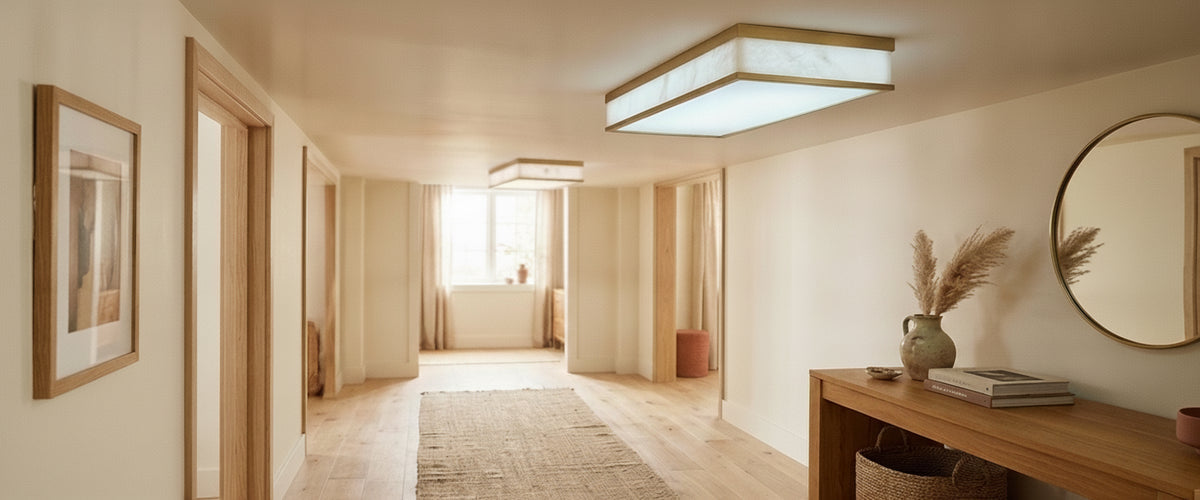

Most hallways are lit by a fitting nobody chose. It came with the house, it sits halfway between the front door and the stairs, and it throws a hard white disc onto the ceiling while the walls sink into shadow. A well-chosen flush mount ceiling light can fix that in an afternoon. A poorly chosen one makes the corridor feel narrower than it really is. At Niori we design alabaster and natural-stone lighting, and the flush mount ceiling fitting is the piece we are asked about most often by people with low ceilings, long passages and very little room for anything that hangs.

Key Takeaways
- Diffuser first, style second. Opal glass, frosted glass and stone each put a different kind of light on the floor and walls.
- Warm bulbs, warm trims. A 2700K lamp paired with brass reads calm. A cooler lamp against chrome reads clinical.
- Hallways need rhythm. One central fitting rarely works in a corridor longer than four or five metres.
- Low ceilings suit flush fittings. Below roughly 2.4 metres (about 7 ft 10 in), flush is usually the right call on its own merits.
- Stone is heavier. Have a qualified electrician confirm the ceiling fixing before anything goes up.

Why the Same Flush Mount Ceiling Light Anchors One Room and Vanishes in Another
A flush fitting has no drop and no silhouette against the room. It depends entirely on two things: what it does to the ceiling plane, and how much presence the shade carries when the light is on. In a square bedroom with pale walls, a modest opal dish can feel complete. Put the same fitting in a dark-painted entrance hall with a high skirting and picture rail, and it reads as an afterthought, a small bright spot with nothing around it.
The difference is proportion and surface. A flush mount ceiling light with a visible, textured shade (carved alabaster, veined onyx, ribbed glass) gives the eye something to settle on during the day as well as at night. A plain white disc only exists when it is switched on. If the room has strong architectural detail, choose a fitting with enough material interest to hold its place among it.
The Hallway Case: Command the Entrance or Get Ignored
Hallways are where a flush mount ceiling light is most often bought by default and least often thought through. The ceiling is usually the lowest in the house and the space is narrow. The light also has to work for both a quick dash to the door and the first impression a guest gets on arrival.
Good flush hallway ceiling lights do two jobs. They wash enough light onto the walls to make the space feel wider. They also give the entrance a focal point that tells you the rest of the house has been considered. A shallow alabaster bowl does both. The stone glows across its whole surface, so the fitting looks lit from within rather than from a single hot point, and the light spills sideways onto the walls instead of dropping straight down.
We see one pattern often. A homeowner in a Victorian terrace replaces a tired glass flush ceiling light in the hallway with a much larger fitting, assuming bigger will feel grander. It crowds the ceiling between the front door and the stair newel and makes the hall feel lower. Two smaller stone fittings spaced along the run usually solve it. The hall reads longer, and the ceiling stops feeling as if it is bearing down on everyone who comes in.
Low Ceilings in Bedrooms and Landings: Flush as the Confident Choice
There is a habit of treating a flush mount ceiling light as what you settle for when a pendant will not fit. In rooms with ceilings around 2.4 metres or lower, that thinking is backwards. A pendant in a low bedroom either hangs too high to give any drama or low enough to become a hazard over the end of the bed. A flush fitting keeps the full height of the room and lets the eye travel up without interruption.
Landings make the case even more strongly. They are passed through constantly, often at the top of a stair where headroom is tight, and they are frequently lit at night by someone half-awake. A flush mount ceiling fitting with a stone or frosted diffuser gives enough low-glare light to see the top step without the dazzle you get looking up at an exposed bulb. In bedrooms, pair it with table lamps or wall lights so the ceiling fitting is not doing all the work. The overhead light becomes the light you dress by, while the lamps become the light you actually live in.
Opal, Frosted or Stone: How the Diffuser Shapes the Light on the Floor
The diffuser is the most important decision you will make, and most product listings tell you very little about it.
Opal Glass
Opal glass is milky and dense. It spreads light evenly and hides the lamp completely, which is why it is so common. The trade-off is flatness. Opal gives a uniform, neutral output with little character, and it can make a narrow corridor feel institutional if the bulb is wrong.
Frosted Glass
Frosted or acid-etched glass is thinner and more transparent. It lets more light through and casts a slightly brighter pool directly beneath the fitting. It suits utility spaces and bathrooms (in a fitting with the correct IP rating) but can look harsh at eye level on a stair.
Alabaster, Onyx and Natural Stone
Stone behaves differently from glass. Alabaster is a soft, fine-grained gypsum. When it is cut thin enough it transmits light through its body, warming it and breaking it up through natural veining. Onyx is denser and often more strongly banded, giving a deeper, amber cast. The result is light that reaches the floor softer and slightly warmer than the bulb's rated colour, with visible movement across the shade itself. Look through our alabaster lighting collection and you will notice that no two shades glow quite the same. That variation is the point.
Stone does absorb some output, so you will need a slightly brighter lamp behind it than behind thin glass to reach the same level on the floor. That is a fair exchange for light with no hard edges.
Bulb Temperature and Trim Colour: From Clinical to Calm
Because a flush mount ceiling light sits tight to the plaster, you see the trim and the light colour together at every glance. Get them wrong and even good stone looks cheap.
- 2700K is the default we recommend for hallways, landings and bedrooms. It matches the warmth of alabaster and keeps stone from looking grey.
- 3000K works in kitchens and in hallways with cool-toned paint, where 2700K can look slightly yellow.
- 4000K and above belongs in workshops and offices, not in a home entrance.
Trim colour should follow the bulb. Brushed brass and aged bronze sit naturally with warm light and warm stone. Black trims give a graphic edge that suits panelled or dark-painted halls. In a hall with a little more headroom where you want both finishes, a fitting such as the Sena 3 Light Semi-Flush Ceiling Light in Black & Brushed Gold shows how black and warm gold can sit together under a 2700K lamp without either looking out of place. Polished chrome under a warm lamp tends to look mismatched. It wants cooler light, which then fights the stone. The Energy Saving Trust's lighting advice is a useful plain-English primer on LED colour temperature and output if you are swapping older lamps.
Dimming matters more in hallways than people expect. At night a dimmed stone fitting becomes a soft landmark rather than an alarm. Check that the lamp is dimmable and compatible with your dimmer, since mismatches cause flicker and buzzing.
Placement and Spacing Mistakes That Flatten a Corridor
Most poorly lit corridors fail on placement rather than product. These are the mistakes we see most:
- One fitting for a long run. A single flush ceiling light in a hallway of five metres or more leaves both ends dim. Two or three smaller fittings in a steady rhythm give an even wash and make the space feel intentional.
- Ignoring the front door. The first fitting should light the area just inside the entrance, where people take off coats and find keys, not the middle of the hall.
- Centring on the old ceiling rose. The existing point is often in the wrong place. Moving it is a small job for an electrician and usually worth it. A simple fitting such as a white ceiling rose with integral terminal block at the new position keeps the connection neat and accessible.
- Forgetting the walls. If art or a mirror hangs in the hall, position fittings so light grazes it rather than leaving it in shadow.
- Oversizing. In a narrow corridor, a fitting that fills too much of the ceiling width makes it feel lower. Leave generous margins either side.
The Society of Light and Lighting publishes guidance used by professional designers on lighting circulation spaces. Its broad principle holds for homes too: even, glare-free light along a route matters more than raw brightness in one spot.
How to Choose a Flush Mount Ceiling Light: Buyer Checklist
Before you commit to hallway flush ceiling lights or a single bedroom fitting, run through these points:
- Ceiling height. Below about 2.4 metres, choose flush. With more height, a semi-flush fitting may give extra presence. In a generous bedroom or a square entrance hall, a wider five-light design such as the Sena 5 Light Semi-Flush Ceiling Light carries the scale better than a compact three-light fitting.
- Diffuser material. Opal gives even, neutral light. Frosted glass gives brightness. Alabaster or onyx gives warmth and texture.
- Number of fittings. Count them along the length of the corridor rather than defaulting to one.
- Lamp type and dimming. Confirm the cap type, a warm colour temperature and dimmer compatibility.
- Trim finish. Match it to door furniture, stair hardware or picture lights in the same space.
- Weight and fixing. Stone fittings are heavier than glass. Ask for the weight and confirm what the ceiling can support.
- Companion lighting. Plan wall lights or a console table lamp alongside the ceiling fitting so it is not working alone.
If you are planning a whole house, look at the hall, landing and bedrooms together across our lighting range so materials and finishes repeat through the circulation route. Budget varies with material, scale, the complexity of the carving, fixing requirements and finish. For multi-fitting projects or hospitality corridors we recommend requesting a tailored quote.
Installation and Care for Stone Flush Fittings
Any flush mount ceiling light should be installed by a qualified electrician, and with stone it is doubly important. The fixing needs to go into a joist or a suitably rated support, not just the plasterboard. The electrician should also confirm the circuit and earthing are sound before the fitting goes up.
Care is simple once it is in place. Dust alabaster with a soft, dry brush or microfibre cloth. Never use water, sprays or household cleaners. Alabaster is slightly soluble and porous, and moisture can leave dull patches. Switch off and let the lamp cool before cleaning, and handle the shade by its edges when changing bulbs. Kept this way, a stone flush fitting ages well, its surface taking on a soft, lived-in sheen over the years.
Choose the diffuser carefully, warm the light, space your fittings along the run, and the most ignored fixture in the house becomes the one guests notice first.