
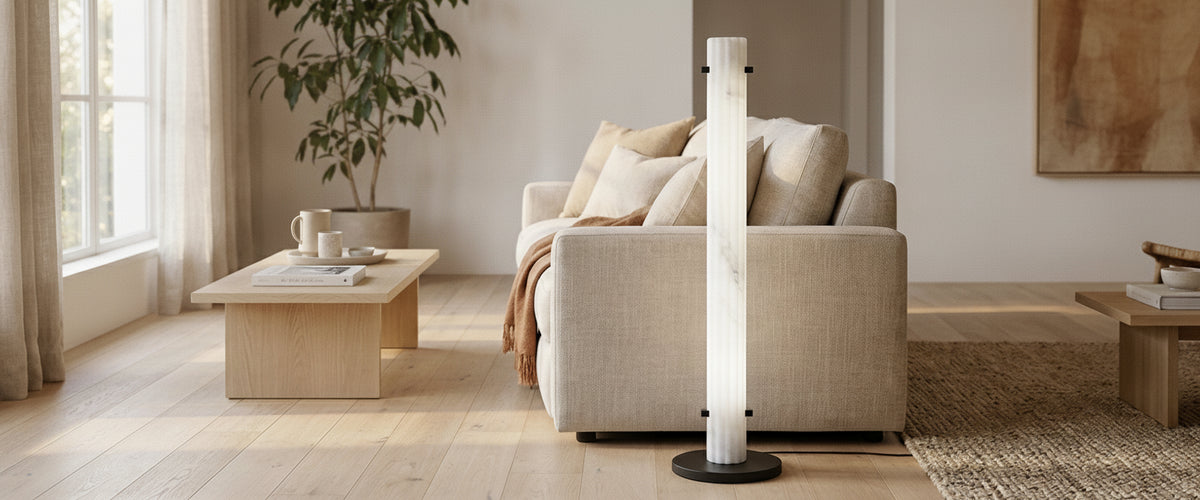

Most living room floor lamps are bought the wrong way around. Someone falls for a silhouette online, it arrives, and only then does anyone ask where it should go. By that point the height, shade and base have already settled the question, and the answer is often the corner nobody sits in. This guide flips the order. The floor lamps living room layouts really need are placed by job first: a dark corner for ambient fill, just behind the sofa arm for conversation light, or over the shoulder behind a reading chair for task light. Pick the position, then match the lamp to it, with the bottom of the shade at roughly seated eye height and a warm 2200K to 2700K bulb.

At a Glance
Position first, style second. A lamp beside the sofa has a different job from one in an empty corner.
Match shade height to seated eye level wherever people read, so nobody looks straight into a bare bulb.
The base material affects the room after dark. Translucent alabaster glows. Brass and timber reflect or absorb light.
Bulb temperature matters as much as the shade. Around 2700K suits most living rooms, and warmer suits stone.
Two living room floor lamps work well when each one has its own job and they don't mirror each other.

Why Buying Living Room Floor Lamps by Looks Goes Wrong
The floor lamps living room shoppers fall for get chosen like furniture, then expected to perform like lighting. The trouble is that a beautiful lamp in the wrong place does almost nothing useful. A tall arc lamp parked against a wall spends its reach on bare plaster. A slim column with a dense shade beside a reading chair throws a cone of light onto the floor and leaves the page in shadow.
We see this often in returns conversations. One client in a north-facing Edinburgh flat ordered a carved alabaster floor lamp for the living room's bay window corner. In daylight it looked right. After dark the stone glowed against glass that reflected nothing back, and the sofa stayed gloomy. Once the lamp moved to the sofa arm, about 18 inches (45 cm) back from the cushion line, the room changed completely. The lamp was fine all along. It was simply in the wrong spot.
Corner, Sofa-Side or Behind the Chair: Where to Put a Floor Lamp in the Living Room
Each of the three classic positions hands the floor lamps living room plans rely on a different job. Decide which job you need before you look at a single product.
The Corner: Ambient Fill
Corners are the darkest part of most living rooms, and a living room floor lamp placed there makes the space feel bigger after dark. This is where an uplighter or a lamp with a translucent body earns its keep, because the light bounces off two walls and the ceiling rather than landing on a seat. Leave a few inches between the shade and the walls so the glow spreads evenly instead of hot-spotting. Where the corner needs a soft spread of light rather than a directed beam, a glass-shaded piece such as the Bubble LED Glass Floor Lamp in Brushed Gold is closer to the right design language than a column with a dense linen drum.
Sofa-Side: Conversation and Casual Reading
Of all the floor lamps living room seating relies on, the one at the sofa end works hardest. It lights faces for conversation and gives enough light for a magazine or a phone. Place it slightly behind the arm rather than level with it, so the shade sits just outside the sitter's peripheral vision. A side table on the other end can hold a table lamp, which keeps the arrangement from tipping into a matched pair.
Set slightly behind the arm, the shade stays out of the sitter's line of sight.
Behind the Reading Chair: Task Light
This is the most demanding position for any floor lamp in the living room. The light should come over the shoulder opposite the hand you turn pages with and land on the book, not the back of your head. Adjustable arms and arc lamps make sense here, and so does a shade that is open at the bottom. If the chair sits close to a wall, an adjustable design such as the Funk Adjustable Floor Lamp in brass with a black base lets you angle the head over the page without claiming the floor space an arc needs. A fully enclosed stone globe looks lovely behind a chair but won't give you enough downward light for long reading sessions.
Height Versus Shade Width: Proportions That Decide Where the Light Goes
Proportion decides whether the floor lamps living room readers depend on pool light where it is needed or let it drift up to the ceiling. As a working rule, the bottom of the shade should sit roughly at seated eye height wherever people read. For most sofas and armchairs that falls somewhere around 40 to 45 inches (100 to 115 cm) from the floor. Set it higher and the bulb shows from the seat. Set it lower and the light pools on the cushions and skips the page.
Shade width works alongside height. A wide drum shade on a slim stem spreads light sideways and suits a sofa end. A narrow shade on a tall column pushes light up and down in tight beams, which is better suited to a corner than to reading. In rooms with ceilings under 8 feet (about 2.4 m), take care with tall uplighters. They can leave a bright ring on the ceiling that flattens the room rather than warming it.
Arc floor lamps in a living room raise a proportion question of their own, because the base stands well back while the shade hangs out over the seat. Measure the reach against the clear floor behind the sofa or chair before committing. In an open-plan room with that space to spare, a large arc such as the Ginger LED Large Arc Floor Lamp in black and brown wood veneer carries light over a seating group without a side table, and its timber finish keeps the long curve feeling grounded rather than spindly.
Stone, Ceramic, Brass and Timber: What the Base Does After Dark
Most people judge the base of the floor lamps living room schemes are built around in daylight. The base matters more at night, when it either joins in with the light or stays out of the picture.
Alabaster: translucent enough to glow when lit from inside, so the body of the lamp becomes a second, softer light source. Alabaster is a fine-grained form of gypsum, soft enough to scratch with a fingernail according to Mindat's mineral data. That softness is why it carves so finely and why it needs a gentle hand.
Marble and onyx: denser and cooler in tone. Marble usually stays opaque and gives a heavy, stable base. Thin-cut onyx can glow amber, but it reads busier than alabaster because of its banding.
Ceramic: opaque and glaze-dependent. A gloss glaze picks up highlights from other lamps, while matte finishes read as solid shapes.
Brass: reflective and warm. Polished brass throws small gleams back into the room. Brushed or aged brass keeps the glow lower and calmer.
Timber: absorbs light and anchors the lamp visually. It suits rooms that already have plenty of reflective surfaces.
Stone and brass is a popular pairing among the floor lamps living room designers specify, and for good reason. The alabaster supplies the diffused glow and the brass gives a crisp edge, so the lamp reads as an object in daylight and as light at night. If you want to compare how different stones carry light, the alabaster lighting collection shows the variation in veining and translucency across pieces.
Shade Opacity and Bulb Temperature: The Two Quiet Mood Controls
Two decisions shape the mood that living room floor lamps create more than almost anything else, and both are easy to overlook. The first is how much light the shade lets through. A dense linen or metal shade directs light down and out, which is good for reading but leaves the upper room dark. A translucent stone or opal glass shade lights the whole lamp and spreads a soft glow at every height.
The second is color temperature. In the studio we test every stone shade under a range of bulbs, and the difference is plain to see. At 2700K alabaster reads honeyed and warm. At 4000K the same piece turns chalky and slightly gray, as if someone had switched on an office light. For living room floor lamps with stone fittings, we recommend 2200K to 2700K, with a CRI of 90 or above so that wood, fabric and skin tones look natural.
Dimming finishes the job. Use dimmable LED bulbs and check that they suit the lamp's dimmer, because a poor pairing leads to flicker or buzz at low levels. Most plug-in floor lamps living room setups use need no wiring. If you want floor sockets or lamp circuits switched from the door, have the work done by a qualified electrician.
Can You Have Two Floor Lamps in the Living Room?
Yes, and in larger or open-plan rooms you usually should, because the floor lamps living room zones need rarely come in ones. One lamp lights one zone. Once a room has a separate reading corner, a sofa run and a dining end, a single floor lamp leaves at least one of them in shadow.
The mistake is placing two identical lamps either side of the sofa like hotel bedside lights. In a living room that symmetry looks staged. A better approach is to give each lamp its own job and its own form. Pair an arc lamp over the reading chair with a glowing stone column in the far corner, or a brass task lamp with a softer alabaster piece. Keep the color temperature identical across both so the room still reads as one space, and set them at different heights so the light moves around the room rather than forming a flat band.
A simple test is to stand in the doorway after dark with only the living room floor lamps on. If your eye travels across the room from one pool of light to the next, the arrangement works. If it lands on a matched pair and stops there, change one of the lamps.
Different forms and heights, one color temperature.
A Buyer's Checklist for Living Room Floor Lamps
Mark the spot. Measure from the floor to seated eye height, and from the lamp position to the nearest wall and socket.
Name the job. Choose ambient fill, conversation light or task light. One lamp rarely does all three.
Check ceiling height before buying a tall uplighter or an arc lamp with a long reach.
Choose the base for night-time. Pick glowing stone, reflective brass or light-absorbing timber depending on what the room already has.
Match opacity to the job. Open-bottomed shades suit reading. Translucent stone suits fill light.
Specify the bulb. Use dimmable LED at 2200K to 2700K with a CRI of 90 or above, and confirm the maximum wattage on the fitting.
Think about weight and footing. Stone bases are heavy and stable, but they still need a level floor and a clear walking path around them.
Plan for care. Dust alabaster with a dry, soft cloth. Keep it away from water, cleaning sprays and steamy rooms, and handle it with clean, dry hands.
On budget, the honest answer is that the price of the floor lamps living room buyers consider depends on the material, scale, the complexity of the carving, the engineering inside the stem and the finish on any brass detailing. A hand-carved stone floor lamp and a lighter metal piece are very different objects. For a specific room or a design project, ask for a tailored quote rather than guessing.
Choosing Floor Lamps for the Living Room With Intent
The floor lamps living room layouts actually need start with a measured spot and a clear job, not a pretty photo. Everything else, from stone versus brass to opal versus linen and 2200K versus 2700K, follows from that. At Niori we design alabaster and natural-stone lighting around how light leaves the material, which is why position matters to us as much as profile. Once you know where your lamp will stand, browse the wider lighting range to see which forms suit the job.