
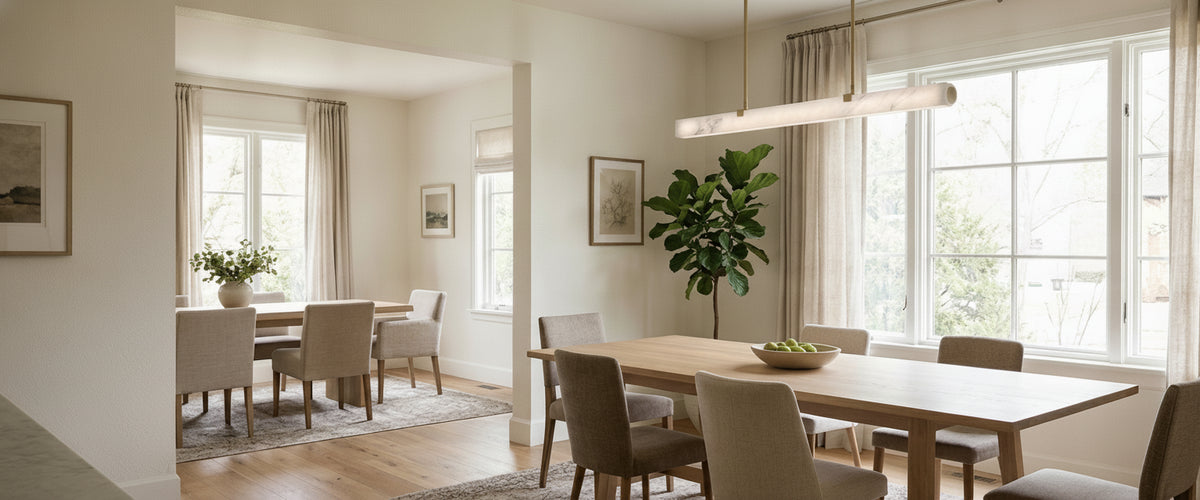

Most modern dining rooms are lit by a single fitting hung over the table and then left alone. The table glows, the walls go gray, and the room looks unfinished no matter how good the chairs are. Good modern dining room lighting treats the table as the starting point rather than the whole job. It works out from there in layers, so the space holds atmosphere long after the plates have been cleared.

At a Glance
Plan a modern dining room from the table outwards. The table's shape and length decide the fitting format, not the other way around.
Choose 2700K for dinner. It flatters food and skin, and it warms stone. Save 3000K for rooms that double as workspaces.
Hang lower than you think. Roughly 30 to 33in (75 to 85cm) from tabletop to the bottom of the fitting suits most rooms.
Go larger than you think. Undersized pendants are the most common sizing error we see.
Add wall lights. They are the layer that carries the room once the meal moves on.
Put everything on dimmers, on separate circuits wherever you can.

The Single-Pendant Trap
A lone pendant in a modern dining room puts a pool of bright light in the middle of the space and throws everything else into relative shadow. Faces at the ends of a long table fall into gloom, the walls read as dull boundaries, and the ceiling feels low because nothing lights it. People then turn the pendant up to compensate, which makes the glare worse.
The fix is a second and third source at different heights; a bigger pendant only adds glare. Alabaster helps here because it diffuses light through its body instead of firing it straight down. A stone pendant lights the table and spreads a soft glow sideways and upward, so it already does some of the work a bare glass shade can't. One still won't light the corners on its own.
Table Geometry Comes First
Before you look at a single fitting for your modern dining room, measure the table. Its footprint sets the rules for everything that follows.
Round or square tables want a centered, roughly circular fitting: one generous pendant, a compact chandelier, or a tight cluster.
Rectangular tables up to about 6ft (1.8m) can take a pair of pendants or one oval or linear fitting.
Longer tables, from around 6.5ft (2m) upwards, need light along their length: three pendants, a long linear piece, or two chandeliers.
Extendable tables should be lit for their everyday length, with wall lights covering the extra leaves on the nights you need them.
Leave around 12in (30cm) between the ends of the fitting, or the outermost pendants, and the ends of the table. Any closer and the light spills off the table and the arrangement looks crammed.
2700K or 3000K: What Color Temperature Does to Food and Faces
Color temperature is the decision most people skip, yet it changes the feel of a dinner more than almost anything else here. At 2700K, light has a warm, slightly amber cast. Red wine reads deep and skin looks rested. At 3000K the light is crisper and a touch whiter. It is cleaner for homework and laptop sessions, but less forgiving after dark.
Stone shifts the result again. Put the same alabaster shade under both temperatures and the difference is plain: at 2700K the veining turns honey and cream, while at 3000K the piece looks cooler, closer to marble. Onyx, which is more translucent, shows the shift even more strongly. For a modern dining room used mainly in the evening, we recommend 2700K warm-white LEDs with a color rendering index (CRI) of 90 or above, so the food looks like food.
If your dining table is also the family desk, consider tunable or dim-to-warm lamps. Dim-to-warm lamps run near 3000K at full brightness and drop towards 2200K as you dim, much as incandescent bulbs used to behave.
What Makes Modern Dining Room Lighting Work
Strip away the trends and modern dining room lighting comes down to honest materials and light that is controlled rather than scattered. That is why natural stone sits so well in contemporary interiors. A plain alabaster drum or a carved bowl against a pale plaster ceiling feels current, yet the material has been worked for thousands of years. The V&A's sculpture collection holds medieval English alabaster panels that still show the stone's soft, waxy translucency.
Modern doesn't have to mean cold. The most successful modern dining room schemes we supply pair a pared-back room with one tactile, glowing material at the center, then repeat it quietly in a wall light or a lamp on the sideboard.
Pendant, Linear or Chandelier: Matching Format to the Room
Pendants
Pendants suit rooms with modest ceilings and a relaxed mood, and they are the most flexible choice for a dining room, modern or period. A single large alabaster pendant over a round table is one of the easiest ways to anchor a kitchen-diner in a London terrace. Over a rectangular table, two or three pendants in a row feel rhythmic, provided they are spaced evenly and sized to match.
Linear Fittings
Linear pieces are the natural choice for long tables in open-plan spaces. They spread light evenly along the table without crowding the sightline across the room. Look for stone panels or segmented alabaster with brass detailing; a bare LED bar can feel more office than modern dining room.
Chandeliers
Chandeliers belong in rooms with height and a sense of occasion, such as Georgian and Victorian dining rooms, country houses and hospitality spaces. A tiered alabaster chandelier lights the ceiling as well as the table, which makes a tall room feel inhabited rather than cavernous. The broader lighting collection is the place to compare pendants, linear pieces and chandeliers side by side before you commit to a format.
Wall Lights: The Course-Change Layer
Wall lights are what turn a modern dining room from functional to atmospheric. Once the main course is over, dim the pendant to a low glow and bring the wall lights up, and the room changes character in seconds.
Fix them at roughly 5 to 5.5ft (1.5 to 1.7m) from the floor so the light source sits above seated eye level. Fittings that wash light up and down the wall work especially well with alabaster, because the stone glows on its own while the wall picks up a soft halo. A pair either side of a sideboard or mirror is the classic arrangement. On a long wall, three evenly spaced fittings stop the room from feeling lopsided.
A common planning mistake is fitting wall lights only on the fireplace wall. Guests sitting with their backs to it end up in silhouette, and adding a second pair once the walls are plastered and painted is a far bigger job than wiring both at the start. Light both long walls, or none.
Drop Height and Diameter: The Two Measurements Everyone Underestimates
Nearly every modern dining room we are asked to rescue has a fitting hung too high and sized too small. Both mistakes make the light feel disconnected from the table.
Drop height. Aim for 30 to 33in (75 to 85cm) between tabletop and the base of the fitting. Go towards the lower end with opaque or dense stone shades, which hide the bulb, and towards the upper end with open chandeliers. In double-height rooms, measure from the table rather than the ceiling.
Diameter. A useful starting point is a fitting roughly half to two-thirds the width of the table. For a 39in (100cm) wide table, that means a pendant of around 20 to 26in (50 to 65cm). Stone has visual weight, so a generous alabaster shade rarely looks oversized, while a small one can look timid.
Check the ceiling as well as the fitting. Natural stone is heavier than glass or fabric, so confirm the fixing point can carry the load before you order. Any new circuit, ceiling rose or dimmer installation should be handled by a qualified electrician registered with a competent person scheme such as NAPIT. This is not a DIY job.
A Buyer's Checklist for Modern Dining Room Lighting
Measure table length and width, then decide on format (pendant, linear, chandelier) before browsing styles.
Note ceiling height and the position of the existing ceiling point; recentering may require an electrician.
Confirm the ceiling can bear the weight of a stone fitting.
Choose 2700K, CRI 90+ LED lamps that are dimmable and match the fitting's bulb cap.
Pair the lamps with a compatible trailing-edge dimmer to avoid flicker.
Plan wall lights on a separate circuit from the central fitting.
Request a tailored quote for larger or bespoke stone pieces. Cost depends on material, scale, engineering, installation and finishing.
If alabaster is the material you keep returning to, the alabaster lighting collection brings pendants, chandeliers and wall lights in the same stone together, which makes it easier to build matching layers across a modern dining room.
Caring for Stone Above the Table
Dining room fittings collect more than dust: cooking vapor, candle soot and the odd splash all find their way up. Alabaster is soft and slightly porous, so dust it gently with a dry microfiber cloth or a soft brush every few weeks. Never use water, sprays or household cleaners, which can dull or stain the surface. Switch off and let the fitting cool before cleaning, and keep candles at a sensible distance below the shade. Treated this way, a Niori stone fitting will age gracefully and keep your modern dining room glowing for decades.