
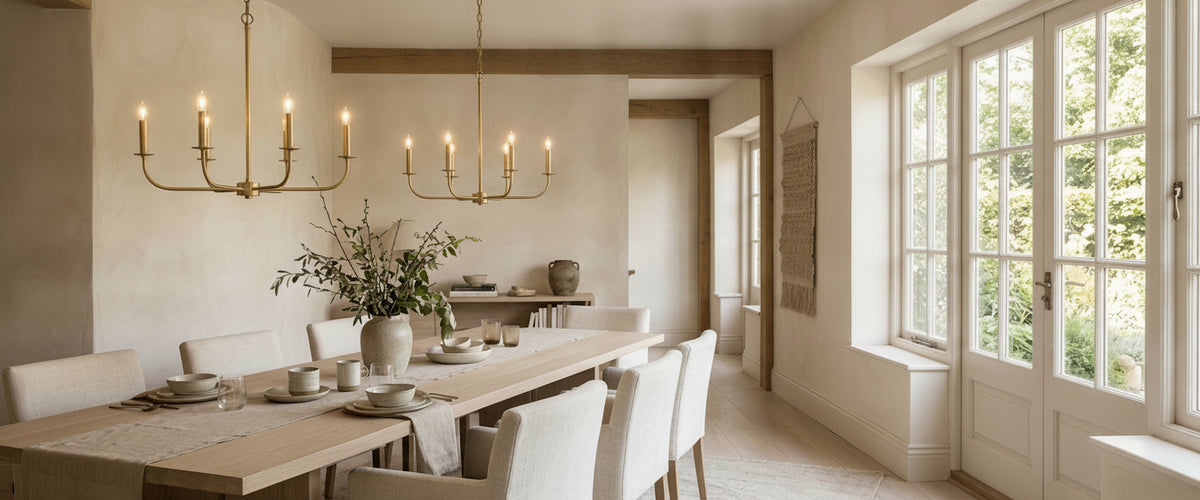

Most brass chandeliers in the dining room hang too high. They get approved from the doorway, and nobody checks the view from a chair. This guide shows how to choose the brass chandeliers dining room tables deserve by finish and size, then where to set the drop so seated guests see each other instead of the bulbs. The short version: pick a fixture about one-half to two-thirds of the table's width. Keep its lowest point 30 to 36 inches (76 to 91 cm) above the tabletop under an 8-foot (2.4 m) ceiling, and use dimmable 2700K bulbs. Brass pulls the eye, so every mistake shows. Get the numbers right and it becomes the warmest thing in the house.
At a glance
Finish: polished brass sparkles, satin brass glows, and antique brass recedes. Under warm LEDs, satin is the safest all-rounder.
Size: for dining room brass chandeliers, the table matters more than the room, so work from the table. A fixture roughly one-half to two-thirds the table's width is a sound starting point.
Height: the bottom of the fixture usually sits about 30 to 36 inches (76 to 91 cm) above the tabletop under an 8-foot (2.4 m) ceiling.
Long tables: past about 8 feet (2.4 m), two smaller fixtures often beat one big one.
Bulbs: 2700K or warmer, high CRI, and a dimmer matched to the lamps.

Why Brass Reads Warmer Above a Dining Table
Brass in a hallway or kitchen is mostly lit from above or beside, by daylight or overhead downlights. Over a dining table it does something different. The table bounces light back up into the metal, the candles and glassware add small reflections, and the room around it is usually dimmed. That is the secret of the brass chandeliers dining room designers love most: light reaches them partly from below, bounced off the table, and that is when the metal turns honey-colored instead of yellow.
That is also why so many of the brass chandeliers dining room clients choose at Niori pair the metal with alabaster and natural stone. A brass frame holding alabaster shades gives you two kinds of warmth. The metal throws back crisp highlights, and the stone diffuses the bulb into a soft, even light with the veining showing through. On a dining table the effect is flattering to faces, which matters more here than in any other room. Nobody wants to look gray over dinner.
Brass outlines, alabaster softens: a flattering combination over a dining table.

Polished, Satin and Antique Brass Under Warm LED
Of all the choices behind the brass chandeliers dining room buyers shortlist, finish decides how loudly the fixture announces itself once the lights go down.
Polished Brass
Polished brass acts like a mirror. Under warm LED it throws pinpoint glints across the ceiling and picks up every candle flame on the table. It suits formal rooms and darker walls, where the reflections have something to read against. The catch is glare: exposed bulbs inside polished arms can produce hot spots right at eye level for seated guests. Shaded or diffused lamps fix that.
Satin and Brushed Brass
Satin brass scatters light instead of bouncing it. The surface glows rather than sparkles, which is why satin is the easy default for the brass chandeliers dining room designers specify in modern and transitional schemes. In the studio we shoot sample finishes under the same warm-white lamps, and satin brass is the one that looks the same in the photo as it does in the room. Polished and antique both shift more with the camera, and with your eye.
Antique and Aged Brass
Antique brass has a darker, toned surface that reads almost bronze at night. It is the quietest of the three and works well where the shade material should carry the show, such as alabaster or seeded glass. Unlacquered or living finishes will keep darkening with handling and air. The Canadian Conservation Institute's guidance on cleaning and waxing brass explains why over-polishing strips metal over time. Care for lacquered dining room brass chandeliers is simple: a dry microfiber cloth is usually all they need.
Sizing Brass Chandeliers for the Dining Room by the Table, Not the Room
The old formula of adding the room's length and width in feet and calling that the chandelier diameter in inches works for an entry hall. It fails with dining room brass chandeliers, because they relate to the table, not the floor plan. A 14-foot room with a compact round table needs a modest chandelier. A narrow room with a long refectory table may need something much longer than the formula suggests.
Start with the table width. A chandelier around one-half to two-thirds of that width looks deliberate and keeps arms clear of anyone standing up from a chair. Then check the length: leave at least 12 inches (30 cm) between the outer edge of the fixture and each end of the table, so the light pools over the plates rather than spilling onto the floor.
Visual weight matters as much as diameter. An open brass frame with slim arms reads smaller than its measurement, while a cluster of solid alabaster bowls reads larger. If you are torn between two sizes of an airy brass dining room chandelier, the larger one is usually right. With heavy stone shades, go smaller. Browsing the full lighting collection side by side with your table measurements makes this comparison much easier than judging one product photo at a time.
Drop Height and Sightlines: The Measurement Most Buyers Get Wrong
This is the number we are asked to sanity-check most often, and the usual error is the same every time: brass chandeliers dining room owners hung too high. The standard starting point is 30 to 36 inches (76 to 91 cm) from tabletop to the lowest point of the chandelier under an 8-foot ceiling. Add roughly 3 inches (7.5 cm) for each additional foot of ceiling height.
Then sit down. The real test is seated sightlines: you should be able to see the person opposite without looking through the arms, and the bulbs should not be visible below the shades from a chair. A client in Austin sent us a photo of a new brass dining room chandelier hung a full 44 inches above the table because "it looked right from the doorway." At the table, guests were staring straight into the lamps. Dropping it 10 inches fixed both the glare and the proportions.
Measure from the table, not the floor, and remember that table heights vary. Leave the final adjustment until the table is in place, and ask your electrician to set the chain or rod so it can still be shortened.
One Statement Piece or a Pair Over a Long Table?
Round, square and standard rectangular tables usually need just one brass dining room chandelier, and a single fixture gives the room a clear center. Once a table runs past about 8 feet, a single fixture large enough to cover it can overpower the room, and the ends of the table fall into shadow anyway.
A pair solves that. Divide the table length into thirds and hang each fixture over a third point, or space them so the gap between them roughly matches the distance from each fixture to the table end. Each piece should be smaller than the single option would have been, often by a third. Among the brass chandeliers dining room clients hang this way, compact three-light designs with seeded glass, such as the Winslow 3 Light Chandelier in Natural Brass, work well because a matched pair reads as one composition, while the glass keeps the light sparkling instead of heavy.
A matched pair spaced at the third points keeps a long table evenly lit.
A linear dining room brass chandelier is the third route for long tables. It gives even coverage but less drama. Choose it when the table is the hero; choose a pair when the lighting is.
Coordinating Brass in an Open-Plan Scheme Without Over-Matching
In open-plan homes, the brass chandeliers dining room guests look up at share a sightline with kitchen faucets, cabinet pulls, stair rails and switch plates. The temptation is to match everything. Resist it. Five identical brass finishes in one view look like a catalog page, and slight differences between manufacturers become obvious when the tones sit side by side.
Pick one dominant brass for the pieces people notice: the chandelier, perhaps the faucet. Let fixed hardware sit a step quieter, so a brushed brass switch plate or matte brass downlight trims next to a polished chandelier reads as related, not cloned. Stone and alabaster bridge the gap. On the dining wall, a brushed brass double wall light with alabaster shades, like the Velaris 2 Light Double Alabaster Wall Light, ties the chandelier to the kitchen hardware through color rather than an exact finish match. Our alabaster lighting range is built around this idea, with stone doing the softening and brass doing the outlining.
A useful rule for dining room brass chandeliers: the sightline around them should hold no more than two brass tones, plus one non-metal material (stone, glass or wood) between them.
Bulbs, Dimming and Safe Installation
Warm white is non-negotiable over a dining table. Use 2700K lamps, or warm-dim LEDs that drop toward 2200K as you dim, which makes brass glow the way it would under candlelight. Look for a CRI of 90 or above so food and skin tones look natural. Small exposed bulbs inside brass arms should be frosted or low-glare.
Always put the brass chandeliers dining room guests sit under on a dimmer. Light at full power is too harsh over dinner, so check that the LED lamps are listed as dimmable and compatible with your dimmer; the U.S. Department of Energy's guidance on LED lighting notes that not every LED works with every dimmer. Mismatches cause flicker and buzz.
The stone-shaded brass chandeliers dining room clients love can be heavy. Installation, including checking that the ceiling box or support can carry the weight, should always be carried out by a qualified electrician. This is not a DIY job, however simple the wiring diagram looks.
Buyer's Checklist Before You Order
Measure the table width and length, and note the ceiling height.
Decide on the finish by how it will look dimmed: polished for sparkle, satin for glow, antique for quiet.
Check the diameter of your dining room brass chandelier against one-half to two-thirds of the table width.
Plan the drop at 30 to 36 inches above the table, adjusted for ceiling height.
For tables over about 8 feet, compare a pair against one large fixture.
Confirm the fixture weight and ask your electrician about ceiling support.
Choose dimmable 2700K or warm-dim lamps with high CRI and a matched dimmer.
Limit brass tones in the open-plan sightline to two.
If you need a custom size, finish or stone shade, request a tailored quote; budget depends on material, scale, engineering, installation and finishing.
The brass chandeliers dining room guests sit beneath have the hardest job of any fixture in the house. Each one earns its place only when it is sized to the table and hung for people who are sitting down, then lit warm enough to flatter the food and the faces. Get those right and the finish becomes the easy part. Niori designs and ships alabaster and natural-stone lighting with brass detailing worldwide, and our team is always happy to check measurements before you commit.