
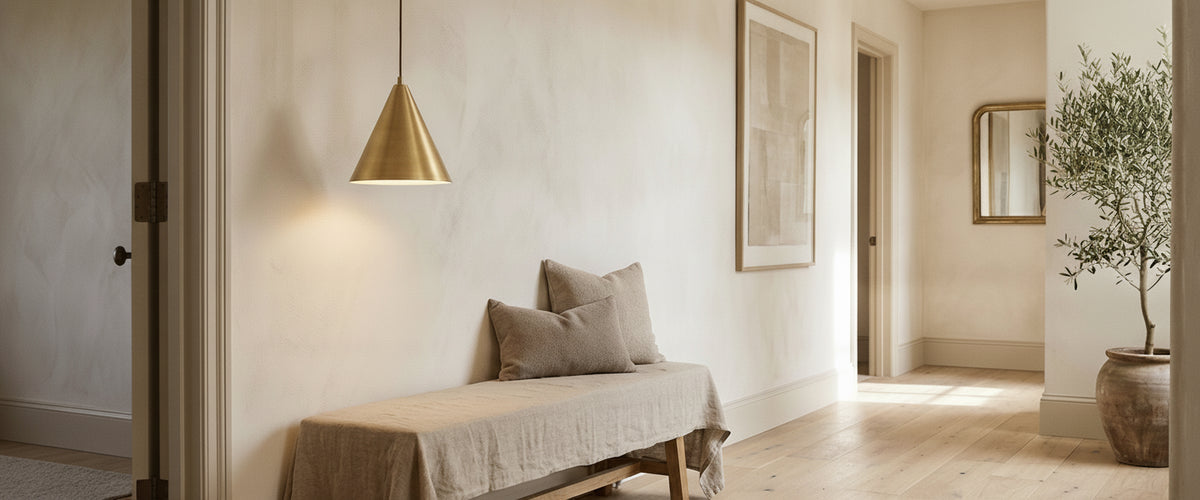

Most people choose a brass ceiling lights the way they choose a pendant: from a product photo taken at eye level. Then it goes up, sits a hand's width from the plaster, and everyone in the house looks at it from directly underneath for the next fifteen years. That change of angle is the whole story. A flush or semi-flush brass fitting behaves differently from the same metal hanging on a flex, and the rooms where it shines are rarely the ones buyers expect.

At a Glance
- A brass ceiling light suits hallways, landings and bedrooms with ceilings under about 2.4 m (7 ft 10 in), where a pendant would eat into headroom.
- Satin and antiqued brass cope with overhead viewing better than polished, which shows hot spots and fingerprints from below.
- Size the backplate to hide the ceiling rose completely. A visible white rose ring behind warm metal looks unfinished.
- Pair warm brass with 2700K lamps at CRI 90 or above.
- A glass panel diffuser cuts glare and changes how warm the metal reads. Opal glass and alabaster soften; clear and seeded glass sparkle.

What Changes When Brass Moves from Pendant to Ceiling Fitting
On a pendant, brass is a silhouette. You see its outline against the room, the light falls below it, and the metal is mostly in shadow. Pull that same metal up to the ceiling and three things shift at once.
First, the viewing angle. You now see the underside of the fitting, the part product photography rarely shows. The diffuser, the lamp holder and the inside of any shade become the face of the light. Second, heat. With no drop, warmth from the lamp gathers between the fitting and the plaster, which is one reason LED lamps make far more sense in a close-mounted brass fitting than old incandescent ones. Third, load and fixing. A pendant hangs from a hook or rose; a flush fitting is screwed directly to the ceiling, and heavier designs need a secure fixing into a joist or a suitable support rather than plasterboard alone.
Any new fitting, or any change to an existing ceiling point, should be installed by a qualified electrician. That matters even more with metal fittings, which must be properly earthed.
Polished, Satin and Antiqued Brass Under Overhead Light
Brass is an alloy of copper and zinc, and the ratio between the two shifts its colour from pinkish gold to pale yellow (the Copper Alliance has useful background on how copper alloys behave). What matters on a ceiling is how the surface handles reflection.
Polished Brass
Polished brass acts like a mirror. At eye level that reads as glamour. Overhead, it picks up the lamp as a hard point of light and throws it back at you, so you see a bright speck rather than a warm surface. It also shows every fingerprint left during a bulb change. Polished works best when the lamp is fully hidden behind a diffuser, so the metal reflects soft light rather than a filament.
Satin Brass
Brushed or satin brass spreads reflections across its grain, which turns a hard highlight into a gentle sheen. Seen from below, it looks evenly warm. For most homes this is the safest finish for a brass ceiling light, and it ages quietly.
Antiqued and Unlacquered Brass
Antiqued finishes reflect far less light than polished or satin, so they read darker and richer on a ceiling. Unlacquered brass keeps changing as it oxidises. In a hallway that is a feature; in a bathroom it can turn patchy faster than owners expect. Lacquered versions hold their colour and only need a dry, soft cloth. Skip abrasive polishes, which strip lacquer and leave cloudy marks.
Where a Brass Ceiling Light Wins Outright
Hallways
Hallways are where a pendant most often fails. Doors swing, coats get carried through, and tall visitors duck. A close-mounted brass ceiling light gives the same warmth with none of the clearance problems, and a run of two or three along a long Victorian hall reads as rhythm rather than repetition.
Landings
Landings are seen from below on the stairs and from the side at the top, so the fitting is viewed from more angles than anywhere else in the house. Satin brass with an opal or alabaster diffuser holds up from every one of them. A common mistake is a small pendant hung so it lines up with eye level halfway up the stairs, which means every trip upstairs involves looking straight into the bulb. A semi-flush fitting with a proper diffuser solves the problem at once.
Low-Ceiling Bedrooms
In a 1930s semi or a loft conversion with ceilings around 2.3 m (7 ft 6 in), a pendant over the bed feels oppressive and a recessed downlight feels clinical. A flush brass ceiling light sits between the two. Choose a diffused design so the light washes the ceiling rather than shining down onto pillows, and put it on a dimmer.
Backplate Diameter and Ceiling Rose Colour
This is the detail that gives away a rushed installation. If the backplate is smaller than the existing ceiling rose, or the fitting sits slightly off-centre on an old patched rose, you get a ring of white plastic or cracked paint around the base of an otherwise beautiful brass ceiling light. Measure the rose, or the scar it has left, before you buy, and choose a backplate that covers it with a little to spare.
Colour matters too. A brass backplate against brilliant white ceiling paint has a crisp edge. Against a warm off-white or a painted ceiling, it blends. If your ceiling has decorative plaster mouldings, a brass fitting looks best centred inside the moulding with clear space around it. Crowding the plaster makes both look smaller.
Why 2700K at High CRI Is the Only Pairing Worth Making
Put a 4000K lamp in a warm brass ceiling light and the metal turns greenish and slightly grey. It is one of the most common disappointments with new fittings: a lovely satin brass piece that looks dull because it was fitted with a cool white lamp. At 2700K the light carries enough red and amber to bring out the gold in the metal, which is why it remains the default for living spaces.
Colour temperature is only half of it. CRI (colour rendering index) measures how faithfully a light source shows colour. Lamps at CRI 90 or above, ideally with a strong R9 value for reds, keep brass looking like brass rather than painted yellow. The Lighting Industry Association publishes guidance on LED quality that is worth a look before you buy lamps in bulk. Check the lamp is dimmable if your circuit has a dimmer, and that the dimmer is rated for LED loads.
Glass Panel Diffusers: Glare, Warmth and What You Actually See
Because a ceiling fitting is viewed from below, the diffuser does most of the visual work. A glass panel ceiling lights uses flat or gently curved panels set into a brass frame, and the type of glass changes everything.
- Clear glass shows the lamp, so you get sparkle and some glare. Pair it with a decorative filament lamp and a dimmer.
- Seeded or textured glass breaks up the lamp into a soft glitter. Lively, but still bright when viewed directly. Where the ceiling is high enough for a short drop, a compact seeded-glass design such as the Winslow 3 Light Chandelier in natural brass lifts that glitter away from the eye line, so it reads as sparkle rather than glare.
- Frosted or opal glass hides the lamp completely and gives an even glow. Brass frames around opal glass ceiling light panels read cooler than you might expect, because the white glass dominates.
- Alabaster diffuses like opal glass but carries its own warmth and natural veining, so the fitting looks warm even switched off.
That last point is why we often steer clients towards brass with natural stone rather than glass ceiling light panels in bedrooms and landings. Alabaster's slight honey tone sits naturally beside brass, and the light it passes is noticeably softer on the eye. You can see how different pieces handle this in our alabaster lighting collection, where brass detailing frames the stone rather than competing with it. Ceiling glass light panels still make sense in kitchens and bathrooms, where you want crisp, even task light and an easy-clean surface.
How to Choose a Brass Ceiling Light: Decision Criteria
- Ceiling height. Under about 2.4 m, go flush. Between 2.4 m and 2.7 m (8 ft 10 in), semi-flush gives more presence without crowding.
- Viewing angle. If people mostly look up at it from directly below (landings, stairs), prioritise a full diffuser over a decorative frame.
- Finish. Satin for most rooms, antiqued for period homes and dark ceilings, polished only behind an opaque diffuser.
- Diffuser material. Clear or seeded for sparkle, opal for even task light, alabaster for warm, low-glare ambient light.
- Room conditions. Bathrooms need an IP rating suitable for the zone. Ask your electrician to confirm before buying. Where the zone calls for a fully sealed fitting, a plain IP65 design such as the Beno Ø220 round LED ceiling light is often the more sensible choice, with brass kept for the landing or bedroom next door.
- Budget. Cost depends on material, scale, finish and how complex the fitting is to make and install. For bespoke or stone-diffused pieces, request a tailored quote.
Before-Installation Checklist
- Measure the existing ceiling rose and check the backplate covers it.
- Confirm the fixing point can take the weight of the fitting.
- Buy 2700K, CRI 90+ lamps in the correct cap type.
- Check dimmer compatibility with LED lamps.
- Book a qualified electrician; metal fittings must be earthed.
- Keep a soft, dry cloth for cleaning. No abrasives, no ammonia sprays on lacquered brass.
A brass ceiling light earns its place when it is chosen for the angle it will actually be seen from. Get the finish, diffuser and lamp right and it will glow warmly in rooms where a pendant would only get in the way. If you are weighing brass against other materials for a whole-house scheme, explore the wider niori lighting range to see how alabaster, marble and brass work together across pendants, wall lights and ceiling fittings.