
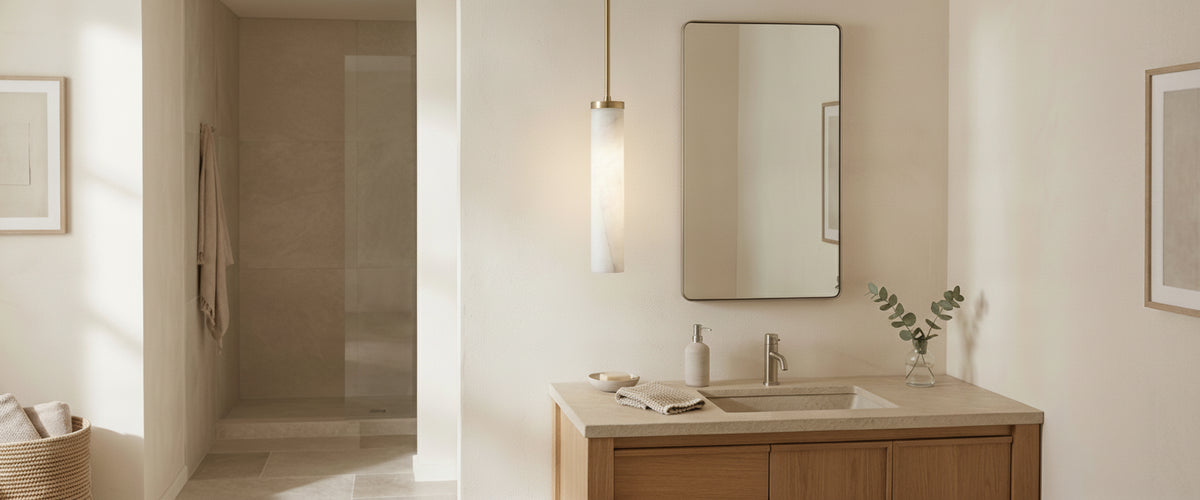

The bathroom that fills every mood board has a freestanding bath, a glowing pendant above it and not a cable or IP label in sight. That image has sold a lot of bathroom hanging pendant lighting, and plenty of those pendant lights have ended in awkward conversations with electricians. A pendant can be the best decision in a bathroom or the most expensive one to undo. Whether one works comes down to where it hangs and what the shade is made of, and the rest of the lighting plan matters just as much.

Key Takeaways
Check the zones first. UK wiring regulations divide a bathroom into zones, and anything hanging near a bath or shower needs a suitable IP rating, usually IPX4 or better.
Height decides the brief. A pendant over a vanity and a pendant over a bath are different jobs with different rules.
Steam is the slow enemy. Opal glass and sealed fittings shrug it off. Alabaster is beautiful but belongs away from direct splash and constant condensation.
Never rely on one pendant over the mirror. Light from above throws shadows down the face. Light from the sides fixes it.
Always use a qualified electrician. Bathroom circuits need RCD protection and, in England, work near the bath or shower is usually notifiable.

IP Ratings Before Aesthetics: What the Bathroom Zones Permit
Pick the shade last. The first question with any bathroom hanging pendant lighting is where the fitting sits in relation to water. UK regulations under BS 7671, the IET Wiring Regulations, answer that with zones.
Zone 0 is inside the bath or shower tray itself. Pendants have no place here.
Zone 1 is the space directly above the bath or shower, up to 2.25 metres (about 7 ft 4 in) from the floor. Fittings here need at least IPX4.
Zone 2 extends 0.6 metres (about 2 ft) beyond Zone 1 horizontally, again up to 2.25 metres. IPX4 is the minimum, and IP44 is the sensible specification.
Outside the zones there is no specific IP requirement. Steam does not read the regulations, though, so a sealed or moisture-tolerant fitting is still wise.
The IP code itself is simple once you know it. The first digit covers solids, the second covers water. IP44 means protected against objects over 1 mm and against splashing from any direction. If a pendant has no IP rating at all, treat it as a fitting for outside the zones only, whatever the showroom says. Your electrician makes the final call on where each boundary falls, because sloping ceilings, shower screens and walk-in enclosures all change the geometry.
Over the Vanity or Over the Bath: Two Heights, Two Briefs
People talk about bathroom hanging pendant lighting as if it were one category, but pendant lights for bathroom spaces really split into two jobs that behave differently.
Bathroom Vanity Pendant Lights
A basin usually sits outside Zones 1 and 2 unless it is close to the shower. That frees you to drop bathroom vanity pendant lights low, roughly to eye level, which is exactly where they do the most good. Hung either side of the mirror, a pair behaves like wall lights with more presence. Scale matters more here than anywhere else in the room. For a flanking pair, a compact opal shade such as the Vetra Opal Glass Small Pendant Light, Black is closer to the right proportion than a broad dome, which crowds the mirror. Confirm its rating against the zone before ordering. Leave enough clearance that nobody catches a shade with an elbow while drying their hair, and check the drop against the height of the tallest person who uses the room.
A Pendant Over a Freestanding Bath
Over a bath, the brief flips. Many UK bathrooms have ceilings of around 2.4 metres (about 7 ft 10 in), which leaves very little room above the 2.25-metre line. In practice, a pendant here either hangs within Zone 1 and carries a proper IPX4 rating, or it sits entirely above that line as a short-drop or near-flush fitting. Period houses and barn conversions with tall ceilings are where pendant lighting in bathroom settings really earns its reputation. There you get a generous drop, a single glowing form, and enough height that the fitting never looms over your head while you soak. If the shade comes down below 2.25 metres, it still needs IPX4.
With a tall ceiling, bathroom hanging pendant lighting over the bath can drop low and still clear your head.
Shade Materials That Survive Daily Steam
Steam is where most bathroom hanging pendant lighting quietly fails, and this is where we are more opinionated than most retailers, because we sell stone and we know its limits. Alabaster is a form of gypsum, a soft mineral that is slightly soluble in water and sits at just 2 on the Mohs hardness scale. That softness is what lets craftsmen turn it so thin it glows. It is also why constant condensation can leave a chalky, slightly roughened surface over time.
The typical failure looks like this. An alabaster shade hung directly over a shower enclosure can, after a couple of winters, develop a faint sugary texture inside the bowl where droplets have sat and evaporated again and again. Nothing cracks, but the polish goes. The same shade in a hallway would last for generations.
So here is how we rank shade materials for bathroom pendant light fixtures:
Opal and frosted glass: the safest bet near water. It is non-porous and easy to wipe, and opal glass diffuses light softly enough to sit comfortably at eye level.
Sealed metal with a glass diffuser: brass, chrome or powder-coated finishes hold up well, provided the fitting is properly rated. Unlacquered brass will patinate faster in humid air, which some people love.
Marble and onyx: harder than alabaster and less sensitive to moisture, though still porous. Good outside the zones in a well-ventilated room.
Alabaster: keep it outside the zones, away from the shower, in a bathroom with a working extractor. In a large principal bathroom with good ventilation, an alabaster pendant over a vanity or dressing area gives a warmth that glass cannot quite match.
Where the bathroom already runs on chrome taps and polished brassware, a glass pendant with a plated finish keeps the metalwork consistent and wipes down as easily as the fittings below it. Something like the Slice Glass Pendant Light, Chrome suits that kind of room better than a mixed-metal piece that would fight the taps. Its IP rating still decides how close it can hang to the bath or shower.
If you want that stone glow, browse our alabaster lighting with placement in mind, and choose pieces for the drier end of the room.
Why a Single Pendant Over the Mirror Is Usually a Mistake
The most common misstep with bathroom hanging pendant lighting looks tidy on a plan: one pendant, centred above the basin, mirror below. In use, it lights the top of your head and the bridge of your nose, then throws shadows under your eyes and chin. Shaving, applying make-up or checking a contact lens all become harder. Worse, a bright shade hanging in front of the mirror often reflects straight back at you, so you get glare on top of shadow.
There are exceptions. A wide, softly diffusing pendant hung well forward of the mirror can work in a bathroom where the mirror is purely decorative. For any basin where people get ready each morning, though, one overhead pendant should never be the only light.
Layering Pendants with Wall Lights for a Flattering Mirror
The fix is to bring light in from the sides, at face height. That can mean a pair of pendants flanking the mirror, a pair of wall lights, or a pendant over the bath with wall lights doing the close-up work at the basin. Side light fills in the shadows that top light creates, and it lands on your face rather than bouncing off the glass.
A flanking pair puts light at face height, which is where bathroom hanging pendant lighting earns its place at the basin.
For hotels and busy family bathrooms, there is a combination we recommend often. Opal glass pendants rated for Zone 1 go over the baths, and stone wall lights go either side of each basin mirror, well clear of the showers. That gives a soft overall glow from above and an even, flattering light at the mirror, while the glass over the bath can be wiped down daily. Add a low-level glow, such as a lit niche or under-vanity strip, and the room works at 7am and at midnight.
Bulbs, Colour Temperature and Dimming
Pendant lighting for bathroom use needs two moods: clear and accurate for getting ready, calm for a bath. Warm white around 2700K suits stone and opal glass, bringing out the honey tones in alabaster and onyx. Look for a colour rendering index (CRI) of 90 or above so skin tones read true in the mirror.
Put the pendants and the mirror lights on separate switches, with dimming on the pendants at least. A dimmed alabaster or onyx shade at bath time gives the warm, low glow people buy stone for. Check that bulbs and dimmers are compatible. Use enclosed-rated LED lamps in sealed fittings, since heat builds up faster inside an IP-rated housing.
How to Choose Bathroom Hanging Pendant Lighting: A Buyer's Checklist
Before you commit to any bathroom hanging pendant lighting, run through these questions:
Which zone will it hang in? Mark the bath, shower and basin on a plan and ask your electrician to confirm the zones.
What IP rating does it carry? IPX4 or IP44 is the minimum anywhere near water. No rating means outside the zones only.
What is the ceiling height? Under 2.4 metres, think short drop or flush. Above it, a longer pendant becomes possible.
How well ventilated is the room? Weak extraction rules out alabaster close to the bath or shower.
Is the mirror lit from the sides? If not, add wall lights or a flanking pair of pendants.
Will the finish suit humidity? Lacquered or plated metals stay brighter. Unlacquered brass will darken.
Can it be cleaned easily? Glass wipes clean in seconds. Carved stone needs a softer approach.
Budget depends on material, scale, engineering and finishing, as well as the work needed to install it. If you are lighting several bathrooms in a house or hotel, the wider lighting collection is a good place to shortlist glass and stone pieces side by side before requesting a tailored quote.
Fitting and Care
Installing bathroom hanging pendant lighting is not a DIY job. Bathroom circuits need 30mA RCD protection, and ceiling supports must carry the weight of a stone shade. In England, work within the bath and shower zones, and any new circuit, is notifiable under Part P of the Building Regulations. Use a qualified electrician who can certify the work.
Care is simple if you keep it gentle. Wipe glass with a soft, barely damp cloth. Dust alabaster, marble and onyx with a dry microfibre cloth. Keep cleaning sprays, bleach and limescale removers well away from stone, since acids etch it quickly. Run the extractor for twenty minutes after every bath or shower. Your mirror stays clearer, and so does your pendant.