
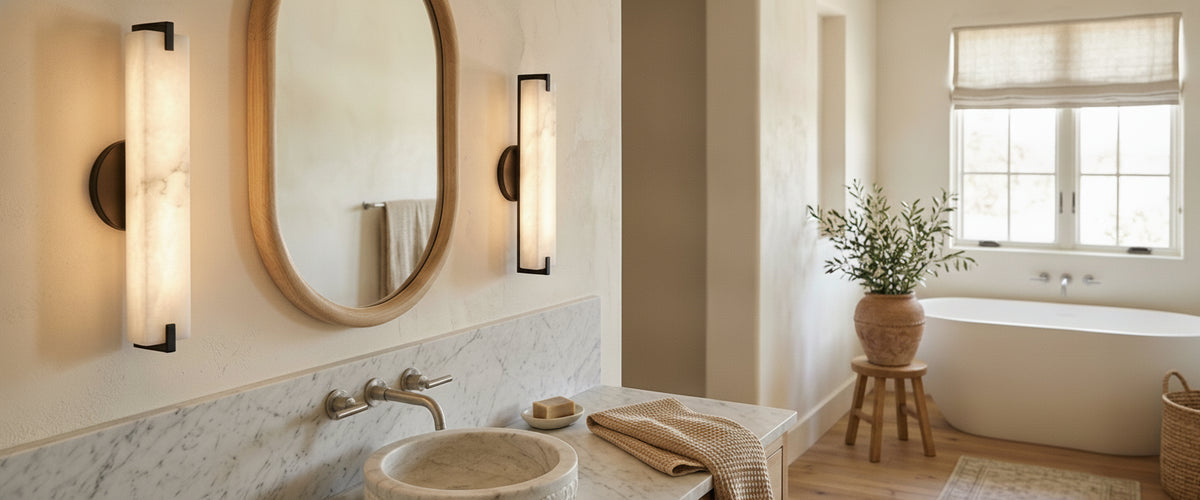

Most bathroom lighting goes wrong in one place: the mirror. You can hang a bathroom wall sconce exactly where it looks balanced on the elevation drawing and still end up shaving or putting on make-up under light that cuts shadows into every line of your face. Plan around the mirror first, and the other choices (IP rating, shade material, mounting height) follow from it.
At Niori we make alabaster and natural-stone lighting, so we spend a fair amount of time talking customers out of putting beautiful stone in the wrong spot. This is the advice we give most often.

Quick Answer: Choosing a Bathroom Wall Sconce
- Mirror first: two sconces flanking the mirror at roughly eye level give the most even light on the face.
- Check the zone: in UK bathrooms, fittings near the bath or shower need a suitable IP rating. IP44 is the usual minimum in zones 1 and 2.
- Match the material to the room: alabaster gives the softest glow but needs good ventilation and a spot clear of direct splash.
- Height: centre flanking sconces around 1.5 to 1.7 m (about 60 to 67 in) from the finished floor.
- Use a qualified electrician: bathroom electrics are a special location under UK wiring regulations and are not a DIY job.

Why the Mirror Position Overrules Every Other Placement Instinct
Most people place wall lights the way they would in a hallway, spacing them evenly along the wall or lining them up with the tiles. In a bathroom that instinct works against you. The mirror is the one spot where you stand still, face the wall and need to see clearly, so it decides where the light goes.
Start by marking the mirror's final position, including its frame, before anyone chases cables into the wall. If the mirror is still undecided at first fix, the electrician has to guess, and you end up with sconces that miss the frame by 10 cm (about 4 in) or sit at the wrong height for the person who uses the basin most. We see this more than any other mistake. A mirror cabinet, a round mirror and a wide rectangular mirror each need different sconce positions, so pick the mirror before you choose wall lights for bathroom use.
Flanking Versus Overhead: What Each Does to Shadows on the Face
A single light above the mirror falls on the top of your head. Your brow, nose and chin each throw a shadow downwards, which makes you look tired and makes close tasks harder than they should be. Ceiling downlights over the basin do the same, only more harshly.
A bathroom wall sconce on each side of the mirror lights the face from the sides at roughly face height. The shadows from each side cancel each other out, and the light falls evenly across cheeks and jaw. That is why the best bathroom wall lights fixtures for a vanity are almost always fitted in pairs. A diffusing shade improves things again. A bare bulb or a clear glass globe creates hard edges and glare in the mirror, while a translucent stone or frosted shade spreads the light over a wider area and softens it.
Overhead still has its uses. In a narrow cloakroom with no wall either side of the mirror, a well-diffused fitting above the glass is a reasonable fallback. Choose one that throws light outwards and downwards across the face rather than straight down.
IP Ratings and Steam Exposure, and Why Finish Fails Before the Fitting
The IP code is a two-digit rating. The first digit covers protection against solid objects and the second covers protection against water, as set out in the IEC's guide to ingress protection ratings. UK bathrooms are divided into zones. Zone 0 is inside the bath or shower tray. Zone 1 is directly above it, up to 2.25 m. Zone 2 extends 0.6 m (about 24 in) horizontally beyond zone 1. Any light for bathroom wall positions in zones 1 or 2 needs an appropriate rating, typically IP44 or higher, and IP65 where water jets are likely. Outside the zones there is no strict requirement, but a rated fitting is still the safer choice in a small, steamy room.
What the ratings don't tell you is how the finish will age. An IP44 fitting can work safely for years while its surface starts looking tired within months. Unlacquered brass above a freestanding bath is the classic example: in a steamy room it can go from bright gold to a mottled caramel in a single season. The fitting still works perfectly. It just no longer matches the taps.
Plated finishes can pit, painted metal can blister along the seams, and condensation can collect inside a closed shade and leave tide marks. Look at extraction and how long steam hangs in the room as well as the rating label. A bathroom wall sconce opposite a rainfall shower deals with very different conditions from one in a well-ventilated en suite with a window.
How Stone, Glass and Metal Shades Handle Humid Bathroom Light
Alabaster
Alabaster gives the warmest, most even glow of any shade material we work with. A lit alabaster shade looks like it is glowing from within rather than holding a bulb. It is also the most sensitive to humidity. Most decorative alabaster is a fine-grained form of gypsum, which is soft and slightly soluble in water. Repeated condensation can dull the surface or leave a chalky bloom on the side facing the shower. If you choose an alabaster bathroom wall sconce, keep it to the basin wall, away from direct splash, in a room with a working extractor fan. Within those limits it suits a principal bathroom very well, and you can browse shapes and sizes in our alabaster lighting collection.
Marble and Onyx
Marble and onyx are both harder than gypsum and cope better with moisture. Onyx in particular lets light through in deep amber and honey bands, which looks warm against cool tiles. Both are still porous. Wipe off splashes and avoid acidic cleaners, which can etch the polish.
Glass
Glass is the easiest material to live with in a bathroom. It does not absorb moisture and wipes clean in seconds. Frosted or opal glass diffuses well. Clear glass looks crisp but will show every water spot and can cause glare in the mirror. Where the basin wall calls for something lower-maintenance than stone, look for a glass shade on a brushed rather than polished frame, such as the Bubble LED Glass Wall Light in Brushed Gold. A brushed surface hides fingerprints and water marks far better than mirror-bright metal. As with any fitting, check the IP rating against the zone before you order.
Brass and Metal Detailing
Lacquered brass holds its colour longer in steam. Unlacquered brass will darken, which some people like and others don't. Make the choice on purpose, and pick the finish of your bathroom wall light sconces with the taps and handles in mind. If you want the warmth of gold without committing to a living patina, a matt finish like the one on the Funk Hourglass Wall Light sits comfortably beside brushed taps and throws far fewer sharp reflections into the mirror than polished metal.
Mounting Height and the Vanity: The Measurements Most Buyers Skip
Mounting height is about where the light falls on your face, so set a bathroom wall sconce by the person who uses the basin, not by the ceiling.
- Centre height: aim for the middle of the shade at roughly 1.5 to 1.7 m (about 60 to 67 in) from the finished floor, close to eye level for most adults.
- Distance from the mirror: leave around 5 to 15 cm (2 to 6 in) between the mirror frame and the edge of each shade, so the light reaches the face without crowding the glass.
- Spacing: a pair works best roughly 75 to 100 cm (30 to 40 in) apart. Much wider and the centre of the face falls into shadow.
- Projection: check how far the fitting sticks out from the wall. A deep shade beside a narrow basin can catch shoulders and towel hooks.
- Finished floor level: measure from the finished floor, not the screed. Thick tiles and underfloor heating can raise it.
Measure these before you order. The product page will give the fitting's own dimensions, and your electrician needs the backbox positions to match.
When a Single Centred Sconce Is the Right Call (and When It Isn't)
A single centred bathroom wall sconce makes sense in three situations: a small cloakroom where a pair would crowd the wall, a narrow mirror under about 50 cm (20 in) wide, or as a decorative light where task lighting comes from somewhere else. It also works well above a mirror in a wide, shallow room where there is no wall space at the sides.
In a cloakroom where the sconce is there for atmosphere rather than grooming, scale matters more than output. A compact fitting such as the Briller LED Wall Light Small in Gold with Amber Spheres suits a short stretch of wall far better than a large multi-arm piece, and the amber tint keeps the glow warm rather than clinical.
It is the wrong choice above a double vanity, where one light cannot reach two faces, and in any bathroom where someone does detailed grooming each day. For a double basin, use three or four sconces: one each side and one or two between the mirrors. Alternatively, flank each mirror with its own pair.
Bathroom Lights and Wall Lights: The Checklist Before You Buy
Plan your bathroom lights and wall lights as one scheme rather than separate purchases. Go through this list before you choose a bathroom wall sconce or any other wall lights for bathroom use:
- Zone: is the position within zone 1 or 2? If so, confirm the IP rating on the specification.
- Ventilation: does steam clear within about ten minutes? If not, choose glass or harder stone over alabaster.
- Mirror fixed: are the mirror size and position decided before first fix?
- Diffusion: will the shade soften the bulb, or will it glare in the mirror?
- Bulb and dimming: a warm white LED of around 2700K to 3000K suits stone shades. Choose dimmable LEDs and a compatible dimmer so you can turn the lights down for evening baths.
- Finish: does it match the taps, and are you happy for it to age?
- Budget: cost depends on material, scale, carving complexity, engineering, installation and finishing. For bespoke or large projects, request a tailored quote.
If you are lighting the whole home in one style, it helps to see bathroom options next to pendants and lamps for other rooms. Our full lighting range lets you match stone and metal finishes from room to room.
A well-placed bathroom wall sconce makes a daily routine easier in a small but real way. Fix the mirror, respect the zones, pick a material that suits how steamy the room gets, and then let the light do its work.