
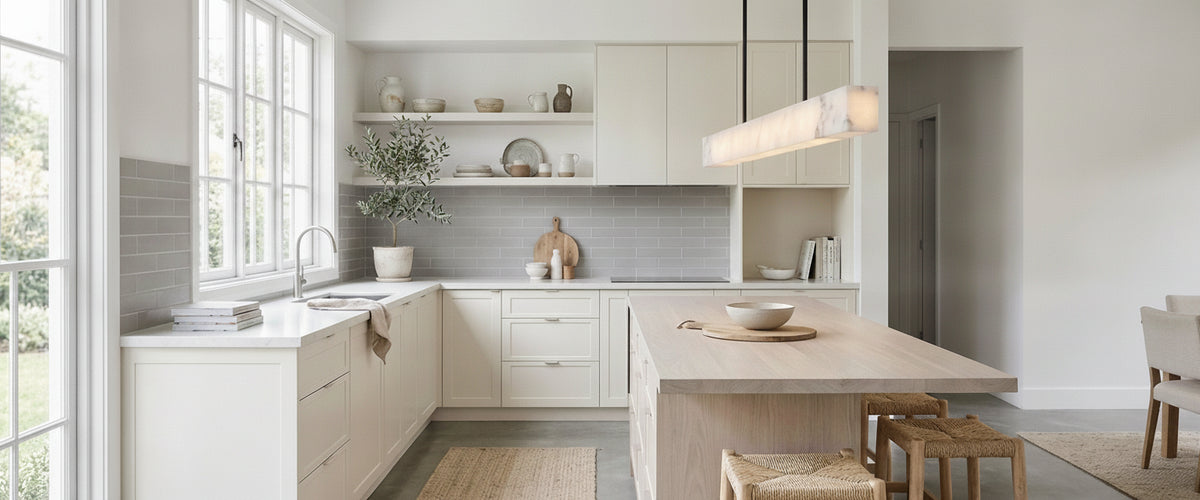

A 10-foot (3 m) island lit by one modest pendant floating somewhere near the middle is the single most common lighting error we see in project photographs. The fixture is fine. The proportion is wrong, so half the working surface sits in shadow and no amount of dimming fixes it. Linear pendant lighting exists precisely to solve that problem: one continuous body of light that matches the geometry of a long surface instead of arguing with it. Getting linear pendant lighting right comes down to length, height, diffusion and driver quality, in that order.

Key Takeaways Before You Specify
Length: aim for a linear pendant light roughly two thirds to three quarters of the island or table length, and never shorter than half.
Height: 30 to 35 in (75 to 90 cm) above the surface is a starting point, not a rule. Ceiling height, sightlines and room depth override it.
Diffusion: alabaster and stone linear pendant lights glow along their whole length; bare tubes and metal shades throw light in pools with gaps between.
Dimming: most flicker complaints come from the driver and dimmer pairing, not the lamp.
Finish: one warm metal plus one stone reads well in kitchens, dining rooms and hospitality spaces alike.

What Genuinely Makes a Pendant Linear
A linear pendant light is a single fixture with one continuous body, suspended from two or more drops, designed to distribute light along a horizontal axis. That continuity is the whole point. A row of three separate pendants is a perfectly good solution, but it behaves differently: three cones of light with shadow troughs between them, three sets of cables to align, three chances for one drop to sit a third of an inch (8 mm) lower than the others and nag at you every evening.
The practical differences matter more than the aesthetic ones. A linear bar is leveled once. A row of singles has to be leveled, spaced and aligned relative to the island edge, the ceiling joists and each other. On plastered ceilings with unhelpful joist positions, a linear pendant light often wins simply because its two canopy points can be positioned where the structure allows, while the visible body stays where the design wants it.
There is also a light-quality difference worth naming. In alabaster, a linear form gives you something a cluster cannot: an unbroken band of warm, softly shifting glow, where the stone's veining reads across the full run. Where a run is short or the layout is irregular, a staggered cluster such as Opaz 3 Light Cluster Pendant is the more honest answer, since it accepts the gaps between light sources instead of pretending to be continuous. We stock both approaches across the niori lighting range, but for long islands and refectory tables, continuous linear pendant lighting is usually the more disciplined solution.
Matching Fixture Length to the Surface Below
The two failure modes of linear pendant lighting are predictable. Undershooting produces the floating-lozenge effect: a 3 ft (90 cm) fixture over a 10 ft (3 m) island, leaving the ends of the countertop in gloom and the composition looking apologetic. Overshooting is rarer but worse, because a fixture that runs almost the full length of a table crowds the ends and makes the room feel low.
Work from the surface, not the ceiling. Measure the island or tabletop length, take two thirds to three quarters of that figure, and treat the result as the target length for your linear pendant light. An 8 ft (2.4 m) island suits something in the region of 63 to 71 in (1.6 to 1.8 m). A 6 ft (1.8 m) dining table sits comfortably under 47 to 53 in (1.2 to 1.35 m). Leave at least 6 in (15 cm) of clear surface at each end so the fixture reads as centered rather than crammed.
Width deserves a thought too. On a narrow galley island, a slim stone bar keeps the visual mass down, and where the ceiling is low or the budget will not stretch to a solid stone span, a lightweight multi-light bar such as Priscila 5 Light Glass & Steel Bar Pendant holds the same horizontal line with far less visual depth. On a wide entertaining island of 43 in (1.1 m) or more, a shallow, broader linear pendant light balances better and spreads light further toward both edges. And always check the centerline of the fixture against the centerline of the countertop, not the ceiling. Kitchen islands are very often not centered in the room, and hanging to the ceiling grid is how you end up with a light that looks 4 in (10 cm) off from every seat at the table.
Why the 30 to 35 Inch Hanging Rule Breaks Down
The standard advice, 30 to 35 in (75 to 90 cm) from the top of the surface to the bottom of the fixture, was written for rooms with ceilings around 8 ft (2.4 m). It holds up well there. With linear pendant lighting, it starts to fail in two situations that dominate contemporary projects.
The first is open-plan. When the island sits in a sightline that runs through to a sofa or garden doors, a linear pendant light hung at 30 in (75 cm) becomes a visual barrier from the seated position. Drop it lower and you cut the view; raise it and you lose the intimacy. The fix is to hang at the upper end of the range, 34 to 35 in (85 to 90 cm), and choose a slimmer profile so the fixture reads as a line rather than a block. A shallow alabaster bar does this far better than a deep drum.
The second is double-height and vaulted ceilings. Here the conventional height leaves linear pendant lighting stranded in empty air. As a working method, we look at the wall behind the island and aim to place the fixture so it occupies roughly the middle third of the visible wall area rather than the top quarter. In a barn conversion with a 17 ft (5.2 m) ridge, the by-the-book height of 34 in (85 cm) left the pendant floating; the composition only resolved once the fixture came down to just under 28 in (70 cm), because the eye needed something anchored at human scale.
Two more checks before you commit to a linear pendant light. Sit down at the table and look across it; if you can see the lamp source or a hard glare edge, the fixture is too high or the diffuser is too thin. Then stand at the range and swing an imaginary tall stock pot. Clearance for heads is easy; clearance for arms and cookware is what people forget.
Diffuser, Bare Tube or Shade
How light travels along linear pendant lighting is decided by what sits between the lamp and your eye.
Stone or Alabaster Diffusers
Alabaster is a fine-grained form of gypsum, soft enough to be worked to a translucent section and dense enough to scatter light rather than transmit it harshly. Gypsum is a sulfate mineral, which explains both the glow and the vulnerability to water; the British Geological Survey publishes the UK mineral profiles if you want the geology in full. Lit from within, a stone linear pendant light becomes the light source itself: even along its length, no visible hotspots, and a color that warms slightly as it passes through the mineral. This is the best option over dining tables, where people sit facing the fixture for two hours at a time.
Bare Tubes and Exposed Lamps
Sharper and more directional, with a more contemporary edge. Good over prep areas where you want punch on the countertop. Poor anywhere people sit at eye level with it, unless the lamp is deeply recessed or shielded. Bare-source linear pendant lights also show every fingerprint and every dust line.
Metal or Fabric Shades
These push light straight down and give almost nothing upward, so the ceiling above stays dark and the room can feel heavier than expected. Useful in high-ceilinged commercial rooms where you want defined pools on the tabletop and darkness above. Less successful in a home kitchen that also needs general ambient light.
A blended approach often wins. Stone diffusion for the pendant, then discreet recessed downlights or under-cabinet strips doing the task work. Linear pendant lighting sets the mood and the vertical anchor; it should not be asked to light your chopping board at 400 lux.
Finish Pairings That Travel Between Kitchen, Dining and Commercial Rooms
Finish decisions look cosmetic and behave structurally, because linear pendant lighting is long and therefore highly visible from several rooms at once in open-plan layouts.
Alabaster with aged or antique brass: the most forgiving pairing. Warms up cool gray stone countertops, sits happily against oak, and reads as considered rather than showy in restaurants and hotel bars.
White marble with blackened steel: crisper and more architectural. Works in city apartments and pared-back schemes; can feel cold in a north-facing room unless the lamp temperature is kept warm.
Honey onyx with polished brass: high drama, best reserved for dining rooms and hospitality, where the amber veining has a dark surround to glow against.
Chrome and glass: still the right call in some contract interiors, particularly where the rest of the hardware is already chrome. It is unsentimental and easy to specify at scale.
One discipline saves a great deal of trouble: pick one metal and repeat it in the faucets, handles and any wall lights in the same sightline. Mixing two warm metals within a single open-plan volume rarely reads as deliberate. If the linear bar over the island is aged brass, a secondary fixture over the breakfast table in the same warm register, such as Esparta 3 Light Pendant in Aged Gold Leaf, keeps the two zones speaking the same language without repeating the same silhouette. If you are building a scheme around a single stone material, the alabaster lighting collection is a sensible place to check that pendants, wall lights and table lamps can be matched in tone before you commit to the big piece.
Specifying Flicker-Free Dimming for Linear Pendant Lighting
Here is where linear pendant lighting quietly goes wrong. A long fixture usually carries an integrated LED board or several lamps on one driver, which means the load is larger and the dimming behavior less forgiving than a single decorative pendant.
The common faults are all pairing faults. A trailing-edge LED dimmer matched to a driver expecting leading-edge control gives you buzzing and a dead zone at the bottom of the dial. A dimmer rated for a 250 W incandescent load may have a minimum load of 10 W that a 12 W LED barely clears, producing flicker at low output. And where one dimmer runs the pendant plus six downlights from three different manufacturers, the mismatched drivers fight each other.
Ask three questions before you buy linear pendant lighting: is the driver dimmable and by which protocol (mains dimming, 1-10 V or DALI), what is the minimum and maximum load of the proposed dimmer, and can the supplier confirm a tested-compatible dimmer model. For dining applications, specify a driver that dims smoothly to 5 percent or lower; alabaster looks its best at around a quarter output, when the stone glows and the veining appears. Anything that dies at 20 percent will frustrate you every evening. Installation and final circuit work should always go to a qualified electrician, and the guidance from Electrical Safety First is a reasonable primer on why that matters.
Pre-Order Checklist
Measure the surface length and width; calculate two thirds to three quarters of the length for your linear pendant light.
Confirm the surface centerline, not the room or ceiling centerline.
Check ceiling height and decide your hanging height from seated sightlines, not a generic number.
Confirm the drop suspension is adjustable on site, and by how much.
Check weight against ceiling construction. Stone fixtures are heavy and drywall alone will not do.
Decide diffusion type against how the room is used, then plan supplementary task lighting.
Choose color temperature: 2700K for dining and evening rooms, up to 3000K for working kitchens.
Get written dimmer compatibility confirmation before the electrician roughs in.
Ask about spare parts and whether the stone panels can be replaced individually.
Request a tailored quote. Cost on stone pendants depends on material, span, engineering, finishing and installation complexity, so a like-for-like figure only exists once the piece is specified.
Living With a Stone Linear Pendant
Alabaster and onyx reward light handling. Dust the upper surfaces with a soft dry brush every few weeks, because horizontal linear pendant lights collect more dust than vertical fixtures and the build-up dulls the glow before you consciously notice it. Never use vinegar, ammonia, bleach or generic bathroom sprays; acidic and alkaline cleaners etch gypsum stone permanently. If a mark needs more than dusting, use a barely damp lint-free cloth and dry immediately.
Over a range without good extraction, expect grease to reach the fixture. That is a specification decision as much as a cleaning one: over a busy cooking zone, choose glass or metal diffusion and keep the stone for the dining end of the room. It is the recommendation we make most often, and the one people are gladdest of a few years in. If you want to compare options across pendants, chandeliers and wall lights in one place, start from the Niori homepage and work down by room.
Specified properly, linear pendant lighting does something no cluster quite manages: it draws a single confident line through the busiest part of a home, and then disappears into the architecture until the moment you dim it.