
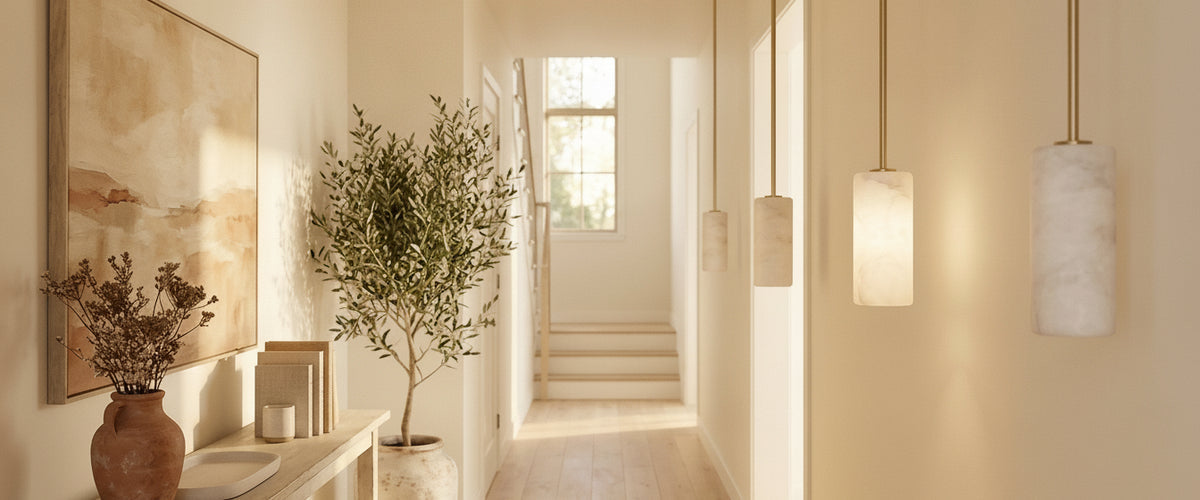

A hallway pendant is judged before your guests have taken their coats off. They see it from the front door, pass beneath it, and then look back at it from the stairs. Hallway pendant light fixtures carry more pressure than almost any other fitting in the house. Most of the mistakes we see come from proportion, not taste: a beautiful shade hung four inches too low or a fixture sized for a living room squeezed into a 3 ft (90 cm) passage.
At Niori we make alabaster and natural-stone lighting, and hallway pendant light fixtures bring us more anxious questions than any other room. Here is the advice we give clients, set out in the order you will need it.
Quick Answer
Clearance: keep at least 7 ft (2.1 m) between the floor and the lowest point of the fixture wherever people walk.
Low ceilings: on an 8 ft (2.4 m) ceiling, the whole fitting including its suspension should be about a foot (30 cm) deep, or less.
Diameter: in a narrow passage, aim for no more than roughly a third of the corridor width. In an open entrance hall, add the room's length and width in feet and use that figure, in inches, as a starting diameter.
Long corridors: use two or three smaller hallway pendant light fixtures spaced about 6 to 8 ft (1.8 to 2.4 m) apart rather than one large one.
Light quality: a warm 2700K dimmable LED behind an alabaster shade gives the soft, even glow that suits a space you see at eye level.

Why Hallways Expose Pendant Proportions Other Rooms Forgive
In a dining room, a pendant hangs over a table. The table sets a natural boundary, and nobody walks into the shade. A hallway gives you no such buffer. A hallway pendant light fixture sits directly in the line of travel, often at the exact height where tall visitors notice it. The walls are also close enough to throw the shape back at you as shadow.
Hallways are long and narrow, so your eye reads a pendant against the full length of the space. A shade that looks generous in a showroom can look like a bulkhead in a terraced hall. A fitting that is too small in a double-height entrance looks like an afterthought. Choosing a pendant light for hallway use starts with the space, not the catalog photo.

Hallway Pendant Light Fixtures and Ceiling Height: The Numbers
With hallway pendant light fixtures, begin with clearance. The working figure we use is 7 ft (2.1 m) from finished floor to the underside of the fitting, measured where people actually walk. If the pendant hangs above a console table or into a stair void that nobody passes under, you can bring it lower. Over the walkway, 7 ft is the minimum.
From there, the arithmetic depends on ceiling height:
8 ft (2.4 m) ceilings: common in post-war and new-build homes. You have about 12 in (30 cm) to play with, and that includes the ceiling cup and any rod or cable. Choose a short-drop or semi-flush design and let the stone shade do the work.
9 to 10 ft (2.7 to 3 m) ceilings: typical of Victorian and Edwardian townhouses. Hang the base of the fitting at around 7 ft to 7 ft 6 in (2.1 to 2.3 m). Pendants that sit too high in tall halls look like they are retreating from the room.
Double-height entrance halls: hallway pendant light fixtures here should read from the landing as well as the doormat. We usually set the lowest point roughly level with, or just above, the first-floor landing line, while still keeping 7 ft clear over any route underneath.
Measure at the actual ceiling point, not the average room height. Older houses in Bath or Edinburgh can vary by more than an inch from one end of a hall to the other, and hallway pendant light fixtures hung on a cable show every bit of that.
Stair Voids, Low Ceilings and Awkward Wiring Positions
Stair voids are where hallway pendant lighting either sings or fails. The temptation is a very long drop down the center of the stairwell. That can work beautifully. Remember, though, that people climb past it, so you need clearance from the stair pitch line as well as from the floor. Stand on each tread and check where your head meets the fitting.
A mistake we see often: a tall alabaster pendant ordered for a stairwell, measured from the hall floor, with no allowance for the stairs. Four treads up, everyone is the best part of 80 cm closer to the shade. Usually an electrician spots it on the day. The fix is to shorten the suspension so the fitting hangs in the turn of the stair, visible from both floors. Done well, a hallway pendant light fixture placed there becomes the best-lit spot in the house.
Low ceilings call for restraint in hallway pendant light fixtures. A shallow alabaster bowl or a short-drop dome in natural stone gives soft downlight and a glow across the ceiling plane. That makes a low hall feel taller. A tall cylindrical or tiered shade does the opposite.
Awkward wiring positions are the third trap. Ceiling points in older homes are often off-center or placed where a previous owner had a different layout. Moving a point before your hallway pendant light fixtures go up is usually straightforward for a qualified electrician, but it needs to be planned before the plaster is decorated, not after.
Narrow Passage or Open Entrance Hall: Choosing the Silhouette
In narrow passages, hallway pendant light fixtures need to look slim from below and from the side. Small globes, compact domes and slim cylinders all work. They let light spill onto both walls without crowding the head height. Where a corridor runs longer than about 12 ft (3.7 m), a row of two or three matching fittings looks deliberate and lights the far end properly. One central pendant leaves the ends in gloom. For a run of matching fittings where weight and diameter both need to stay modest, a small opal glass shade such as the Vetra Opal Glass Small Pendant Light in Gold diffuses light in a similar spirit to stone, and its warm metalwork sits comfortably beside brass elsewhere in the hall.
Open entrance halls can take hallway pendant light fixtures with more presence. A wider alabaster bowl, a small multi-light chandelier or a stone pendant with brass detailing gives the room a focal point the moment the door opens. Where you would rather have a graphic outline than a carved bowl, a geometric form like the Spar Single Pendant Light in White & Gold gives the same pull from the doorway without adding visual bulk. Here the sizing rule of length plus width in feet, translated to inches of diameter, gives a sensible starting point. Adjust down if the hall is already busy with joinery, artwork or a staircase. If you want to compare forms side by side, the full alabaster lighting collection is a useful place to see how bowls, domes and globes differ in visual weight.
Do not forget the walls. In very narrow halls, the best pendant lighting for hallway use is often a single modest pendant at the entrance with alabaster wall lights carrying the light down the passage. That keeps the ceiling clear and brings glow to eye level.
Finish and Shade Opacity at Eye Level
Few fittings are seen as closely as hallway pendant light fixtures. On the stairs, your eye may be level with the shade or even above it. That changes what matters.
Alabaster is a fine-grained form of gypsum, and its translucency is why it has been carved into lamps and windows for centuries. Lit from within, it shows its veining and gives a diffused, warm light with no hot spot. That matters in a hallway, because a bare or clear-glass bulb at eye level dazzles anyone coming downstairs. Onyx, cut thin, can be even more translucent and more dramatic, with stronger banding. Marble is denser and lets less light through, so it suits pendants where most of the light goes downward and the stone itself reads as sculpture.
One observation from the studio: alabaster hallway pendant light fixtures look their best under warm light. Under a 4000K lamp the stone can look gray and slightly chalky. At 2700K it turns the honey and cream tones that people buy it for. Choose a dimmable LED and check that it is compatible with your dimmer. A hallway often needs to go from welcoming brightness in the evening to a low night-light glow at 2am.
Metal finishes on hallway pendant light fixtures are seen up close too. Brushed or aged brass on a ceiling cup and suspension sits naturally with alabaster. Polished finishes show fingerprints from installation, so ask your electrician to wear gloves or wipe the metalwork before they leave. Matt finishes are more forgiving: in a broad entrance hall with dark joinery or black ironwork on the stair, a solid shade such as the Funk Stout Large Pendant Light in Matt Black holds up to close viewing from the landing, though at that scale it belongs in an open hall rather than a narrow passage.
The Installation Details Buyers Overlook Until the Electrician Arrives
Stone is heavy, and hallway pendant light fixtures in solid alabaster or marble can weigh a good deal more than a glass or fabric shade of the same size. A standard plastic ceiling rose clipped into plasterboard is not the right fixing. The fitting should be secured into a joist or a properly rated support, and the installation should always be carried out by a qualified electrician who can confirm the circuit, the fixing and compliance with current UK wiring rules.
Other details that catch people out:
Suspension length: confirm whether the cable or rod can be shortened on site, and by how much, before you order.
Ceiling cup size: an old ceiling may hide a damaged rose or a patched hole. A larger cup covers more.
Two-way switching: halls and stairs usually have switches on two floors. Make sure your dimmer arrangement works from both.
Access: stairwell pendants need a safe way to reach them for bulb changes and dusting. Plan this before installation, not after.
For care, dust alabaster hallway pendant light fixtures with a dry, soft cloth or a soft brush. Gypsum is soft, sitting at around 2 on the Mohs scale, and it is sensitive to water, so never use damp cloths, sprays or cleaning products. A well-kept stone shade ages gently. It does not wear out.
A Buyer's Checklist Before You Order
Measure ceiling height at the exact pendant point, plus floor-to-tread heights on any stairs below.
Confirm at least 7 ft (2.1 m) clear beneath the fitting over every walking route.
Measure hall width and decide between one pendant or a row of smaller ones.
Choose a silhouette that suits the space: slim for passages, broader for open halls.
Pick the stone for the light you want: alabaster for soft diffusion, onyx for drama, marble for sculptural downlight.
Specify a warm, dimmable LED and a compatible dimmer, working across two-way switching.
Ask about weight and fixing, and book a qualified electrician who has seen the product details.
Budget for hallway pendant light fixtures depends on the stone, the size, the complexity of carving and any metalwork, plus installation. For larger entrance halls or multi-pendant schemes, we recommend asking us for a tailored quote. If you are still comparing fitting types across the house, our wider lighting range includes wall lights and lamps that work alongside a hallway pendant.
Get the drop right and the rest follows. The best hallway pendant light fixtures are rarely the largest or the boldest. They are the ones sized to the space, hung at the right height and lit warmly enough that the stone glows rather than glares.