
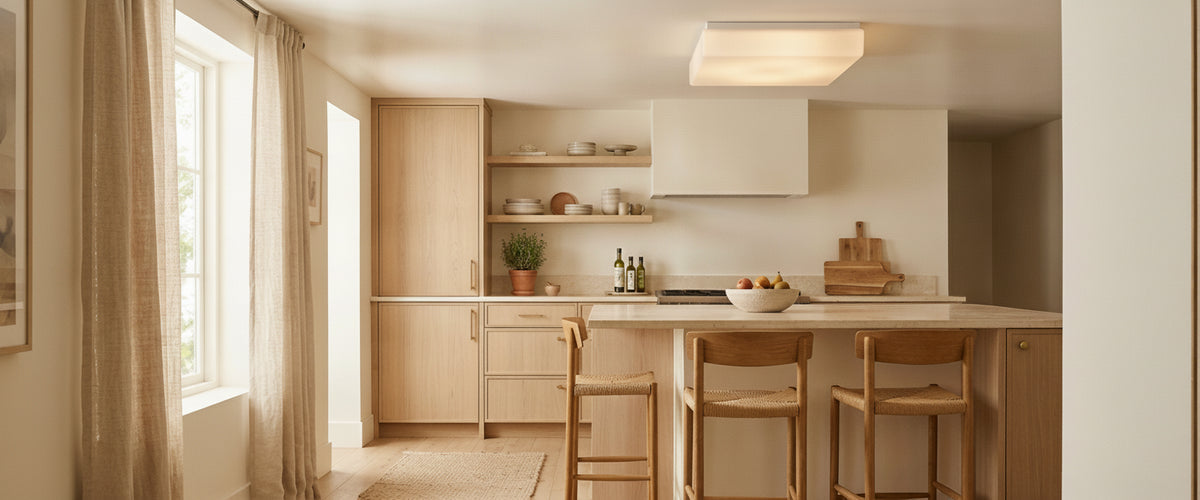

Most rooms with a 2.4-metre ceiling end up with the same fitting: a plain glass dome screwed tight to the plaster, bought in a hurry and never thought about again. That is a missed opportunity. A glass flush mount is one of the few fixtures that controls the entire ceiling plane in a low room, and the glass itself decides whether it reads as soft daylight, a warm evening glow or a coloured panel overhead. Choose well and nobody notices the ceiling height. Choose badly and you live under a glaring disc.
At Niori we spend our days with alabaster and natural stone, materials that hold light inside themselves and release it slowly. Glass behaves differently. Seeing exactly where the two diverge will help you buy better, whichever material ends up on your ceiling.

Glass Flush Mount Essentials at a Glance
- Opal and milk glass diffuse light evenly and hide the lamp; clear glass shows it.
- Stained or antique glass turns the fitting into a focal point but delivers less usable light.
- Low ceilings (around 2.4 m / 7 ft 10 in or less) are where a flush profile earns its place.
- Colour temperature shifts inside glass; opal tends to cool the light slightly, so a 2700K lamp behind opal often reads closer to 3000K.
- Check diameter, rose cover and glass thickness before you fall for a shape.

Milk, Opal and Clear: How Opacity Changes the Light Before the Bulb Matters
Opal glass is made with additives that scatter light inside the material, so the whole surface glows rather than one bright point. Milk glass is the denser, more opaque cousin, popular in mid-century kitchens and hallways, and a milk glass ceiling lights gives a chalky, even light with almost no visible hotspot. Clear and lightly frosted glass sit at the other end: more light gets through, but so does the shape of the lamp, which means the bulb you choose becomes part of the design.
The Corning Museum of Glass keeps a useful glass dictionary if you want the technical distinctions, but the practical rule is simple. The more opaque the glass, the softer the shadows and the less you notice the fitting is there. That softness is why opal glass was historically pitched as an affordable stand-in for alabaster.
Hold the two side by side and the difference is obvious. In the studio we regularly put an opal bowl next to an alabaster one with the same 2700K lamp inside. The opal reads clean and slightly milky white. The alabaster glows amber at the thicker edges and almost peach through the thinner veins, because natural stone filters light unevenly. If you love the even calm of opal but want that living, mineral warmth, it is worth exploring our alabaster lighting before you commit to glass.
Why Antique and Stained Glass Turn a Ceiling into a Focal Point
A stained glass ceiling light (or the “stain glass ceiling light” many people search for) works on a different brief. You are buying colour and pattern first and illumination second. Amber, rose and deep green panels absorb a good share of the output, so a stained fitting rarely works as the only light source in a working room.
Where it shines is in hallways, landings and period front rooms, where the ceiling is part of the architecture. Picture a leaded glass flush mount in a Victorian terrace hallway, chosen to echo the original fanlight above the front door. It does almost nothing for reading. It does everything for the hallway. Pair it with a couple of plug-in table lamps for actual light: treat stained glass as a decorative layer and plan task lighting separately.
Antique and reeded glass sit in between. The texture breaks up the lamp image without killing output, so you get sparkle on the ceiling and a gentle pattern cast onto walls.
What a Low Profile Does at 2.4 Metres That a Deeper Bowl Cannot
At standard UK ceiling heights, every centimetre a fitting drops is a centimetre that tall guests notice. A glass flush mount sits tight to the plaster, so it keeps clear headroom and preserves the horizontal line of the ceiling. A deeper bowl or semi-flush fitting casts more light sideways onto walls, which can make a room feel larger, but at 2.4 metres it also starts to feel like an obstacle in the middle of the room.
If you have a little more height to play with, the calculation changes. Where a room needs that sideways spill but still wants the calm of a diffused glass body, a compact semi-flush opal fitting such as the Vetra 1 Light Opal Glass Wall/Semi-Flush Ceiling Light in Gold strikes a better balance than a deep bowl or a full pendant.
There is a trade-off. Flush fittings throw most light downwards and leave the ceiling itself a little darker near the edges. In a small room that is fine. In a larger one, it can create a pool-of-light effect that flattens faces. The fix is rarely a bigger ceiling light; it is wall lights or lamps that wash the vertical surfaces.
Where a Glass Flush Mount Holds the Ceiling and Where It Disappears
Hallways and landings. The natural home. Low ceilings, through traffic and no furniture to put a lamp on. Opal for calm, stained glass for character. In a pale hallway where a plain white dome would simply vanish, a two-tone fitting like the Galaxy 1 Light Wall & Flush Ceiling Light in Black & White Glass gives the ceiling a defined graphic edge while keeping the profile tight to the plaster.
Kitchens. Opal or milk glass over the main floor, with separate pendants or under-cabinet lighting for worktops. Clear glass in a kitchen shows grease and dust quickly.
Bathrooms. Choose a fitting with an IP rating suited to its zone: IP44 is the usual minimum in zone 2, while fittings directly above a bath or shower (zone 1) typically need IP65. Ask your electrician to confirm the zone before you order.
Bedrooms. A glass flush mount works well as general light, but it tends to disappear here because most people switch to bedside lamps in the evening. Spend the budget on those lamps instead.
Living rooms. This is where a lone glass flush mount most often fails. One central light in a sitting room reads flat. Use it as a background layer and let alabaster table lamps or floor lamps do the atmospheric work; our wider lighting collection is organised by fixture type if you are building those layers together.
Colour Temperature Inside Glass: Why the Box Figure Is Only a Starting Point
The Kelvin figure on the box describes the lamp in open air. Put it behind glass and the colour you see changes. Amber and tinted antique glass push light noticeably warmer, so a 3000K lamp behind tinted glass can feel close to candlelight. Opal does the opposite in a subtle way: its white body can make light read a touch cleaner and cooler than expected, especially against warm-toned walls.
Our working rule for UK homes:
- Opal or milk glass: 2700K for living spaces and hallways; 3000K in kitchens and bathrooms.
- Amber, smoked or stained glass: 3000K, because the glass will warm it further.
- Clear glass with a visible filament lamp: 2200K to 2700K for a soft look.
Most glass flush mounts are enclosed fittings, so heat builds up. Choose LED lamps rated for enclosed fixtures, and if you plan to dim, pair dimmable lamps with a compatible trailing-edge dimmer. Cheap mismatches cause flicker and hum, and flicker is far more noticeable through a smooth opal diffuser.
Diameter, Rose Cover and Glass Thickness: The Three Numbers Most Buyers Check Last
Diameter. A rough guide is to add the room's length and width in metres and multiply by five for a starting diameter in centimetres, so a 3 m by 4 m room suggests something around 35 cm. Go slightly larger in hallways where the glass flush mount is the only feature, smaller in kitchens that also have pendants. In a larger kitchen or open-plan space where one lamp behind opal would leave the corners dim, a twin-lamp fitting such as the Vetra 2 Light Opal Glass Wall & Semi-Flush Ceiling Light in Matt Black spreads the output more evenly than simply sizing up a single dome.
Rose cover. Many glass ceiling light covers mount to a base plate that needs to hide the old ceiling rose or the mark left by it. Measure any existing outline before ordering. Older homes often have a ghost of a much larger fitting painted around.
Glass thickness. Thicker hand-blown or cast glass diffuses better and feels more substantial, but it is heavier. A heavy bowl needs a secure fixing into a joist or a suitable support, not just the plasterboard. This is one of the most common issues we see with stone fittings too, and the answer is the same: let a qualified electrician assess the ceiling before installation.
Buyer Checklist Before You Order
- Measure ceiling height and confirm a flush profile is genuinely needed.
- Decide whether the fitting is your main light or a decorative layer.
- Pick glass opacity to suit the room: opal or milk for function, stained for character.
- Check the lamp cap type, maximum wattage and whether it suits enclosed LED lamps.
- Confirm dimmer compatibility if you want dimming.
- Check the IP rating for any bathroom or damp area.
- Measure the existing rose footprint and the diameter you need.
- Ask how the glass attaches (thumbscrews, twist-lock or central finial) so cleaning is not a chore.
- Book a registered electrician for installation.
Removing and Cleaning Glass Ceiling Light Covers
Before touching any fitting, switch it off at the wall and at the consumer unit, then let the lamp cool. Most glass ceiling light covers are held by one of three systems: small thumbscrews around a collar, a twist-lock bayonet, or a central finial nut. Support the glass with one hand while you release it with the other; thin cotton gloves give better grip and keep fingerprints off.
Opal and milk glass can be washed in lukewarm water with a little mild washing-up liquid, then dried fully before refitting. Leaded and stained glass should only be wiped with a barely damp soft cloth, because soaking can loosen the cement around the came. Avoid abrasive pads and ammonia-based sprays on any decorative or gilded glass. If a cover will not budge, do not force it; old paint or a cross-threaded screw is usually the culprit, and an electrician can free it safely.
A well-chosen glass flush mount should outlast several redecorations. Pick it for the light it gives as well as the shape it has, layer it with lamps, and it will quietly hold the ceiling for years.