
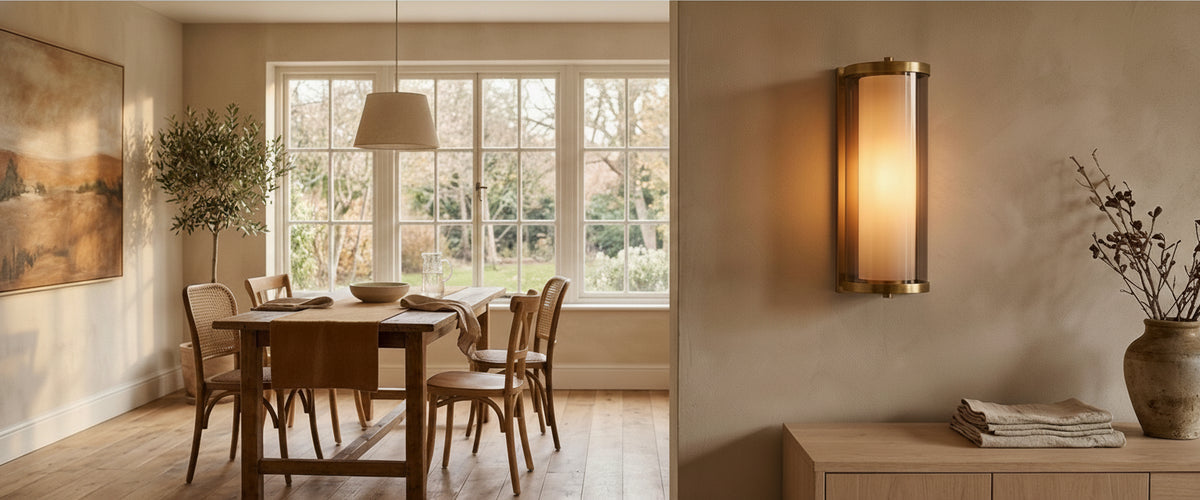

Smoked glass is one of the most misjudged finishes in lighting, because almost nobody chooses it switched on. On a shelf a smoked glass wall lights reads as a cool, grey, faintly moody object. Put a warm bulb behind it on a dark evening and it becomes something else: a bronze or amber glow with the filament hanging inside like a lit ember. That gap between the two states is where most disappointing purchases start. Pick for the switched-on effect and the fitting will reward you for years. Pick for the daytime object and you may end up with a handsome wall ornament that barely lights the room.
At a glance
- Judge smoked glass lit, never unlit. The tint shifts from grey to bronze once a warm bulb is behind it.
- Dense smoke is mood lighting. Light smoke can still do practical work.
- Brass frames and warm, mid-tone walls flatter the tint. Chrome and stark white work against it.
- A warm white bulb around 2700K and a properly matched dimmer matter more than the fitting's shape.
- Confirm glass density, projection from the wall and IP rating before you order.

Why Lit Smoked Glass Looks Nothing Like It Does in the Showroom
Smoked glass is coloured right through, usually during melting, so the glass filters every bit of light that passes through it. Unlit, the only light acting on it comes from the room. That light reflects off the surface and makes the glass look grey, sometimes almost black. Lit, the light passes through the glass from behind, and warm wavelengths survive the trip better than cool ones. That is why a smoked glass wall light that looks steely in daylight turns honey-brown at night.
We see this every week in the studio. A sample sits on the bench looking like a piece of slate; someone flicks the switch and the whole conversation changes. It is also why product photographs can mislead. A smoke glass wall lights shot unlit under bright studio light tells you almost nothing about how it will behave above a sideboard at 9pm in November.

Dense Tint or Light Smoke: How Much Light Actually Escapes
Smoked glass sits on a spectrum, and where your smoked glass wall light lands on it decides whether it is a light source or a lantern.
- Light smoke reads as a pale tea or grey wash. You lose some output, but the fitting still throws useful light and you can read a menu or find your keys beside it.
- Medium smoke is the sweet spot for most homes. The glass glows clearly, the bulb is visible but softened, and the light on the wall has a warm, slightly tobacco-coloured edge.
- Dense smoke is almost a statement of intent. It gives a low, contained glow and very little spill. Beautiful in a bar or a snug; frustrating anywhere you need to see properly.
Thickness matters as much as colour. A thick, hand-blown globe with the same tint as a thin pressed shade will pass noticeably less light. Its walls will also vary in density, which is part of its charm. If you are comparing fittings online, ask for a photo of the light switched on in a dim room. Any specialist supplier should have one.
Where a Smoked Glass Wall Light Earns Its Place, and Where It Suffocates
A smoked glass wall light is at its best in rooms used after dark, where atmosphere is the point. Dining rooms are the obvious home: a pair either side of a mirror or a long sideboard gives a warm, low glow that flatters faces and lets a pendant over the table do the heavy lifting. Snugs, libraries and dark-painted sitting rooms work for the same reason. In bedrooms, a light-smoke wall light either side of the bed makes a good alternative to table lamps when bedside tables are small.
Hospitality is where dense smoke really earns its keep. Hotel corridors, restaurant banquettes and bar backs all benefit from a glow that marks the space without flooding it. One restaurant client in Manchester specified dense smoke along a run of booths and, after the first service, asked for dimmer bulbs, not brighter ones. Diners liked the glow on the glass more than the light on the table.
The rooms it quietly suffocates are the ones that need task light. A north-facing hallway lit only by smoked glass wall lights will feel like a cave in January. Kitchens need clear, even light over worktops, so smoked glass should be an accent there, never the main source. Bathroom mirror lighting is another trap: tinted light across the face makes shaving and make-up guesswork. And in a home office, a dense tint at eye level is simply tiring.
Smoked Glass or Alabaster?
Clients often weigh the two, because both promise warmth. They behave differently. Smoked glass tints the light and lets you see the bulb. Alabaster diffuses it, glowing evenly across the stone with its veining lit from within and no bright point at all. If you want mood with a visible filament, choose smoke. If you want softness that still lights the room generously, natural stone is the better tool, and you can compare the two approaches across our full lighting range. Many of our schemes use both: smoked glass in the dining room, alabaster in the bedroom and hallway where gentler, fuller light is needed.
Frame Finish and Wall Colour: What Amplifies the Tint
On a smoked glass wall light, the metal around the glass changes how you read the colour. Brass, especially aged or brushed brass, pulls the smoke towards bronze and makes the whole fitting feel warm even before it is switched on. Matt black frames make the glass look heavier and more graphic, which suits industrial or very contemporary interiors. Polished chrome and nickel are the hardest pairing: their cool reflections push the smoke towards grey and can make the glow look slightly dirty.
The wall behind matters just as much. Mid-tone, warm colours such as plaster pink, ochre, terracotta and warm greige bounce the amber light back into the room and make the fitting look generous. Deep greens and inky blues absorb a lot of it; the result is dramatic but darker, so go a step lighter on the tint. Bright white walls cause the opposite problem by day. The unlit glass becomes a dark blot on a pale surface, which is fine if you want a graphic accent and odd if you were expecting something discreet.
Bulb Temperature and Dimming: The Two Controls That Decide Everything
Colour temperature is the single biggest lever. Around 2700K is the safe starting point for a smoked glass wall light: warm enough to bring out the bronze, clean enough to avoid muddiness. Drop to 2200K behind dense smoke and the light can turn brown and gloomy. Go up to 4000K and the tint reads cold grey, which defeats the purpose.
Because the bulb is on show, its shape matters too. A clear filament LED gives that suspended-ember look through light and medium smoke. Behind dense smoke the filament may barely register, so an opal LED with slightly higher output is often the better choice. Start brighter than you would with clear glass; you can always dim down.
Dimming is where good schemes go wrong. Use bulbs marked dimmable and pair them with an LED-compatible dimmer, usually trailing-edge. Check the minimum load too, as a single pair of low-wattage LEDs can fall below it and flicker. Have a qualified electrician fit or change the dimmer; it is not a job to improvise. Set properly, a dimmer lets the same smoked glass wall light be practical at 7pm and atmospheric at 11pm.
Glass Density, Fitting Depth and IP Rating: Confirm Before You Order
Three practical details catch people out more than style ever does.
- Glass density. Ask whether the tint is light, medium or dense, and request a lit photo or video. If you are buying in quantity for a project, order one sample first.
- Fitting depth. Check how far the light projects from the wall. In a corridor around 90cm (3ft) wide, a deep globe at shoulder height will be knocked by people and bags. Wall lights are commonly mounted around 1.5 to 1.8m (5 to 6ft) from the floor, but measure against your own furniture and mirrors.
- IP rating. Indoors in dry rooms this rarely matters. In bathrooms, near sinks or outdoors, the IP rating system set out by the IEC tells you how well a fitting resists dust and water. Bathroom zones carry specific requirements, so confirm the rating with your electrician before you commit.
If the warm evening palette is meant to carry through to a porch or garden wall, the fixture decision changes. The fitting has to be sealed first, and only then styled. For a front door that wants the same graphic weight as a matt black frame indoors, a compact weather-rated fitting such as the OBEX Outdoor Wall Light IP55 GU10, Matt Black makes more sense than an indoor wall light with an exposed globe. Some exteriors need the wall itself to glow, the way the masonry catches the light behind smoked glass inside. There, an up-and-down wash from the OBEX Outdoor Up/Down Wall Light IP55 GU10, Anthracite is closer to the right design language. Fitted with a warm 2700K GU10 lamp, it keeps the outside consistent with the rooms you can see through the window.
Common Buyer Mistakes
- Choosing from an unlit product photo and being surprised by the colour at night.
- Relying on smoked glass as the only light in a working room.
- Pairing a dense tint with a deep, dark wall and wondering where the light went.
- Fitting cool-white bulbs and turning a bronze glow into a grey one.
- Ignoring dimmer compatibility and living with flicker or a buzzing switch.
Quick Pre-Order Checklist
- Have I seen this glass lit, in a dim room?
- Is the tint right for how bright this room needs to be?
- Does the frame finish warm or cool the smoke?
- Will my wall colour reflect the glow or swallow it?
- Have I chosen dimmable, warm white bulbs suited to the tint?
- Does the projection suit the corridor or furniture beside it?
- Is the IP rating right for this location?
- Is a qualified electrician booked for installation?
A smoked glass wall light rewards buyers who plan for the evening rather than the shop floor. If you would like help balancing tinted glass with the softer glow of natural stone, explore our alabaster lighting or ask the Niori team for advice on your scheme.