
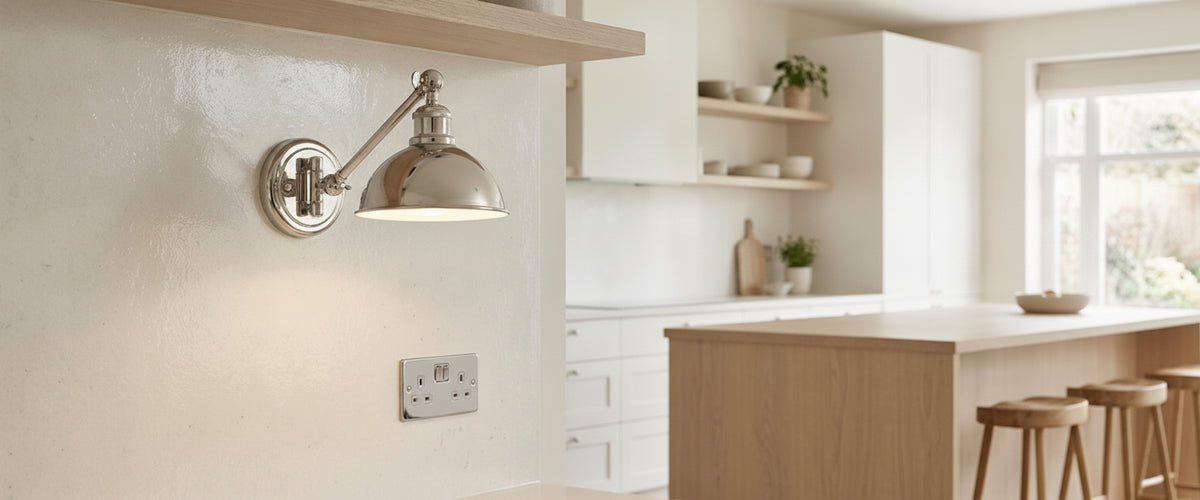

Most people choose a polished chrome plug socket in a showroom under flat, bright light. Then they fit it beside an alabaster table lamp, switch the lamp on at dusk, and find the plate has become the second-brightest thing in the room. Chrome is a mirror. It shows whatever is near it, so the right decision depends less on the plate and more on the walls, the lamps and the hour when you will see it most.
At Niori we design alabaster and natural-stone lighting, so we see a lot of walls at night. A carved stone lamp is often only as calm as the socket it plugs into. This placement guide is written from that angle.

Quick Answer
- Polished chrome reflects. Brushed chrome diffuses. The polished version picks up lamp glow as a hot spot and shows nearby colours faithfully.
- It suits crisp schemes: white or cool grey walls, glossy tile, lacquered joinery, and rooms where chrome or nickel already appears.
- It fights warm, matte schemes such as limewash, antique brass and heavily veined stone, unless you place it with care.
- Screwless plates look cleaner and leave fewer edges for grime to collect.
- Plan for fingerprints. A soft microfibre cloth, used dry, handles most of the upkeep.

Why Polished Chrome Changes Between Daylight and Evening
Chromium is a hard, bright metal, which is why it is plated over brass or steel for a durable, highly reflective finish (the Royal Society of Chemistry has a clear summary of its properties). On a switch plate, that reflectivity means the finish has almost no colour of its own. It borrows colour from its surroundings.
In daylight from a north-facing window, a polished plate reads cool and slightly blue. It sits back against a white wall and looks tidy, almost invisible. Brushed chrome in the same light reads as a soft grey, because the fine grain scatters reflections instead of showing them.
Evening changes everything. Once the room is lit by warm lamps, the polished plate picks up a pinpoint image of every bulb within range. Beside an alabaster lamp, it reflects the stone's amber glow back as a bright smear on the plate. We see this in the studio every time we photograph a table lamp against a sample wall: the brushed plate disappears into the shadow, and the polished one pulls the eye. Neither is wrong. Just decide whether you want the socket noticed after dark.
Where a Polished Chrome Plug Socket Holds Its Own
Polished chrome looks deliberate in rooms that already have a sharp, reflective vocabulary. A polished chrome plug socket feels at home in:
- Bathrooms and dressing rooms with chrome taps, mirrored cabinets and glazed tile, where a brushed plate can look like a mismatch.
- Contemporary kitchens with high-gloss doors, quartz worktops and stainless appliances. Where the worktop doubles as a charging station, a Quad USB Charger Outlet in Polished Chrome Screwless (Grey Insert) keeps phones and tablets off the plug sockets and reads as part of the hardware set rather than an add-on.
- Art Deco and mid-century inspired rooms, where chrome, black lacquer and glass were original partners.
- Hotel corridors and bedrooms that need a clean, consistent finish across many rooms and are cleaned daily.
Polished chrome creates noise in rooms built on warmth and texture: a sitting room with linen upholstery, oak floors, antique brass and a veined onyx lamp. Here a bright plate competes with the very materials meant to set the mood. If you love polished chrome but your scheme leans warm, confine it to bathrooms and kitchens and choose a quieter finish for living spaces.
Matching Polished Chrome Plug Sockets to Your Lighting Finishes
Matching gets harder once the lighting arrives. The rule we give clients is simple: match the family of finish closest to the plate, and let the light source itself be the contrast.
Chrome With Chrome and Nickel
A polished chrome plug socket beside a wall light with polished chrome or polished nickel arms reads as one decision. Nickel is a touch warmer than chrome, but at socket distance most people will not notice. Brushed nickel next to polished chrome is a different story. The difference in sheen shows far more than the difference in tone, and it looks like two suppliers.
Chrome With Alabaster and Stone
Alabaster gives a warm, diffused glow with no hard reflection of its own. Paired with polished chrome, you get a deliberate contrast of soft and sharp, which works well when the lamp has chrome or glass detailing to bridge the two. When the lamp has an aged brass base, the chrome socket below it tends to look like an afterthought. If you are browsing alabaster lighting for a room where the sockets are already chrome, favour pieces with polished metal or clear glass fittings over warm patinated brass.
Avoiding Accidental Contrast
Picture a new alabaster floor lamp placed beside a polished chrome double socket, a brushed steel dimmer and a white plastic TV outlet, all on one wall. Each component is fine. Together they look like three renovations. Specify sockets, switches, TV outlets and USB outlets from one range so that finish, plate profile and insert colour agree. On a media wall, the aerial point deserves the same attention as the double socket beside it: a screwless plate such as the TV Outlet Non-Isolated Coaxial in Polished Chrome Screwless carries the same profile and sheen, so a stray white plastic plate never breaks the line.
Backdrops That Flatter a Mirror-Bright Plate
Because a polished chrome plug socket shows its surroundings, the wall behind it does a lot of the work.
- Bright white and pale grey paint: the plate reflects a clean, neutral field and looks crisp. This is the safest backdrop.
- Deep colours such as navy, bottle green or charcoal: the plate stands out strongly. It can look smart and jewel-like in a dining room, but expect it to read as a feature.
- Glazed and metro tile: gloss meets gloss, and the plate settles in. Check that grout lines do not cut through the back box position before tiling.
- Marble splashbacks: polished chrome sits well on cool white and grey marbles. On warm, heavily veined stone it can look cold.
- Painted or lacquered joinery: a chrome plate inset into a glossy cabinet or bedside panel looks tailored. On raw or oiled timber, it tends to look clinical.
Textured finishes like limewash, clay plaster and grasscloth are the hardest backdrop. The plate's perfect surface exaggerates the texture around it, and the result can feel unfinished.
Period Homes Versus Contemporary Refits
The age of a building changes the calculation. In a Victorian terrace or Georgian townhouse, original details like cornicing, panelled doors and sash windows set a softer, older material language. Polished chrome is a twentieth-century finish, and in a formal period room it can look like a modern intervention. That is fine in a bathroom or a deliberately modern kitchen extension. In a drawing room with ceiling roses and a stone fireplace, many owners prefer aged brass, bronze or a painted plate that disappears into the wall. For listed or sensitive buildings, the Society for the Protection of Ancient Buildings is a useful starting point on making changes with care.
Contemporary refits give you more freedom. Flat-plate and screwless designs with slim profiles suit plaster-skimmed walls and shadow-gap skirting, and polished chrome plug sockets and switches can run consistently through a whole house. Where several lighting circuits meet at a doorway, a single 4 Gang Grid Faceplate in Polished Chrome Flat Plate gathers them behind one slim, mirror-bright plate, which looks far calmer on a skimmed wall than a cluster of separate switches. Interwar and Deco homes are the interesting middle ground: chrome is period-appropriate there, and polished plates can look more authentic than brass.
Fingerprints, Upkeep and Finish Longevity
The mirror finish is both polished chrome's best quality and its weakness. It shows every fingerprint, water spot and smear, and sockets are touched constantly. Kitchens and hallways show it first.
Good plating holds up well over time, because chromium is hard and resists tarnish. The damage usually comes from cleaning, not from use. Abrasive pads, cream cleaners and bleach sprays can haze or scratch the surface, and once polished chrome is scratched, the marks catch light at every angle.
- Turn off at the switch before cleaning, and never let liquid run toward the socket openings.
- Use a dry or barely damp microfibre cloth, then buff dry.
- Skip abrasive and ammonia-heavy products.
- Choose screwless plates so there are no screw heads to collect grime or rust.
- In hotels and rentals, brief cleaning teams; a single wrong spray can dull a whole corridor of plates.
Brushed chrome hides fingerprints far better. If a polished chrome plug socket is going somewhere touched dozens of times a day, such as beside a kettle or a front door, decide honestly whether you will wipe it.
A Buyer's Checklist Before You Order
- Look at a sample at night. Hold it beside the lamp you will actually use, switched on, at the height it will be fitted.
- List every outlet on each wall. Sockets, switches, dimmers, TV and satellite outlets, USB chargers. Order them from one range.
- Check insert colour. Black, white and grey inserts change the look of the plate considerably.
- Match sheen before tone. Polished with polished, brushed with brushed.
- Consider lamp cable runs. Table and floor lamps usually come with a fixed cable length; position sockets so cords do not stretch across a room.
- Use a qualified electrician. Faceplate swaps and new sockets involve mains wiring. Have a registered electrician fit them and check that back boxes suit the plate depth.
- Think about cleaning. Busy surfaces may suit brushed chrome even if the rest of the house is polished.
When you are planning sockets and lighting together, it helps to see fixtures and finishes side by side. Explore the full lighting range with your plate finish in mind, and if a project involves several rooms or a hospitality fit-out, ask us for a tailored quote. A polished chrome plug socket rewards that kind of planning. Placed against the right wall, beside the right lamp, it looks sharp and intentional. Placed carelessly, it is the first thing you notice when the lights go down.