
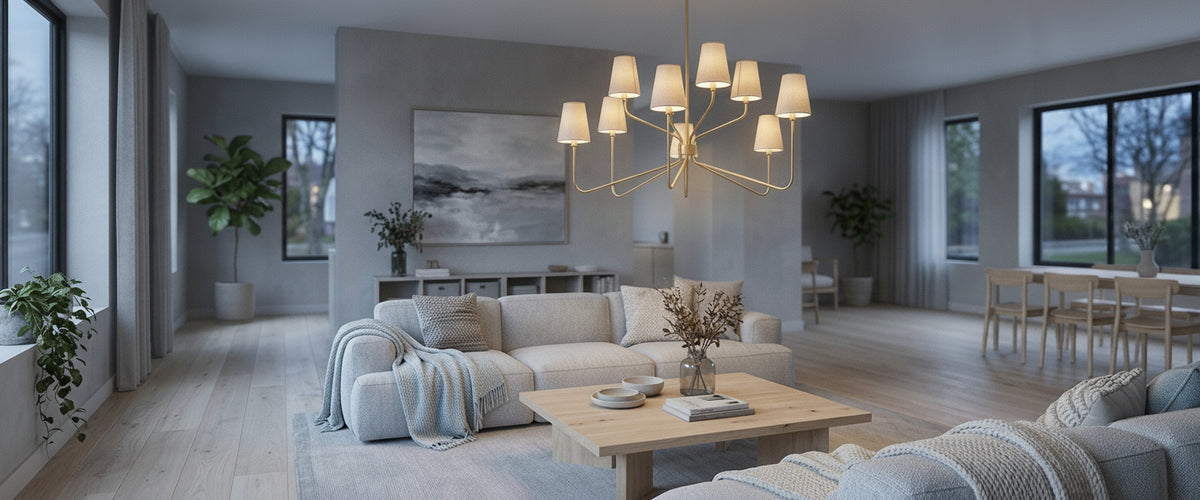

A gold chandelier living room scheme succeeds on three things: a finish matched to a warm bulb (2700K or below), a fitting sized to the room, and a position over the seating rather than the ceiling's center point. Get those right and the style takes care of itself. A gold chandelier looks one way on a product page and quite another at nine o'clock on a February evening, when it is the brightest object in the room and every decision behind it is on show. Most of the regret we hear has little to do with style. It comes from a finish that turned brassy under the wrong bulb, a frame that looked lost above a large sofa, or a dimmer that made the whole thing hum.
At Niori we work mainly with alabaster and natural-stone lighting, so we spend a lot of time watching metal and stone share the same light. That is the lens for this guide: how a living room gold chandelier actually behaves once the daylight has gone.

At a Glance
Match the finish to the bulb. Polished gold wants 2700K or warmer. Satin gold is the most forgiving. Aged brass looks best between 2200K and 2700K, dimmed.
Size it properly. For any gold chandelier living room plan, add the room's length and width in meters and multiply by roughly eight for a starting diameter in centimeters.
The diffuser controls glare far more than the frame does.
In open-plan rooms, hang a gold chandelier in the living room over the seating group, not the geometric center of the ceiling.
Warm walls help a gold living room chandelier; cool grays fight it.
Budget for an LED-compatible dimmer fitted by a qualified electrician.

Polished, Satin and Aged Gold Behave Like Different Metals After Dark
Buyers choosing a living room chandelier, gold in particular, tend to treat the metal as one color with three textures. After dark it is closer to three different metals.
Polished gold is a mirror. It reflects the bulb, the ceiling and anything bright in the room, which is why a polished gold chandelier living room setup can read as luxurious in a warmly lit space and oddly yellow in a cool one. In the studio we photograph every finish under both 2700K and 4000K lamps, and polished gold under 4000K goes almost lemon. If you love polished gold, commit to warm white and do not waver. The same discipline applies to polished brass: a fitting such as the Balance 5 Light Chandelier in Brown/Polished Brass will look rich under 2700K lamps and noticeably harsher under anything cooler.
Satin or brushed gold scatters reflections across its surface, so the bulb never appears as a hard hotspot on the frame. It holds its color under a wider range of lamps and is the safest finish for a busy gold chandelier living room scheme in a family home, lit by several fittings with slightly mismatched bulbs.
Aged or antique brass has darker tones worked into it, and it rewards low, warm light, which suits a living room gold chandelier used mostly in the evening. At full brightness it can look flat. Dimmed to a glow, it takes on the depth of old gilt bronze, the kind you see on the eighteenth-century French chandeliers at the Wallace Collection, which were designed for candlelight rather than electric light.
The Scale Calculation Most Buyers Skip
Scale is the single most common reason a gold living room chandelier disappoints on arrival. The rule of thumb is simple: add the room's length and width in meters, then multiply by about eight to get a sensible diameter in centimeters. A 4 x 5 meter room (roughly 13 x 16 ft) points to a chandelier of around 75cm (29 in) across. In imperial terms, the room's length plus width in feet gives the diameter in inches.
Height matters just as much. Allow roughly 6 to 7.5cm of fixture height for every 30cm (1 ft) of ceiling height, and keep at least 2.1m (7 ft) of clearance beneath anywhere people walk. Over a coffee table, you can hang a living room gold chandelier lower, as long as it does not block sightlines between seated guests.
One adjustment catches people out. Skeletal gold frames with thin arms carry less visual weight than a solid drum or a stone-shaded fitting of the same diameter. If you are choosing an open, wiry design, size up by 10 to 15 percent, or the whole gold chandelier living room arrangement will look timid.
Crystal, Open Glass, Fabric or Alabaster: What Each Does to a Gold Frame at 2700K
In any gold chandelier living room plan, the diffuser decides whether people notice the gold or its glare. At a warm 2700K, each option pulls the frame in a different direction.
Crystal multiplies every point of light and throws sparkle across the ceiling. Paired with polished gold it is opulent but busy; with satin gold it calms down considerably.
Open or clear glass puts the bulb on display, so lamp choice becomes part of the design. Use frosted or decorative lamps, otherwise bare LED chips will glint off the frame.
Fabric shades soften everything and turn the gold into structure rather than a light source. The shade color tints the light, so ivory and linen keep things warm while white can cool them.
Alabaster glows rather than sparkles. Light passes through the stone and picks up a honeyed warmth that the gold frame then echoes, which is why a gold pendant chandelier with alabaster discs reads so settled in a living room. The veining also means no two pieces glow identically.
Where the sofa sits directly beneath the fitting in a gold chandelier living room layout and glare is the main worry, stone-diffused light such as the Marmo 3 Light Pendant Chandelier in Gold with Alabaster Discs is closer to the right answer than a crystal or open-glass design. Browsing our alabaster lighting alongside metal-framed pieces is a useful way to compare how stone and gold carry light together. Stone shades need little more than a dry, soft brush; avoid water and cleaning sprays, as alabaster is porous and marks easily.
Why Dead Center Is Often Wrong in an Open-Plan Living Room
The existing ceiling point is usually in the middle of the room, and the middle of an open-plan room is rarely where life happens. It is often a walkway, and a gold chandelier living room plan built around a walkway lights the wrong thing.
We shipped a gold chandelier for the living room of a client in a converted mill in Yorkshire who had measured everything perfectly, except that the center point fell on the route between the kitchen and the garden doors. The fitting lit people walking past rather than the sofa. Their electrician moved the ceiling point about a meter (3 ft) towards the fireplace, and the room finally made sense.
Anchor the fitting over the seating group instead, ideally centered on the coffee table or rug. For long, narrow spaces, a linear chandelier fills the zone better than a round one; a black-and-gold frame such as the Zuma 6 Light Linear Chandelier, hung parallel to the length of the sofa, spreads light across the whole seating area instead of pooling it in one spot. If moving the point is not possible, a ceiling hook and a swag of flex can offset the fitting, though a qualified electrician should always handle the connection itself.
Wall Colors That Let a Gold Chandelier Warm the Living Room
Gold borrows from what surrounds it, and a gold living room chandelier is no exception. Warm, deep backdrops give it something to glow against: forest and olive greens, oxblood, ochre, terracotta, warm plaster and limewash. Deep navy works too, because the contrast makes gold look intentional.
In a gold chandelier living room, cool blue-grays and bright whites with a blue undertone make gold look yellow and slightly cheap, especially in winter. If you are committed to a cool palette, choose satin rather than polished gold and bring in warm materials nearby, such as oak, walnut, travertine or an alabaster table lamp, to bridge the gap.
One more trap in a polished gold chandelier living room: a large mirror directly opposite the fitting doubles the reflections and the glare. Angle the mirror or choose a brushed finish.
Dimming a Gold Chandelier: Why the Wrong Dimmer Wastes the Investment
A beautiful living room chandelier in gold on a cheap or incompatible dimmer will flicker, buzz, or refuse to go below half brightness. Most problems come from older leading-edge dimmers paired with LED lamps, or from a dimmer whose minimum load is higher than the few watts a set of LEDs draws.
Look for a trailing-edge dimmer rated for LED loads, and check that your lamps are listed as dimmable. The Lighting Industry Association publishes useful guidance on LED and dimmer compatibility. Warm-dim lamps, which drop towards 2200K as you lower them, suit aged brass and alabaster particularly well and flatter almost any gold chandelier living room setup. Dimmer replacement is electrical work, so use a qualified electrician; in England and Wales, much of it also falls under Part P of the Building Regulations.
Buyer Checklist Before You Order
Measure the room and work out the diameter and drop before falling for a design.
Confirm the ceiling height and the clearance beneath the fitting.
Decide where the fitting should sit: over the seating, not the room center by default.
Choose finish and bulb together, and keep every lamp in the room at the same color temperature.
Pick a diffuser based on how much glare you can tolerate from the sofa.
Check that the wall color in your gold chandelier living room flatters the finish.
Ask whether the ceiling can take the weight, particularly for stone or crystal fittings.
Book a qualified electrician for installation and any dimmer upgrade.
For bespoke sizes or finishes on a gold chandelier living room project, request a tailored quote; budget depends on material, scale, complexity, installation and finishing.
A gold chandelier living room scheme works when the fitting is treated as part of a lighting plan rather than a standalone statement. Pair it with wall lights and table lamps so it never has to carry the whole evening alone, and you can browse the wider Niori lighting range to build that layer around it.