
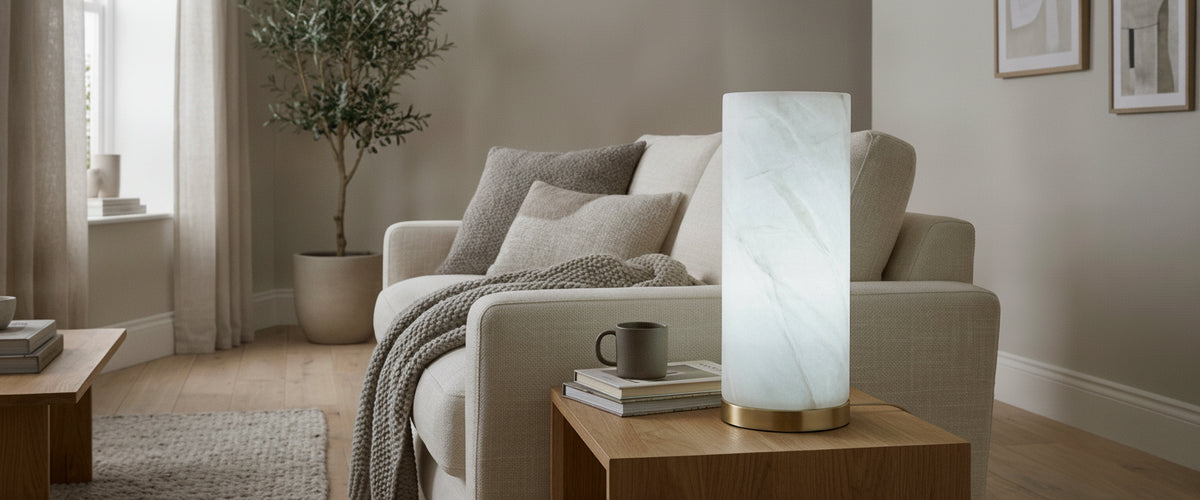

Most lamps are judged in a showroom at noon and lived with at nine in the evening, and those are two different objects. An alabaster brass table lamps shows this gap more than most. Switched off, it reads as a handsome piece of stone and metal. Switched on, the stone turns into a light source and the brass starts reflecting it, and the choices you made about finish, proportion and bulb either come together or quietly undermine each other. Here is how to buy one that works once the curtains are drawn.

At a Glance
- Material: alabaster glows from within. Ceramic and opal glass cannot copy the depth or the visible veining.
- Brass finish: satin and aged brass flatter the stone after dark. Highly polished brass can compete with it.
- Proportion: a heavy stone shade on a slender stem looks top-heavy. The base needs visual and physical weight.
- Bulb: stay between 2,400K and 2,700K with a high colour rendering index (CRI 90 or above).
- Stone check: ask to see the piece lit. Translucency, veining and wall thickness only show up with light behind them.

What Alabaster Brings That Ceramic or Glass Cannot
Alabaster is a fine-grained form of gypsum, soft enough to carve and turn by hand, with a crystal structure that lets light travel through it instead of simply bouncing off. That is the whole point. A ceramic base is opaque, so the light comes only from the fabric shade above it. Opal glass diffuses evenly, which sounds good until you notice it looks the same from every angle and every distance. Alabaster does not. Thinner areas glow brighter, thicker ones hold back, and the natural veining appears as soft amber and honey-coloured lines that barely register in daylight.
Carvers have valued the stone for centuries. England had its own tradition of alabaster carving centred on the Midlands, and the Victoria and Albert Museum's sculpture collection holds fine medieval examples. What has changed is the light source. With a modern LED inside, the stone becomes the lampshade. That is why an alabaster brass table lamp behaves so differently from a brass lamp with a linen shade: the stone gives off light rather than just covering the bulb.
How Brass Finish Depth Changes What the Stone Does After Dark
Brass reflects. On an alabaster brass table lamp, the question is what it reflects and how sharply. Put the same alabaster shade on three differently finished bases and, once the main lights go off, they look like three different products.
Polished Brass
Mirror-bright brass picks up the hot spot of the bulb and throws it back as a hard highlight. In a large, formal room with plenty of ambient light that can look crisp. On a bedside table it often turns into a distraction, a bright glint right at eye level that pulls attention away from the stone.
Satin and Brushed Brass
The fine grain of brushed brass breaks up reflections into a soft sheen that matches the diffused glow of alabaster. For most homes this is the safest choice for an alabaster table lamps brass base, because neither material fights for attention. The same logic carries to anything else on the walls: if the lamp shares a room with wall lights, a brushed fitting such as the Selvara LED Medium Alabaster Wall Light in Brushed Brass keeps one consistent sheen across the scheme, where a polished wall fitting would introduce a second, competing highlight.
Aged, Bronzed and Unlacquered Brass
Darker, warmer finishes sink back in the evening and let the stone do the talking. Unlacquered brass will darken and patinate over time, which some people love and others find unsettling. Decide which camp you are in before you buy, as a dark finish cannot easily be reversed without professional refinishing.
The Base-to-Shade Ratio That Tips Elegant into Top-Heavy
Stone is heavy, and a carved alabaster shade carries real visual mass. Put it on a pencil-thin brass stem and the eye reads it as precarious, even when the lamp is perfectly stable. The fix is proportion rather than size.
- Give the base presence. A wide brass foot, a stepped plinth or a stone base helps anchor the shade. As a rough guide, the footprint should be close to the shade's width or wider.
- Keep the shade to roughly a third of total height when the shade is solid stone. Push past that and the composition starts to look like a mushroom.
- Watch stem thickness. A stem that looks fine under a fabric drum can look underweight under stone. Slightly heavier tubing or a turned profile reads as more deliberate.
- Check physical stability. A weighted base matters more with stone than with any other shade material, particularly near children, pets or busy hotel surfaces.
Then consider the furniture. On a console in a narrow London hallway, a tall alabaster brass table lamp with a compact stone shade works well. If the console is too shallow to take a properly weighted base at all, moving the stone onto the wall is often the better decision: a small fitting such as the Serava LED Small Alabaster Wall Light gives the same translucent glow without asking a narrow surface to carry it. On a deep sofa-side table, a lower, broader piece sits more comfortably at seated eye level, which is roughly 100 to 110cm (39 to 43in) from the floor in most living rooms.
Where an Alabaster Brass Table Lamp Flatters a Scheme, and Where It Fights One
The pairing comes alive alongside warm, matte, natural surfaces: limewashed or plastered walls, oak and walnut, linen, wool, travertine, aged leather. Georgian and Victorian rooms take it easily because the materials feel historically at home. So do pared-back contemporary schemes in warm neutrals, where the lamp brings the craft that the architecture leaves out.
It struggles in three situations. Cool grey schemes with chrome hardware make the brass look garish and the stone look yellow. High-gloss white kitchens bounce the glow around until it loses its softness. Busy veined marble directly behind the lamp competes with the alabaster's own veining, so the eye cannot settle on either.
Surrounding light matters as much as the lamp itself. A common case: an alabaster brass table lamp looks flat in a newly painted drawing room, and the owner blames the stone. The real culprit is usually a cool-white wall colour under a 4,000K ceiling downlight. Warm the paint slightly and dim the overhead light, and the same lamp becomes the focal point of the room. Where a ceiling downlight has to stay, one with selectable colour temperature, such as the SpektroLED Evo 4-CCT Tilt Downlight in Brushed Brass, can be set to its warmest option so it supports the stone rather than washing it out. If you are building a scheme around several pieces, browsing the full alabaster lighting range helps you match stone tones between table lamps, wall lights and pendants so the glow stays consistent from fixture to fixture.
Bulb Temperature: The Narrow Range Where Alabaster and Brass Both Peak
The bulb is where most good lamps get spoiled. Alabaster already adds warmth as light passes through it, so a bulb that seems fine in a fabric shade can push the stone towards orange. Go too cool and the stone turns chalky while brass takes on a greenish cast.
- Colour temperature: 2,400K to 2,700K. As a rule, 2,700K suits paler, whiter stone; 2,400K to 2,500K flatters honey-toned pieces and aged brass in the evening.
- Colour rendering: CRI 90 or above. Lower-quality LEDs flatten the subtle colour shifts in the veining.
- Output: modest. An alabaster brass table lamp is for mood and task light, not room lighting. Overpowering it produces a visible hot spot through thinner areas of the shade.
- Dimming: use a dimmable LED and a compatible dimmer. Alabaster looks its best at low output, which is when the veining shows most clearly.
If you want a lamp on a wall-mounted dimmer or on a switched socket circuit, have a qualified electrician install it to current UK wiring regulations. The same applies if a vintage or inherited base ever needs rewiring; stone and metal lamps are not a DIY rewiring project.
Stone Quality and Finish Spec: What to Scrutinise Before You Commit
Two alabaster lamps can look identical in a product photo and behave completely differently when lit. These are the questions we would ask of any supplier, including ourselves.
Decision Criteria
- Lit photography or video. Ask to see the actual piece, or one from the same block, switched on. Daylight shots tell you very little.
- Even wall thickness. Uneven turning gives blotchy light. Hold the shade up to a window if you can: the glow should fade gently, not jump between bright and dark patches.
- Veining versus fissures. Natural veins and cloudy inclusions are part of the appeal. A hairline crack that catches a fingernail is not.
- Fills and resin. Some natural voids are filled during finishing, which is normal craft practice. Ask how much and where, as heavy filling can show as dull patches when lit.
- Surface finish. Honed alabaster gives a softer, more diffused glow. Polished stone looks richer by day but can show more surface reflection at night.
- Brass construction. Solid brass or plated steel? Lacquered or living finish? Solid brass with a quality lacquer will wear well for many years with minimal care.
- Fittings and plug. Confirm the lamp ships wired for UK sockets and that the lamp holder suits the bulb you plan to use.
Budget depends on all of the above: the quality and size of the stone block, the complexity of the carving, the brass engineering and the finishing work. For bespoke sizes or matching sets for a hotel or residential project, request a tailored quote rather than comparing headline figures. You can see how Niori approaches stone, scale and finish across the wider lighting collection before you get in touch.
Living with It: Care for Stone and Brass
Alabaster is soft and slightly water-soluble, so caring for an alabaster brass table lamp comes down to restraint. The most common damage comes from well-meaning cleaning: a damp cloth and a multi-surface spray can leave the stone dull and slightly rough in patches within weeks. In hotels and serviced homes, make sure housekeeping knows this before the lamps go in.
- Dust the stone with a dry, soft microfibre cloth or a clean soft brush. No water, no sprays, no polish.
- Keep alabaster lamps out of bathrooms and steamy kitchens.
- Wipe lacquered brass with a dry cloth only. Metal polish will strip the lacquer.
- Let unlacquered brass patinate, or polish it gently with a product made for solid brass if you prefer it bright.
- Switch off and unplug before cleaning, and let the bulb cool first.
- Lift the lamp by the base, never by the stone shade.
Chosen with care, an alabaster brass table lamp improves with age: the brass mellows, the stone keeps its glow, and the piece reads as part of the room rather than a purchase. Get the finish, proportion and bulb right at the start, and it will look as good at nine in the evening as it did in the showroom at noon.