
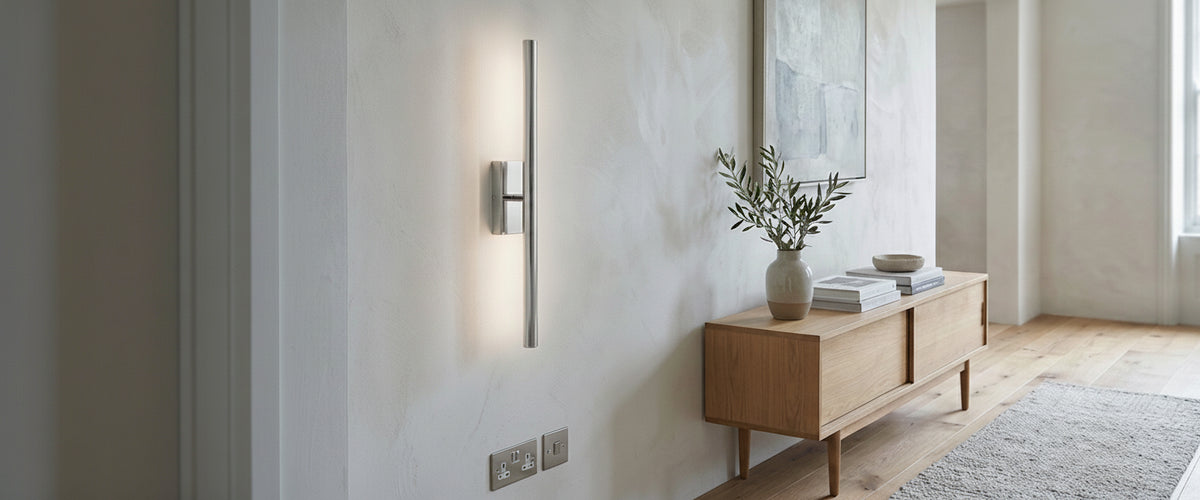

You can spend months choosing an alabaster pendant, settle the plaster colour after six sample pots, and then watch a single wall socket undo the lot. Brushed chrome sockets are the default upgrade from white plastic in most UK renovations, and for good reason: they are cool, discreet and forgiving of fingerprints. Placed carelessly, though, they become the one cold, bright rectangle in a room built around warm stone and soft light. This is a placement guide, written from the point of view of a lighting studio that sees the finished rooms, not the wiring diagrams.
Key Takeaways
- Brushed beats polished in almost every living space; polished chrome reflects every lamp and reads as a hotspot.
- Height changes everything. A plate at skirting level is barely seen; one at worktop or bedside height is in your eyeline daily.
- Brushed chrome suits cool and neutral schemes: grey kitchens, white bathrooms, contemporary hallways.
- It jars against warm metals such as unlacquered brass, bronze and aged gold, which are common around alabaster lighting.
- Screwless plates earn their keep where sockets sit at eye level or on plain plaster walls.

Brushed Versus Polished Chrome on a Socket Plate
The difference between brushed and polished chrome looks trivial in a catalogue thumbnail. On a wall it is not. Polished chrome is a mirror: it picks up the nearest window, the nearest lamp and the nearest dark object, so the plate flickers in and out of view as you move through the room. Brushed chrome has a fine directional grain that scatters reflections into a soft sheen, which means the plate holds one steady tone instead of a dozen shifting ones.
It is worth knowing what you are actually buying. Many plates sold as brushed chrome are brushed stainless steel, finished with an abrasive grain rather than plated. That is no bad thing. The British Stainless Steel Association publishes useful guidance on how brushed and satin finishes are produced and why they hide marks better than mirror finishes. For a socket that gets touched every day, a grained steel surface wears more gracefully than a thin plated coating.
One detail that buyers overlook: the grain runs in one direction. If you are fitting a run of brushed chrome sockets and switches, make sure the grain is horizontal on all of them. A plate rotated 90 degrees reads as a slightly different colour under a raking wall light, and you will not be able to unsee it.

How Mounting Height and Sightlines Change What a Plate Says
For new dwellings in England, Approved Document M sets switches and sockets between 450mm and 1200mm from finished floor level, and LABC is a good plain-English starting point if you want the detail for your project. Within that band, though, the visual weight of a plate changes enormously.
A socket at 450mm (roughly 18 inches) sits below the line of sofas, consoles and beds. People rarely look at it directly, so finish matters less than colour contrast with the wall. Lift that same plate to worktop height in a kitchen, or to 1000mm beside a bed, and it becomes part of the composition. Now it shares a sightline with your table lamp base, your wall light backplate and your cabinet handles.
We saw this clearly on a townhouse project in Bath where the client had chosen a pair of alabaster wall lights flanking a bedhead. The electrician placed brushed chrome sockets directly below each light, about 300mm (12 inches) lower. Every evening the stone glowed amber and the two steel plates beneath caught that light and turned it a faintly blue grey. Nothing was technically wrong. It simply looked unconsidered. Lowering the sockets behind the bedside tables solved it in an afternoon.
Before you finalise positions, stand where you will actually sit or work and note which plates fall into your natural eyeline. Those are the ones that deserve finish decisions. The rest can be chosen on practicality.
Rooms Where Brushed Chrome Sockets Disappear Quietly
Brushed chrome sockets are at their best in rooms that already contain cool metal and pale, flat colour. In those spaces the plate becomes one more piece of steel in a family of steel.
Kitchens
Stainless appliances, chrome taps and white or grey worktops make brushed chrome sockets the natural choice. A double socket with USB-A and USB-C ports above the counter looks like part of the appliance line. Choose a black insert against dark splashbacks and a white or grey insert against pale tile. Against a slate or charcoal splashback, a grained steel plate such as the Stainless Steel 13A Double Socket with USB-A & USB-C in Brushed Chrome with a black insert keeps the charging points while letting the dark centre recede into the wall behind it.
Bathrooms
Standard 13A sockets are heavily restricted in UK bathrooms; the usual exception is a dedicated shaver socket with an isolating transformer. A brushed chrome shaver socket sits comfortably beside chrome brassware and white sanitaryware. Where the walls are white tile or pale plaster, a white-insert unit such as the Brushed Chrome Shaver Socket with Dual USB-A & USB-C (White Insert) keeps the plate as light as the room around it, with charging for a toothbrush or phone built in. Any bathroom electrical work should be carried out by a qualified electrician who can confirm zones and distances for your layout.
Contemporary Hallways and Home Offices
Grey or white walls, oak floors and matt black or steel accents absorb a brushed plate easily. In a home office, where a socket bank often sits at desk height, brushed chrome reads as equipment rather than decoration, which is exactly right.
If your lighting in these rooms leans cool and architectural, such as white marble or pale onyx shades with steel or nickel detailing, our wider lighting collection is a useful place to compare finishes side by side before committing to the electrics.
Where Brushed Chrome Jars, and What You Should Have Chosen Instead
The clash usually happens in the warmest rooms in the house. Alabaster gives a honeyed, diffused light, and it is typically paired with brass, bronze or aged gold. Put a cool steel plate beneath that palette and the temperatures fight. The stone pushes amber; the chrome pushes blue.
The worst offenders we see:
- Period living rooms with painted panelling, where a brushed chrome socket on a deep green or plaster pink wall looks like a later repair. A plate painted to match the wall, or an antique brass finish, sits far better.
- Bedrooms with warm table lamps, where bedside sockets share the same small vignette as a stone lamp base. Aged brass or bronze links the two.
- Dining rooms under an alabaster chandelier, where every surface is warmed by the fitting overhead. Here a dark bronze or a matt finish close to the wall colour lets the chandelier stay the focus.
A simple rule: if the room has more warm metal than cool, brushed chrome sockets are the wrong finish. If you genuinely cannot decide, pick the plate that matches the wall rather than the fittings. Wall-matched plates almost never jar; mismatched metals often do.
Pairing Socket Plates With Light Fittings: The Finish Logic Most Interiors Skip
Most schemes coordinate light fittings with door furniture and taps, then forget the electrics. Yet a socket plate often sits closer to a light fitting than any handle does. Think of the room in zones: the metal detailing on a fitting should agree with any plate within roughly an arm's length of it.
With alabaster and natural stone, the metal is usually the supporting act: a brass gallery on a pendant, a bronze stem on a floor lamp, a slim backplate on a wall light. Browse our alabaster lighting and you will notice how much of the detailing is warm. That tells you which socket finish will sit beside it without friction.
Brushed chrome pairs well with stone in one specific case: cooler stones and cooler metals together. White Carrara-type marble, grey onyx or alabaster fitted with a nickel or steel collar can live happily above brushed chrome sockets. Bulb choice matters here too. A 2700K warm white lamp makes even pale stone glow golden, which pushes the room warmer; 3000K keeps the stone creamier and narrows the gap with steel. On dimmers, remember that warm-dimming lamps drift further towards amber as they lower, so judge the plate finish with the lights dimmed as well as at full output.
Screwless Plates Versus Framed Ones: When the Cleaner Edge Actually Earns Its Keep
Most brushed chrome sockets come in two styles. Screwless plates hide the fixing screws behind a clip-on front, leaving a clean metal rectangle. Framed plates show two screw heads. It sounds like a small thing. At eye level on a plain wall, it is not.
Screwless earns its keep where the plate is visible and the surface around it is quiet: limewashed plaster, painted panelling, a kitchen splashback, the wall beside a statement wall light. The screw heads on a framed plate are the first thing your eye catches in those settings.
Framed plates are perfectly fine at skirting height, inside joinery, behind furniture, in utility rooms and garages. They are also easier to remove and refit when decorating. Do not pay the screwless premium for sockets nobody will ever look at directly.
Insert colour deserves the same attention. A black insert makes a brushed chrome plate read darker and more graphic; white keeps it light and clinical; grey is the quiet middle ground and tends to be the safest choice beside stone, because it avoids the hard contrast of either extreme. In a marble-lined bathroom, for instance, a screwless grey-insert design such as the Brushed Chrome Screwless Shaver Socket with Dual USB-A & USB-C (Grey Insert) sits closer to the veining than a bright white centre would, and the clean edge holds up at the eye-level height shaver sockets usually occupy.
Choosing Brushed Chrome Sockets: A Quick Checklist
- Count your warm and cool metals. If warm wins, choose a different finish.
- Mark eyeline plates from seated and standing positions; spend your attention there.
- Keep grain direction consistent across every plate in the room.
- Match insert colour to the wall or splashback, not the plate.
- Go screwless at eye level and on plain walls; framed is fine elsewhere.
- Check the plate under your actual lighting, including dimmed, before ordering a full set.
- Plan USB positions for bedsides, desks and kitchen counters so chargers do not trail across stone surfaces.
- Use a qualified electrician for all installation, especially bathroom and kitchen circuits.
Small metal decisions shape how a room reads once the lights go on. Get the socket plates right and your stone fittings, from a single alabaster table lamp to a full chandelier, will look as considered at eye level as they do overhead. If you are planning lighting and electrics together, start with the fittings on the Niori site and let their detailing decide the plates, not the other way round.