
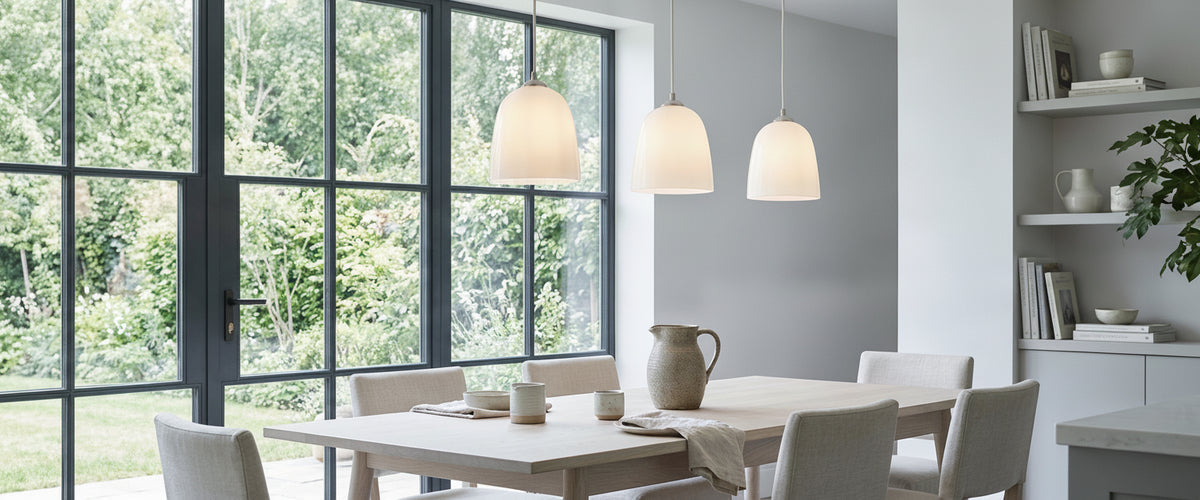

Hang the wrong piece of old glass over a dining table and the room starts to feel like a set dresser has been in. Hang the right one and dinner looks lit by something older and kinder than a ceiling spot. Antique glass dining lighting earns its place through what the glass does to light: small bubbles, slight waves and faint tints that break a hard bulb into something closer to candle flame. The catch is that much of what is sold as "antique" glass is a printed effect on flat modern sheet, and even the genuine article can look costumed if the format, the bulb or the furniture around it is wrong.

At a Glance
- Know what you are buying: seedy glass, hand-rolled glass and period reproductions behave differently, and only some of them actually change the light.
- Format matters: open chandeliers and multi-pendant runs show textured glass better than a single closed globe.
- Correct for the tint: amber glass plus a very warm bulb tends to read orange. Step up to 3000K when the glass is already warm.
- Mix eras on purpose: one old-glass fitting against clean contemporary furniture looks chosen. A whole room of it looks like a theme.
- Check the photos closely: real texture distorts what sits behind it. Printed effects do not.

What "Antique Glass" Actually Covers
The phrase is used loosely, so before shopping for antique glass dining fittings it helps to separate the main types.
Seedy glass carries small trapped air bubbles, called seeds, left behind when molten glass was not fully refined. In early glassmaking these were a flaw; today they are introduced on purpose. Each bubble acts as a tiny lens, which is why a seedy shade throws faint pinpricks of light and shadow across a tablecloth.
Hand-rolled glass is worked through rollers or blown and flattened by hand, leaving gentle ripples, uneven thickness and the occasional drag line. It is the glass you see in old sash windows, where the view outside seems to swim slightly as you move. The V&A's glass collection is a useful place to see how much variation historic hand-made glass really had, and why perfectly even "old" glass should make you suspicious.
Period reproductions cover everything from carefully mouth-blown copies of Victorian and Edwardian shades to mass-produced pieces that borrow the shape but use flat float glass. The shape alone tells you little. The glass itself is what earns the price of a good reproduction.
How Aged Glass Bends Light Differently From Float Glass
Modern float glass is made by floating molten glass on tin, which gives a perfectly flat, even sheet. Light passes straight through it. Put a bare filament bulb behind float glass and you see a bare filament bulb, slightly dimmed.
Aged and hand-made glass refuses to be that obedient. Variations in thickness bend light by different amounts across the surface, so the source softens and spreads. Bubbles scatter small points of brightness. A faint green or amber cast, often from iron or other trace minerals in older batches, warms everything the light lands on. The Corning Museum of Glass has good material on how batch chemistry and forming methods produce these effects.
With candles, this movement is lovely because the flame itself flickers. With LEDs the light is steady, so the glass has to do the work. That is why in antique glass dining lighting we push clients toward filament-style LED lamps with a visible element: the glass has a defined point to refract, and the scattered pattern reads as texture rather than blur.
Pendant or Chandelier: Which Format Lets the Glass Perform?
Textured glass needs to be seen edge-on as well as face-on, and it needs light passing through it from inside. Some formats manage that far better than others.
Open Chandeliers
Arms carrying individual glass shades or cups give you many small surfaces at different angles. Every diner sees a slightly different pattern, and the brass or bronze frame catches reflected light between the shades. For a rectangular table, aim for a chandelier roughly half to two-thirds of the table's width so nobody stands up into it.
Multiple Pendants
Two or three seedy or hand-rolled pendants in a line over a long table is often the most convincing arrangement in a contemporary room. It reads as a deliberate composition, and each shade stays small enough that the texture is visible. An antique brass lamp holder and gallery suits this glass far better than polished chrome, which pulls the look toward the industrial. If you are building pendants around salvaged or reproduction shades, a holder such as the E27 Vintage Pendant Holder 150mm, Antique Brass keeps the visible metalwork in the same aged register as the glass, and the standard E27 fitting leaves you free to choose the right filament lamp.
Single Large Globes
A single big closed globe of reproduction glass is the antique glass dining format we see disappoint most often. The texture spreads across a large surface and loses its intensity, and with an opal bulb inside it can look like plain frosted glass from the far end of the room.
As a general starting point, the bottom of a pendant or chandelier sits around 28 to 34 inches (about 70 to 85 cm) above the tabletop, adjusted for ceiling height and how tall your guests are. Glass shades tend to be heavier than they look, so confirm the ceiling fixing can take the weight and have a qualified electrician install and connect any hardwired fitting.
Colour Temperature When the Glass Is Already Tinted
This is where well-chosen antique glass dining pieces go wrong. Amber, smoked and green-tinted glass already shift the light warm or cool before it reaches the table, so the bulb has to account for that.
- Amber or honey glass: a 2200K or 2400K filament behind amber glass often turns food and skin orange. A 2700K or even 3000K lamp lets the glass add the warmth instead of piling it on.
- Green-tinted or old window glass: pick 2700K with a high colour rendering index (CRI 90 or above) so faces and food do not take on a grey-green cast.
- Clear seedy glass: this is the most forgiving. 2700K suits most dining rooms, with 2200K reserved for very low-level evening light.
One of our clients in a Georgian townhouse in Bath had a run of amber reproduction pendants over a walnut table and complained the room looked "like a pub at closing time". Swapping 2200K lamps for 3000K dimmable filaments fixed it in an afternoon. The glass still looked old; the dinner plates simply stopped looking orange.
Always dim. Dining is the one room where a fitting will spend most of its life below full output, so use LED lamps marked dimmable and a compatible LED dimmer, fitted by a qualified electrician.
Placing Antique Glass Dining Lights With Contemporary Furniture
The fastest route to a costumed room is matching everything to the light: turned legs, a dark dresser, a Victorian mirror and a seedy-glass chandelier all at once. The eye reads it as a period set rather than a home.
Contrast works better. A hand-rolled glass chandelier over a plain oak or sintered-stone table, with simple upholstered chairs, makes the glass the single piece of age in the room, and it looks chosen. Keep metal finishes consistent; aged brass on the fitting can be echoed in a cabinet handle or a picture light, but stop there.
Natural stone is a strong partner here. An alabaster wall light on a side wall or a pair of stone table lamps on a sideboard adds a second layer of warm, diffused light that sits comfortably beside old glass, because both materials soften light rather than throw it. You can see how translucent stone handles this in our alabaster lighting collection. Let the glass be the centrepiece over the table and the stone do the quieter ambient work around the edges.
In open-plan kitchen-diners, keep antique glass to the dining zone. Over the island, a simpler fitting stops the whole space feeling themed and helps the table read as its own room. Where the kitchen wall needs appliance isolators in sight of the table, an aged brass plate such as the Grid Switch Cover Marked 'Dishwasher' - Antique Brass carries the pendant finish through quietly, so the metalwork stays consistent without adding another period object to the room.
Reading Product Photography Honestly
Plenty of shades sold online as antique glass are flat, pressed or spray-coated glass with a printed or etched pattern. In photos they can look convincing. A few checks help:
- Look through the glass. Real hand-rolled or seedy glass distorts anything behind it, such as a wall edge or a window frame. A printed effect sits on the surface and the background stays sharp.
- Check the bubbles. Genuine seeds vary in size and sit at different depths. Evenly spaced, identical dots usually mean a decorative coating.
- Find the lit shot. Textured glass changes character when lit and throws pattern onto nearby surfaces. If every photo is unlit, ask why.
- Look at the edges. Hand-made glass has slightly uneven rims and thickness. Perfectly uniform rims suggest machine-pressed glass.
- Ask the supplier. A reputable maker will tell you how the glass is formed and whether variation between pieces is expected.
Buyer's Checklist for Antique Glass Dining Lighting
- Confirm the glass type: seedy, hand-rolled, mouth-blown reproduction, or decorative surface effect.
- Choose the format for the table: open chandelier or multi-pendant run for long tables, a compact chandelier for round ones.
- Check the weight against your ceiling structure and use a qualified electrician for installation.
- Match the bulb to the tint: warmer glass, slightly cooler lamp. Specify dimmable filament LEDs with CRI 90 or above.
- Set the drop at roughly 28 to 34 inches (70 to 85 cm) above the table and test it seated before final fixing.
- Limit antique pieces to one focal fitting and support it with diffused ambient light from wall lights or lamps.
- Accept variation. Small bubbles, ripples and tint differences between shades are the point, not a defect.
Care for Old and Reproduction Glass
Textured glass hides fingerprints but collects dust in its ripples. Switch off and let the fitting cool, then wipe with a soft, lint-free cloth lightly dampened with water and a drop of mild washing-up liquid. Avoid abrasive pads and ammonia cleaners, which can dull surface finishes on reproduction glass and attack lacquered brass. Remove shades for cleaning rather than working on them in place, and dry them fully before refitting.
Budget for a quality antique glass dining fitting depends on how the glass is made, the scale of the piece, the metalwork and the installation it needs. If you are planning a dining room around a centrepiece light and want stone and glass to work together, explore the wider niori lighting range and ask us for a tailored quote.