
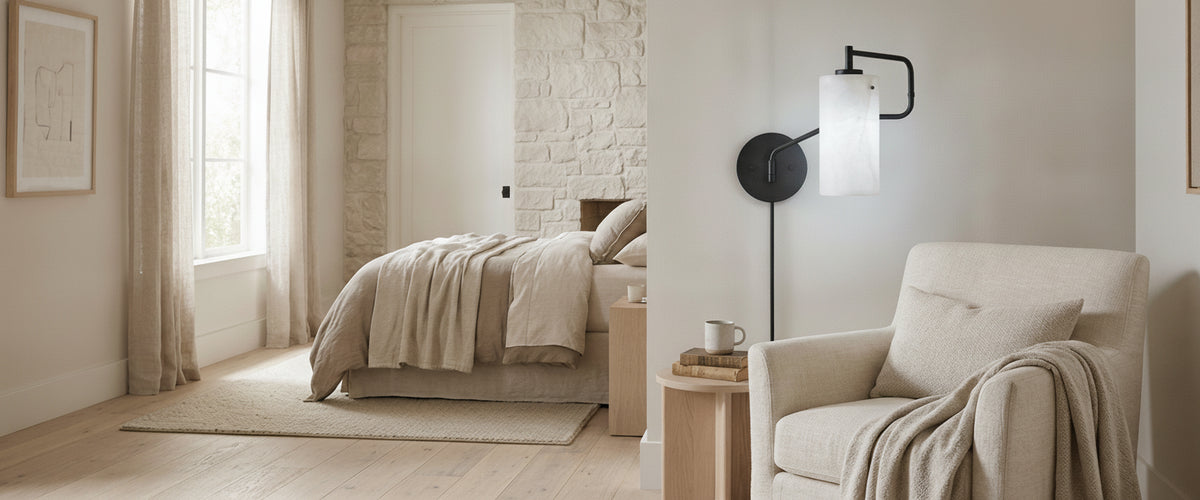

The most common complaint we hear about a dimmable LED wall light has nothing to do with the fitting. The fitting is fine. The dimmer behind the faceplate is fifteen years old, built for a 60-watt filament bulb, and quietly sabotaging everything connected to it. You get a faint buzz at bedtime, a flicker below half brightness, or a light that jumps from dim to full with nothing useful in between. This piece explains why that happens and how a swing-arm wall sconce used as an LED reading light changes the dimming range you actually use. It also covers which rooms deserve variable output at all.
A dimmable LED wall light is a wall-mounted fitting whose LED driver can read a dimmer's signal and vary output smoothly, ideally from full brightness down to around 10 percent. It only performs that well when the driver and the dimmer are matched.
Quick answer: a dimmable LED wall light that hums or flickers is almost always paired with an old leading-edge dimmer, or with a dimmer whose minimum load is higher than the LEDs draw. Replacing it with a compatible low-load trailing-edge dimmer, fitted by a qualified electrician, usually fixes both problems.
At a Glance
Match the dimmer to the driver. Most dimmable LED wall lights want a trailing-edge dimmer. An old leading-edge unit is the usual cause of hum and flicker.
Check minimum load. One or two LED wall lights may draw less than an older dimmer needs to work properly.
Arm position changes everything. Pull a swing-arm wall sconce LED reading light closer to the page and this adjustable-fixture design will live at the bottom of the dimming curve.
Low output changes shadow quality. Below a certain point, contrast on the page flattens and color can look gray unless the fitting dims warm.
Not every room needs dimming. Hallways, utility spaces and task zones often work better on fixed output.
The Numbers Worth Knowing
Minimum load: many older leading-edge dimmers were rated for a minimum of around 40 watts or more, while a pair of LED sconces often draws only 10 to 20 watts combined.
Low-end dimming: a good dimmable LED wall light with a reading head should dim smoothly down to about 10 percent on a compatible trailing-edge dimmer.
Color temperature: 2700K to 3000K suits bedrooms, living rooms and stone shades.
Color rendering: CRI 90 or above keeps print crisp and skin tones natural.
Distance: halving the gap between a reading head and the page delivers roughly four times the light, per the inverse-square law.
Standards: NEMA SSL 7A covers phase-cut dimmer and LED driver compatibility in North America. IEC 62386 defines DALI digital control.

Key Terms, in Plain English
Ten terms explain nearly every dimming problem and every reading-light choice. Knowing them makes a conversation with your electrician or supplier much faster.
LED driver: the small electronic unit inside or behind an LED fitting that converts mains power into the steady current the diodes need. It is also the part that has to read the dimmer's signal.
Phase-cut dimming: the method most wall dimmers use. They switch off part of each mains wave to reduce power. Leading-edge and trailing-edge are the two types.
Leading-edge dimmer: an older dimmer type that cuts the front of each mains wave. It was designed for filament and transformer loads and often makes LED drivers hum.
Trailing-edge dimmer: a dimmer that cuts the back of each mains wave. It switches more gently and is the usual match for LED fittings.
Minimum load: the lowest total wattage a dimmer needs to work properly. A pair of LED sconces can fall below it, causing flicker or drop-out.
Dim-to-warm: LED behavior where the color temperature shifts warmer as brightness falls. It mimics the glow of a dimmed filament bulb.
Color rendering index (CRI): a 0 to 100 score for how faithfully a light shows colors. For reading and skin tones, look for CRI 90 or above.
Swing-arm wall sconce: a wall light on a hinged, adjustable arm that folds flat to light the wall or extends to act as an LED reading light over a bed or chair.
LED reading light: a small, directional LED source aimed at the page rather than the room. It can be a standalone fitting or a separate head built into a larger dimmable LED wall light.
Adjustable fixture: any light whose arm, head or shade can be repositioned after installation, so the beam can be moved to the task. Swing-arm sconces and pivoting reading heads are the most common types.

Why a Dimmable LED Wall Light Fails Silently on the Wrong Dimmer
In short: LED drivers have to interpret a dimmer's signal, and when the two are mismatched the light flickers, hums or cuts out without any obvious fault.
Incandescent bulbs were simple loads. Turn the voltage down and the filament glowed less. LEDs don't work like that. Every LED fitting has a driver, and that driver has to interpret the chopped-up signal a dimmer sends it. When the two disagree, nothing dramatic happens. There is no bang and no tripped circuit. The light simply behaves badly, and most people assume they bought a poor fitting.
The symptoms are worth knowing by name. Flicker at low levels. Pop-on, where the light won't start until you push the dimmer well past its lowest setting. Ghosting, a faint glow after the switch is off. Drop-out, where the light cuts out entirely before reaching the bottom of the dial. Any of these on a dimmable LED wall light usually points to a compatibility issue, a minimum-load issue, or both. Consumer guidance from the Energy Saving Trust makes the same point plainly: before blaming either part, confirm that LED lamps and fittings are marked dimmable and that your dimmer switch is compatible.
Symptom, Likely Cause, Fix
Audible hum or buzz: usually a leading-edge dimmer. Swap it for a trailing-edge model.
Flicker at low settings: usually total load below the dimmer's minimum. Fit a low-load trailing-edge dimmer, or set its low-end trim if it has one.
Pop-on: the driver needs more power to start than the dimmer's lowest setting gives it. Raise the dimmer's minimum level or choose a better-matched dimmer.
Ghosting when switched off: a small leakage current through the dimmer. A low-load dimmer or a manufacturer-approved load correction device usually cures it.
Drop-out before the bottom of the dial: dimmer and driver mismatch. Check the fitting's approved dimmer list.
Trailing-Edge Versus Leading-Edge: The Choice That Decides Whether Your Sconce Hums
In short: trailing-edge dimmers are the right default for almost every dimmable LED wall light, because they switch gently, run silently and handle low loads.
Dimmers cut part of each mains wave to reduce power. A leading-edge dimmer cuts the front of the wave, and a trailing-edge dimmer cuts the back. That sounds like a technicality, but it matters a great deal for LEDs. Leading-edge units send a sharp spike into the electronics of an LED driver, and the driver's components vibrate audibly in response. That is your hum.
Trailing-edge dimmers switch more gently, run quieter, and generally cope with the low wattages LEDs draw. For almost every dimmable LED wall light we sell, trailing-edge is the right starting point. Check the manufacturer's compatibility notes too, because some drivers work well with certain dimmers and poorly with others. In North America, look for drivers and dimmers that reference the NEMA SSL 7A standard. It was written to make phase-cut dimmers and LED drivers work predictably together.
Leading-Edge vs Trailing-Edge, Side by Side
Designed for: leading-edge suits filament bulbs and wire-wound transformers. Trailing-edge suits electronic loads, including LED drivers.
Noise: leading-edge often causes audible hum in LED fittings. Trailing-edge is typically silent.
Minimum load: older leading-edge units often expect tens of watts. Low-load trailing-edge models are built for the few watts a pair of LED sconces draws.
Low-end control: trailing-edge usually dims more smoothly near the bottom of the range, which is where a reading light spends its evenings.
A real example. Last winter we supplied a pair of alabaster wall lights for the bedroom of a Georgian townhouse in Edinburgh. The client called within a week about a soft buzz at night, loud enough to notice in a quiet room. The fittings were fine. The dimmer was a leading-edge unit from a previous renovation, rated for a minimum load several times what two LED sconces draw. Their electrician swapped it for a low-load trailing-edge model and the noise vanished. Any change to a switch or dimmer should be done by a qualified electrician. In the UK, a registered installer under a competent person scheme such as NAPIT can certify the work.
How a Swing-Arm's Position Shifts the Dimming Sweet Spot
In short: a swing-arm wall sconce is the most practical LED reading light for a bed or armchair, because the adjustable fixture moves the beam to the page instead of making you move the book to the light.
Lighting catalogs file this category under a few names, articulated wall lamp being a common one. Spec sheets often go longer and call it a swing-arm wall sconce LED reading light adjustable fixture, and supplier product feeds sometimes compress that into a single tag, swing-arm-wall-sconce-led-reading-light adjustable-fixture. Whatever the label, the idea is the same: a wall-mounted source on a movable arm with an LED head you can aim.
Think of a swing-arm wall sconce as two lights in one. Folded back, it lights the wall. Pulled out, it becomes an LED reading light for the page. That adjustability quietly rewrites how you use the dimmer. Under the inverse-square law, light falls off sharply with distance: halve the gap between the head and the page and the page receives roughly four times the light, not slightly more. So when you fold the arm against the wall, the fitting is washing the wall and the room, and you will probably run it near the top of its range. Swing it out over the pillow or armchair and you will find yourself turning it right down.
Extended over the pillow, an adjustable fixture like this spends most evenings at the bottom of its dimming range. That position is where cheap dimming falls apart. If you read with the arm extended, you are living in the bottom fifth of the curve, exactly where flicker and drop-out show up. When choosing a dimmable LED wall light with an arm, ask how smoothly it dims at the low end. Whether it dims at all is the easy question. A swing-arm reading sconce is only as good as its last ten percent of dimming.
Fittings with a separate integrated LED reading light help here. A dimmable LED wall light with a main diffused source plus a small directional reading head, often with its own switch and sometimes a USB port for a phone, lets the ambient glow stay soft while the reading beam does the close work. You stop asking one light source to be both a candle and a desk lamp. For a bedside wall where the phone also charges overnight, a combined fitting such as the Nao Circular USB LED Wall Light with Reading Light in Matt White makes more sense than a wall light plus a separate lamp and charger cluttering the nightstand.
What to Check on a Swing-Arm Wall Sconce LED Reading Light Adjustable Fixture
Reach: measure from the wall to where the page or pillow actually sits. The arm should get there without straining at full extension.
Joint stiffness: the arm and head should hold position without drooping, or you will keep nudging the beam back into place.
Low-end dimming: ask for smooth output down to around 10 percent on a trailing-edge dimmer.
Separate switching: an independent switch for the reading head lets a partner sleep while you read.
Color and color rendering: warm white around 2700K to 3000K with a CRI of 90 or above keeps print crisp and skin tones natural.
What Low-Percentage Dimming Does to Shadows at Reading Height
In short: at very low output, page contrast drops, fixed-white LEDs can look gray, and hand shadows dominate, so angle the head carefully and keep a second soft light on.
Turn the directional reading head of a dimmable LED wall light down to its lowest settings and two things happen. First, contrast on the page drops, so print looks slightly muddy and your eyes work harder. Second, if the LED holds a fixed color temperature as it dims, the light can look oddly cold and gray at low output. Our eyes expect a dimmed light to warm up, the way a filament did, which is why dim-to-warm fittings feel more natural in bedrooms.
Shadow quality shifts as well. A small, tight reading beam casts a crisp shadow of your hand and the edge of the book. At full output, the ambient light in the room fills that shadow in. At very low output, with the room otherwise dark, the shadow becomes the dominant feature on the page. The fix is positional rather than electrical: angle the head so it comes over the shoulder opposite your writing or page-turning hand, and keep a second soft source glowing somewhere in the room. Beside an armchair, a crisper, more architectural profile often suits the furniture better than a round shade. There, the Nao Rectangular LED Wall Light with Reading Light in Matt Black is closer to the right design language: one source for the room, a separate head for the page.
This is where stone earns its place. An alabaster shade scatters light through the mineral rather than pointing it, so there are no hard edges. In the studio we have noticed that alabaster reads noticeably warmer at low dimming levels. The veining turns honey-colored and the shade glows rather than shines. Paired with a separate reading light, an alabaster dimmable LED wall light gives you the soft fill that stops reading shadows looking harsh. If you want to see how different stone thicknesses and shapes carry light, explore our alabaster lighting collection, or browse the full range of dimmable wall lights.
Beyond the Wall Dimmer: Smart, 0-10V and DALI Control
In short: smart dimmers follow the same trailing-edge rules as wall dimmers, while 0-10V and DALI avoid phase-cut problems but must be specified from the start.
A rotary or push dimmer is not the only way to vary output. Smart dimmers add app, voice and schedule control, but most still use phase-cut dimming underneath. That means a dimmable LED wall light on a smart dimmer follows the same trailing-edge and minimum-load rules, and many smart dimmers also need a neutral wire at the switch. Check the smart dimmer's own LED compatibility list as well as the fitting's.
In commercial and hospitality projects, two other methods are common. 0-10V dimming sends a separate low-voltage control signal to a driver built to accept it, so it needs extra control wiring. DALI (Digital Addressable Lighting Interface, standardized as IEC 62386) gives each fitting a digital address, so a hotel corridor or restaurant can run preset scenes by time of day. Both avoid most phase-cut problems, but the driver must be specified for the system from the start. Retrofitting is rarely simple.
Where Variable Output Earns Its Cost, and Where Fixed Output Is Smarter
In short: dim wall lights in bedrooms, living rooms, dining rooms and hospitality spaces, and keep hallways, kitchens and bathrooms on fixed output.
Dimming adds cost and another component that can disagree with the fitting. It is worth it in some rooms and a waste in others.
Worth Dimming
Bedrooms. The obvious case for a dimmable LED wall light: bright for dressing, low for reading, barely on for a night-time glass of water.
Living rooms and snugs. Wall lights at eye level set the mood of the whole room. Being able to pull them down for a movie changes the space.
Dining rooms. Low wall light around the edges keeps faces flattering while a pendant handles the table.
Hotel rooms and restaurant banquettes. Guests expect control, and venues often run wall lights on a scene system that sets levels by time of day.
Better on Fixed Output
Hallways and landings. You pass through. A well-chosen fixed output, perhaps on a sensor, is simpler and more reliable.
Kitchens and utility rooms. Task light should be consistent. Dim the pendants over the island, not the wall lights over the countertop.
Bathrooms. Dimmer switches need careful placement outside the wet zones, and the fitting needs the correct IP rating for its zone, typically at least IP44 close to a basin or shower in UK installations. Alabaster is porous and dislikes steam, so we steer stone wall lights away from showers and baths entirely.
Across the wider Niori lighting range, we often suggest designers dim the wall lights and leave a few fixed sources elsewhere. The contrast between the two is what makes a dimmed room feel deliberate rather than gloomy.
Five Things to Confirm Before a Dimmable LED Wall Light Leaves the Basket
In short: confirm the fitting is dimmable, know your dimmer type and load, count the fittings on the circuit, check color behavior, and measure arm reach.
The fitting is genuinely dimmable. Integrated LED fittings must say so. Fittings with replaceable lamps need dimmable bulbs, which are sold separately.
Your dimmer type. Find out whether it is leading-edge or trailing-edge, and its minimum load. If you don't know, assume it needs replacing and ask your electrician.
How many fittings share the circuit. Two wall lights on one dimmer may sit below its minimum load, while six may push past its maximum LED rating.
Color temperature and dimming behavior. A warm white around 2700K suits stone and bedrooms. Ask whether the light warms as it dims or stays fixed.
Arm reach and mounting height. A swing-arm wall sconce LED reading light that can't reach the page will leave you using full output from too far away, which defeats the point of an adjustable fixture.
Caring for a Stone Wall Light Once It Is Up
In short: dust stone shades dry, keep them away from water, and check the dimmer first if dimming behavior changes over time.
A dimmable LED wall light in alabaster or marble asks very little. Dust with a soft, dry cloth, never spray cleaner directly onto the stone, and keep water away from it. LEDs run far cooler than old filament bulbs, which is good news for stone shades that once sat over hot lamps. If dimming behavior changes after a few years, check the dimmer first. It is the part most likely to wear, and the cheapest to replace.
Niori specializes in alabaster and natural-stone lighting, from wall lights and pendants to table and floor lamps. If you are specifying a dimmable LED wall light scheme for a residential project or hospitality interior and want guidance on dimming and fitting choice, get in touch for a tailored quote.