
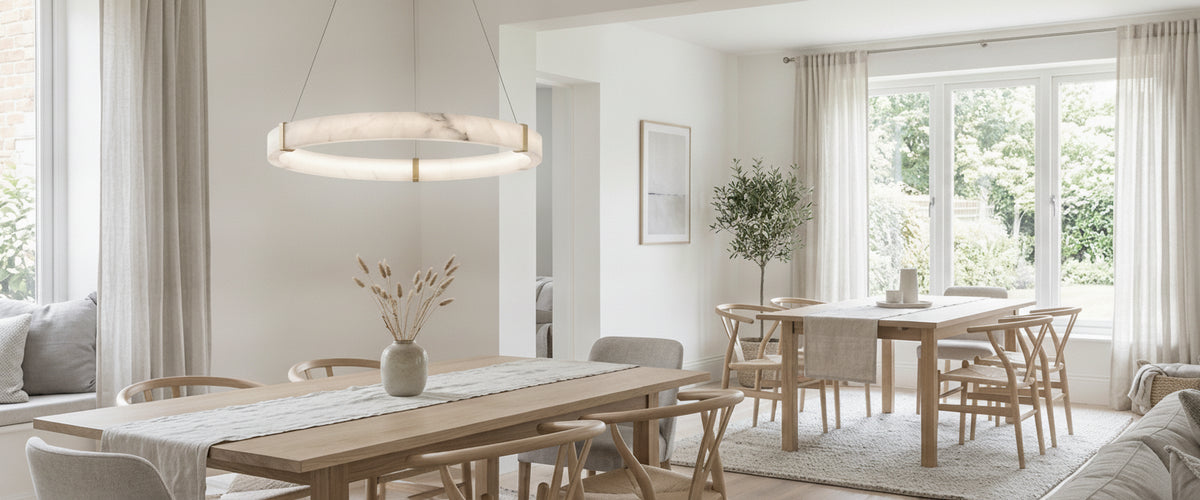

A hand-carved alabaster pendant that shudders at 20 percent is almost never a faulty pendant. Nine times out of ten the culprit is the wall plate, and the dimmer switch LED lights actually need is where most schemes quietly go wrong. This guide covers which dimmer switch LED lights behave with modern drivers: trailing-edge versus leading-edge, why minimum load causes flicker on low-wattage sconces, how multi-gang plates derate once they heat each other, and what a bypass capacitor fixes. You chose the stone, waited weeks for the fitting and had it hung at exactly the right height over the table. The cheapest component in the whole installation should not be the one ruining it.
Get the dimmer switch LED lights need right and a translucent shade fades down to candlelight with no hum and no dead zone at the bottom of the dial. Get it wrong and you see the flicker in the stone before you hear anything. Here is what to check before you buy an LED light dimmer switch, and what to hand your electrician before first fix.

Quick Answer: What Actually Matters
Trailing-edge dimmers suit almost all modern LED lighting, so a trailing-edge dimmer switch LED lights can live with is the sensible starting point. Leading-edge dimmers were built for old incandescent and wirewound transformer loads.
Load ratings decide flicker. Low-wattage circuits often fall below the minimum load rating of the dimmer switch LED lights are wired to, which is why a single sconce misbehaves while a run of five behaves perfectly.
The driver rules. Check whether the fitting is mains dimmable (phase-cut/TRIAC) or needs 1-10V, DALI or a proprietary control, because no dimmer switch LED lights sit behind can override the protocol built into the driver.
Multi-gang plates need derating. Four dimmer modules in one back box rarely each deliver their full rated load.
Hum has causes, not curses. Ghost voltage, a missing bypass capacitor or an untuned dimmer curve explains most of it.
Get a qualified electrician to specify and install any dimmer switch LED lights are connected to. In England and Wales, relevant domestic work falls under Part P of the Building Regulations.

Trailing-Edge Versus Leading-Edge: The Difference That Decides Whether Your LEDs Survive
Both types chop the mains waveform to reduce power; they just chop it at opposite ends. Leading-edge (often called TRIAC) dimmers cut the start of each half-cycle and switch abruptly. That sudden inrush was harmless with a 60W filament lamp, which had thermal inertia and simply glowed a little dimmer. Feed the same spike into a small electronic LED driver and you get audible buzz, visible flicker at the bottom of the range, and in bad cases a driver that fails early. That is the whole case against pressing an old leading-edge plate into service as the dimmer switch LED lights have to sit behind.
Trailing-edge dimmers cut the end of the waveform instead, ramping down more gently. The result is quieter, smoother and far kinder to electronics. If you are specifying a dimmer switch LED lights will run on today, trailing-edge should be the default assumption, and anything else needs a reason. The exception is a handful of drivers that explicitly state leading-edge compatibility, usually in commercial or older retrofit contexts. The manufacturer's compatibility sheet settles it, not the wall plate's marketing copy.
One practical tell: if a house was rewired in the 1990s and the dimmers have never been changed, they are almost certainly leading-edge. Replacing every LED bulb in the room before you swap that plate for a dimmer switch LED lights can actually work with is money spent in the wrong order.
Minimum and Maximum Load: The Numbers That Cause Flicker When Ignored
Every dimmer has a rated range, and with LED the minimum matters more than the maximum. An LED light dimmer switch rated for, say, 10W to 250W of load will do exactly what it promises with a chandelier carrying several lamps. Put a single 4W candle bulb on it and the circuit sits under the minimum threshold, the dimmer cannot read the load reliably, and you get shimmer, cold-start delay or a bulb that simply will not strike at low settings. It is the most common reason a brand new dimmer switch LED lights should have suited feels faulty on day one.
This catches people out with alabaster wall lights more than any other fitting. A pair of stone sconces flanking a bed might draw very little combined wattage, which is wonderful for your energy bill and awkward for a plate designed around older loads. The same applies to slim integrated fittings such as the Aron Dimmable LED Wall Light, where the driver is built in and the total circuit draw can sit in single figures. Two answers exist: choose a dimmer switch LED lights of that size can still register on, rated for very low minimum loads, or fit a load-correction device (see the bypass capacitor section below).
The maximum is simpler but still misread. Manufacturers usually quote one figure for incandescent and a much lower figure for LED, sometimes a fifth of the headline number. Read the LED column. When a client adds a second alabaster pendant to an existing circuit a year later, that quiet arithmetic is what decides whether the dimmer switch LED lights already share can cope.
Match the Dimmer to the Driver, Not Just the Bulb
Integrated LED fittings are where most specification errors happen. With a lamp-holder fixture you can swap in a different dimmable bulb and try again. With an integrated fitting the driver is part of the product, and its control protocol is fixed. Mains-dimmable drivers work happily with a conventional wall plate, the sort of dimmer switch LED lights in most homes already sit behind. Others need 1-10V or 0-10V control, DALI, Casambi or another system, which means extra conductors and a different control module entirely.
Before you buy the dimmer switch LED lights in that room will be stuck with, pull the fitting's spec sheet and look for three things: the dimming protocol, the stated minimum dimming level (10 percent, 1 percent, true dim-to-warm), and any named list of tested plates. Reputable manufacturers publish compatible pairings. If yours does not, treat that silence as a warning. The Energy Saving Trust lighting guidance is a useful sense-check on dimmable LED products in general, but compatibility remains a product-level question rather than a category-level one.
A detail we care about at Niori: alabaster and onyx are not neutral diffusers. Stone carries warm mineral color, and as an LED dims, the perceived warmth of the stone shifts with it. A driver that only dims to 10 percent will make a translucent alabaster shade look flat and slightly clinical at its lowest usable point. One that dims to 1 percent, or dims to warm, lets the veining glow like a lit candle behind marble. That is the difference between owning a stone light and actually enjoying it after dark. If you are still choosing fittings, compare dimming specs across the alabaster lighting collection before you commit to a control scheme and an LED light dimmer switch.
Multi-Gang Plates and Thermal Load
Dimmers produce heat. A single dimmer switch LED lights are wired to sheds it comfortably in a standard back box. Stack four modules behind one brushed brass plate and they heat each other, so manufacturers publish derating tables: a module rated at 250W alone might be limited to 150W or less in a four-gang arrangement. Ignore this and the plate runs hot, the dimming range narrows, and lifespan drops.
Back box depth is the other half of the problem. Shallow boxes leave no air gap and no room for the extra cable a dimmer module needs. On refurbishment projects we routinely suggest asking the electrician to deepen the box at first fix rather than discover the issue on the day the lights go in. Splitting control across two plates in a busy room is often better practice than one crowded four-gang plate, and it also gives you cleaner scene control: pendants on one, sconces on another. Where a circuit is simply on or off and needs no dimming at all, a single-gang plate such as the 10AX 1 Gang 1-Way Switch in white rounded edge keeps that load out of the dimmer box entirely and frees up thermal headroom for the modules that do need it.
Ghost Voltage, Bypass Capacitors and Dimmer Curve Settings
A persistent hum or a bulb that glows faintly when switched off usually traces back to one of three causes. Ghost voltage is induced voltage on a switched live that shares a long cable run with other conductors. It is tiny, harmless to an incandescent lamp, and just enough to make a sensitive driver twitch behind a dimmer switch LED lights would otherwise run on perfectly happily. Some two-way switching arrangements make it worse.
A bypass capacitor (sold as an LED load corrector or dimmer bypass) sits across the load and gives that stray current somewhere to go. It also raises the apparent load, which solves the minimum-load problem described earlier. It is a small component fitted at the light fitting or the back box, and it settles far more complaints about LED lights dimmer switches than people expect.
Then there is the dimmer curve. Better LED light dimmer switches let you trim the minimum and maximum output, either with a small potentiometer or a press-and-hold sequence. Setting the floor just above the point where your specific LEDs start to misbehave removes the dead zone at the bottom of the dial. Twenty minutes of trimming on handover day is one of the highest-value adjustments in a lighting installation, and almost nobody does it.
A designer sent us a video last winter of three alabaster pendants buzzing over an island. Same fitting, same bulbs, no fault in any of them. The dimmer was leading-edge, left over from a previous scheme, and the run was long. A trailing-edge module, one bypass capacitor and a trimmed minimum setting later, the whole run faded to a clean amber with no sound at all.
Choosing the Dimmer Switch LED Lights Need, Room by Room
Kitchens and open-plan spaces benefit from separate control per lighting layer. Pendants over an island want their own dimmer so they can drop to a low glow while task lighting stays bright. Dining rooms are the strongest case for deep dimming; a stone chandelier at 5 percent is the whole reason you bought it. Bedrooms need very low minimums and silent operation, which pushes you towards a quality trailing-edge dimmer switch LED lights can fade smoothly on and, often, a bypass at each sconce.
Bathrooms bring zone restrictions, so the plate normally sits outside the room. Hallways and stairs need two-way or intermediate arrangements, which is exactly where ghost voltage tends to appear, so flag it to your electrician early; where the plate is switched dozens of times a day, a hard-wearing two-way unit like the 10AX 1 Gang 2-Way Wide Rocker Switch in white screwless is the sensible companion to a dimmer at the other end of the run. Hospitality projects are a separate conversation: if you are running scenes across a restaurant or hotel lounge, a DALI or similar addressable system is usually a better investment than twenty individual LED light dimmer switches, and fittings across the wider lighting range should be specified with that protocol in mind from the start.
What Your Electrician Needs Before Installation
The spec sheet for every fitting on the circuit, showing dimming protocol and minimum dim level.
Total LED load in watts, plus any load you expect to add later.
Number of gangs on each plate and the derated per-module rating.
Back box depth at each location.
Whether the circuit is one-way, two-way or intermediate, and the approximate cable run length.
Bypass capacitors on hand for low-load circuits, so there is no second visit.
Your preferred finish and plate style, agreed before first fix.
Dimmer installation is mains work. Have every dimmer switch LED lights depend on fitted by a qualified, registered electrician who can certify it; in England and Wales, relevant domestic electrical work falls under Approved Document P of the Building Regulations, with equivalent rules in Scotland and Northern Ireland. Swapping a plate looks trivial. Getting the certification and the earthing right is not.
One Last Thing About Stone
Alabaster rewards low light in a way frosted glass never quite manages, because the stone is doing the work rather than a coating. Dim it properly and the veining reads like weather in the material. Dim it badly and you see the flicker in the translucency first, before you hear anything. That is why we treat control gear as part of the specification rather than an afterthought, and why the question of which dimmer switch LED lights should sit behind comes up in almost every project conversation at Niori. Choose the LED light dimmer switch with the same care you chose the stone, and the room will settle into exactly the light you imagined.