

Every flaw in a bathroom lighting scheme eventually lands on your face. The mirror sits inches from your nose and glazed tile throws light straight back at you, while steam finds any badly sealed joint within a year or two. That is why bathroom LED strip lighting rewards careful specification more than anywhere else in the house. Cheap or poorly placed bathroom led strip lights show their guesswork every morning.
Done well, bathroom LED strip lighting is genuinely useful. It can float a vanity, outline a mirror and give a shower niche a soft glow. It can also make a beautiful room look like a highway rest stop. The difference comes down to a handful of decisions, and none of them is the price of the reel.
At a Glance
Color temperature: 2700K to 3000K at the mirror, with a color rendering index (CRI) of 90 or higher.
IP rating: IPX4 is the floor in zones 1 and 2. Inside a bath or shower tray you need IPX7 and safety extra-low voltage.
Drivers: outside the zones, ventilated, and reachable without pulling tiles off.
Strip type: COB strips in an aluminum profile with an opal diffuser, so glossy tile does not reflect a row of dots.
Wiring: a qualified electrician for any bathroom LED strip lighting, every time.

Why the Bathroom Punishes Bad Strip Placement
In a living room, a slightly cool strip under a shelf is a minor irritation. With bathroom LED strip lighting, the same strip sits beside a mirror you use for shaving, makeup and checking your skin. It is surrounded by hard, reflective surfaces with nothing soft to absorb the error. Porcelain, polished plaster, chrome and glass all bounce light around, so any glare, color cast or visible LED dot gets multiplied.
Humidity is the second problem. A strip that looks fine on day one can yellow, flicker or fail within a couple of winters if its coating, end caps or joints were never meant for a steam room. Most of the bathroom LED strip lighting failures we hear about from clients trace back to installation details, not faulty LEDs.

2700K Versus 4000K at the Mirror
This is the decision people get wrong most often, usually because 4000K is sold as "crisp" or "bright". At a mirror, 4000K neutral white bathroom LED strip lighting tends to read as clinical. It flattens skin tones, emphasizes shadows under the eyes and makes a bathroom at 11pm feel like a pharmacy. 2700K is warmer and kinder, closer to the glow of a traditional incandescent lamp. It suits evening bathing without fighting the rest of the house.
The pattern is a familiar one. Someone fits 4000K bathroom led strip lights around a backlit mirror, then wonders why a new marble vanity looks gray and dull. Swapping to a 2700K strip with a CRI above 90 usually brings the veining back, and skin tones with it. Color rendering matters as much as warmth here: a low-CRI warm strip can still make skin look waxy.
If two people share a bathroom and one wants brighter morning light, tuneable white bathroom LED strip lighting is worth considering. A COB strip such as the COB LED Strip 14W/m Tuneable White keeps the line dot-free on glossy tile. It also lets you run cooler first thing and drop to the warm end of its range for a bath in the evening. That only works if the controller and driver are specified together.
IP Ratings for Bathroom LED Strip Lighting: Minimums, Not Guidelines
The IP code, defined in the international standard IEC 60529, describes how well an enclosure keeps out solids and water. In a UK bathroom, BS 7671 divides the room into zones, and the rating you need depends on where the strip sits:
Zone 0 (inside the bath or shower tray): IPX7 minimum, and the strip must run at safety extra-low voltage from a source outside the zones.
Zone 1 (above the bath or shower up to about 7.4 feet (2.25 meters)): IPX4 minimum, IPX5 where jets of water could hit it.
Zone 2 (about 2 feet (0.6 meters) beyond zone 1, which often takes in a basin sited close to the bath or shower): IPX4 minimum.
Outside the zones: no formal requirement, though we would still choose IP44 or better for any strip near a basin or a steamy shower enclosure.
For bathroom LED strip lighting, treat these numbers as the safety floor and aim above them. For a shower niche, a sealed silicone-extruded IP67 strip will outlast an IP65 coated strip, which can discolor after years of hot steam. Your electrician will confirm which zone each run falls in. A mirror strip that looks safely clear of the shower can sit inside zone 2 once the measurements are taken.
Where Strips Add Depth, and Where They Flatten a Tiled Wall
Bathroom LED strip lighting works best when the source is hidden and the light lands on something worth seeing. Three placements consistently earn their place:
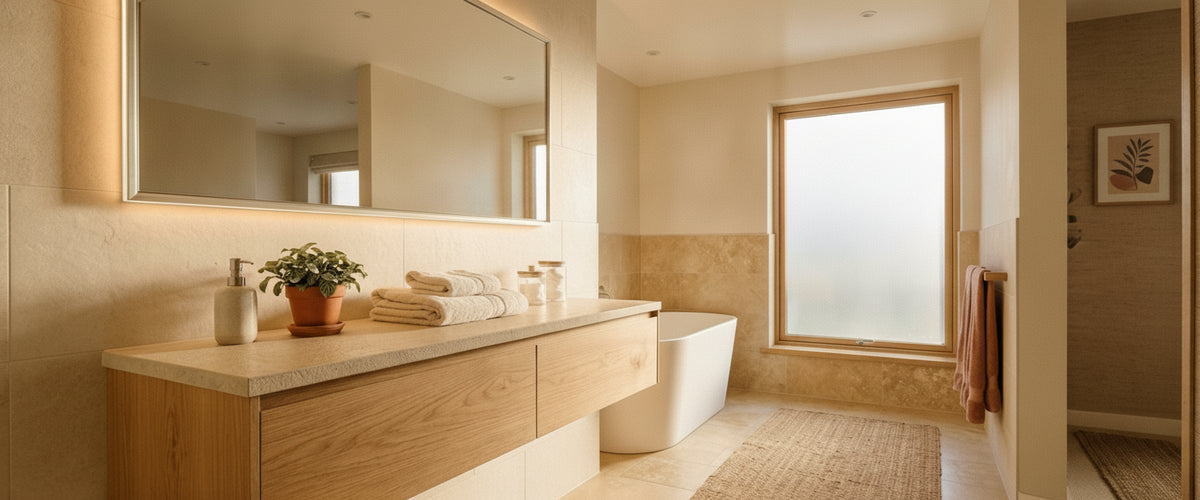
Under a wall-hung vanity: a strip set back under the unit throws a soft pool across the floor. It makes the vanity appear to float and gives you a gentle night light.
Behind a mirror: a halo of 2700K light off the wall adds depth without pointing light into your eyes.
The top edge of a shower niche: recessed in a profile, it lights the bottles and the tile inside without glare.
The run under a vanity is often the easiest bathroom LED strip lighting to get right, since it usually sits outside the zones or in zone 2, away from direct spray. There, a warm white COB strip such as the COB LED Strip 14.4W/m Warm White makes more sense than a cool reel. Its IP65 coating comfortably clears the IPX4 minimum, and the continuous line will not show as dots on a polished floor. Check its Kelvin and CRI against the mirror light before ordering so the two match. Keep the sealed IP67 option for the niche itself.
Grazing a large tiled wall is where bathroom LED strip lighting goes wrong. Light skimming across tile reveals every lip between tiles, every uneven grout line and every spot of limescale. Handmade zellige can look beautiful with a graze; large-format porcelain fitted slightly out of plane will look like a plowed field. Before committing, hold a flashlight flat against the wall at night and look along it. If you do not like what you see, wash the wall from further away or light it another way.
Drivers, Dimmers and Waterproof Connectors
In any bathroom LED strip lighting scheme, the strip is the cheap, replaceable part. The driver, the dimmer and the joints decide whether the installation lasts a decade or a single winter.
Drivers. Bathroom LED strip lighting usually runs at 24V, and the driver converts mains to that low voltage. It should sit outside the bathroom or well outside the zones, in a ventilated, accessible void. We regularly see drivers buried behind tiled walls with no access panel, which turns a routine replacement into a retiling job. Size the driver with headroom rather than running it at its limit. Feed long runs from both ends to avoid voltage drop, which leaves the far end visibly dimmer and can shift the color of tuneable strips.
Dimmers. The dimmer and driver must speak the same language. A mains phase dimmer needs a driver rated for it, while DALI, 0-10V and wireless systems need compatible drivers. Mismatches cause flicker, buzzing and a dimming curve that jumps from glowing to dark with nothing in between. Bathroom LED strip lighting should be dimmable; dropping a mirror strip to a low warm glow is what makes a late bath feel calm.
Connectors and end caps. Clip-on connectors have no place in bathroom LED strip lighting, because humid rooms work them loose. Soldered joints sealed with adhesive-lined heat shrink, and end caps sealed with a neutral-cure silicone, hold up far better. The acetic-cure silicone sold for sealing baths gives off acid as it cures and can corrode the copper on the strip. We have seen niche strips turn green and fail within months because of it.
How Strips Sit Alongside Alabaster and Natural Stone
At Niori, we think of bathroom LED strip lighting as the background layer, the light you feel rather than notice. The light you actually look at should come from something with character. An alabaster wall light either side of the mirror gives warm, diffused light from the sides, which is the most flattering direction for a face. A 2700K strip under the vanity then fills the room quietly. Match the color temperatures so the stone and the strip read as one warm scheme.
One material note matters here. Alabaster is a form of gypsum and is softer and more water-sensitive than marble or onyx. Keep alabaster fixtures outside the wet zones and make sure the bathroom has a decent extractor fan. Placed sensibly beside a basin in a well-ventilated room, an alabaster sconce lasts for many years. You can see wall lights and pendants suited to that role in our alabaster lighting collection.
Choosing Bathroom LED Light Strips: Decision Criteria
When comparing bathroom LED light strips, use these criteria in roughly this order:
Zone and IP rating: confirm the zone first, then choose a rating that clears it comfortably.
Color temperature and CRI: 2700K or 3000K, CRI 90 or above, for anywhere near a mirror.
Strip type: COB for dot-free lines on glossy surfaces; standard SMD only where the strip is fully hidden.
Profile and diffuser: aluminum for heat dissipation, opal diffuser for an even line, sealed end caps.
Voltage and run length: 24V for most bathroom runs, with feed points planned for long lengths.
Driver and control: dimmable, compatible with your switch or system, and installed where it can be replaced.
Color-changing bathroom LED strip lighting has its place in a spa or hotel, but in a home it tends to date quickly. A good warm white, well placed, does more for the room.
How to Install LED Strip Lights in a Bathroom: A Planning Checklist
This is the preparation you can do before your electrician arrives. It is not a DIY wiring guide.
Mark each strip position on a drawing and note which zone it falls in.
Decide where the driver will live and plan an access panel.
Choose profiles and recess details before tiling, so channels can be cut and tiles finished neatly around them.
Agree the switching: separate circuits for mirror and vanity strips give you far more control.
Specify neutral-cure silicone and sealed connectors in writing for the installer.
Test the strip color against your tile and stone samples at night, not in a showroom.
Why a Qualified Electrician Must Wire It
Water, mains voltage and bare skin are the reason bathrooms have their own section in the wiring regulations. Bathroom LED strip lighting needs correct zone assessment, SELV supplies where required, 30mA RCD protection and the right earthing and bonding decisions. In England, much bathroom work is notifiable under Part P of the Building Regulations. Use a registered, qualified electrician, keep the certificate, and treat "plug-in" strip kits as unsuitable for bathrooms.
Get those foundations right and your bathroom LED strip lighting will quietly do its job for years, leaving the alabaster and stone to provide the warmth. If you are planning the full scheme, the wider niori lighting range covers the pendants, wall lights and lamps that carry a room once the strips are in.