
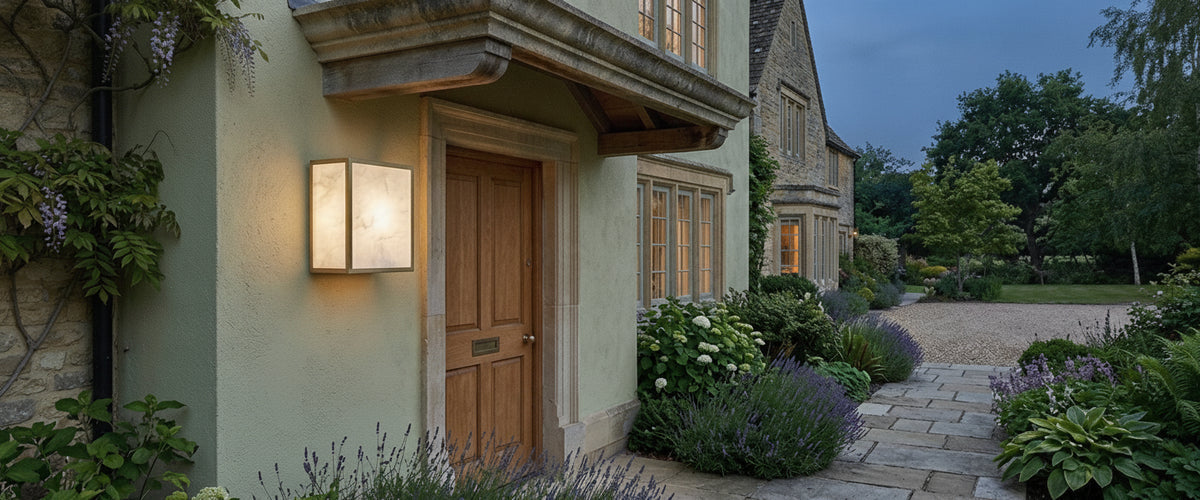

Most lanterns sold as suitable for indoors and outdoors are outdoor lanterns that someone hoped would look fine in a hallway. A few manage both. The difference shows once rain blows sideways across an exposed porch, or once the same fitting hangs against a pale painted wall and suddenly looks like it belongs on a railway platform. If you want an indoor outdoor lantern so the front door and the entrance hall read as one considered scheme, here is how we test the claim at Niori. We spend most of our time looking at how alabaster, natural stone, glass and brass behave under real light, and that shapes the advice below.

Key Takeaways
- Dual-rated means the fitting is sealed for weather. It says nothing about whether the light quality or styling suits a living space.
- IP44 is fine under a deep canopy. An exposed wall facing the prevailing weather needs IP65.
- Finish matters more than form. Solid brass, bronze and good powder coat age well. Thin plating and cheap chrome do not.
- Scale shifts at the door. A lantern sized for a hall ceiling often overwhelms a domestic porch.
- Alabaster and thin stone shades are indoor materials. Pair them with a weather-rated glass and metal lantern outside rather than forcing one fitting to do everything.

What Dual-Rated Actually Means for an Indoor Outdoor Lantern
A dual-rated lantern carries an ingress protection rating high enough for outdoor use, plus a design that a manufacturer believes will sit comfortably inside. Indoors, that IP rating is mostly irrelevant. A dry hallway asks nothing of a gasket. So the useful question is whether the outdoor-grade fitting gives you anything you would want indoors, or whether you are paying for weatherproofing you will never use.
There are places where the crossover is a genuine advantage. Covered loggias, orangeries, garden rooms, boot rooms and open porches that flow into a hall all sit in a halfway zone of damp air, condensation and swinging temperatures. An indoor outdoor lantern earns its keep there because a purely interior fitting can corrode at the terminals or cloud behind the glass within a couple of winters.
An indoor outdoor lantern turns into marketing when the indoor half simply means it will switch on inside. Watch for ribbed or heavily textured glazing that throws a harsh, broken light, integrated LED modules running at a cool 4000K, and photocell sensors you would never want in a hallway. Those features are right for a side passage. In a hall they read as utility.
IP Ratings in Plain Terms
An IP code has two digits. The first covers solids such as dust and fingers. The second covers water. The International Electrotechnical Commission's IP rating guide sets out the full scale, but for an indoor outdoor lantern three ratings do most of the work:
- IP44: keeps out objects larger than 1mm and splashing water from any direction. Right for a porch with a proper canopy or a recessed doorway.
- IP54: adds dust protection with the same splash resistance. A sensible middle ground for semi-sheltered walls.
- IP65: dust-tight and protected against water jets. This is what an exposed garden wall needs, especially one facing the prevailing south-westerly weather.
Here is why IP44 fails on an open wall. Splash protection assumes water arriving at modest force. Wind-driven rain hits harder and finds the cable entry, the glazing seal and the top cap. A common failure is an IP44 lantern that looks perfect from the front while water collects at the back plate, because it was fixed to a gable end with no overhang. For a wall with some shelter from a canopy or a deep reveal, a traditional black coach lamp at IP54, such as the Outdoor LED Wall Lantern, Black Traditional Coach Lamp IP54, is a sensible match; a bare gable end still calls for IP65. The rating also only holds if the fitting is installed as intended, gasket seated and cable gland tightened. Outdoor connections should always be made by a qualified electrician.
Finishes That Survive Weather Without Looking Clinical Indoors
The finish decides whether an indoor outdoor lantern looks at home in both settings. Brushed stainless steel lasts well outside, and marine-grade 316 holds up near the coast, but indoors it can feel like a commercial kitchen. Powder-coated aluminium in black or anthracite is durable and neutral. It suits a modern hall but can look flat in a period house.
Solid brass and bronze are the most convincing crossover metals. Unlacquered brass will darken outdoors, and that is the point. Over its first winter by an exposed porch, an antique brass lantern typically settles into a deep, uneven walnut tone that sits far better against granite or old stone than the bright finish it arrived with. Lacquered brass keeps its colour longer, but once the lacquer breaks down outside it patinates in patches, which is harder to live with.
Glazing is the other half of the equation. Clear glass shows the lamp and works with a decorative filament bulb. Seeded glass softens glare. Opal or frosted glass comes closest to the soft, wraparound glow of a stone shade. That is where honesty matters: alabaster is a form of gypsum, soft and slightly porous, and it marks and weakens with persistent moisture. Thin translucent marble and onyx shades are also best kept in dry interior air. If you love that diffused stone light, keep it inside the door. Choose something from our alabaster lighting collection for the hall, and let a frosted glass and brass lantern carry the same warmth outside.
Painted Hallway or Stone Facade: How the Same Lantern Reads
Put an identical black lantern in two places and you get two different objects. Against a pale, flat painted hallway wall it becomes a hard graphic silhouette. Every glazing bar throws a shadow, and with a clear-glass fitting you get a grid pattern across the plaster. Some people love that. Others find it busy, particularly in a narrow hall where the wall is close to the eye.
On a stone or brick exterior the same black frame melts into the texture, and the glow does most of the work. Honey-toned limestone such as Bath stone warms the light further. Grey slate and pale render cool it down. Antique brass and bronze tend to look richer on stone than on paint, while a crisp black or anthracite finish often suits a painted interior better. If you want one indoor outdoor lantern for both, test the finish against both surfaces before you commit. A sample held up at dusk tells you more than any product photograph.
Scale Drift: Why the Hall Lantern Swamps the Porch
Hall lanterns are usually chosen for ceiling height and stairwell volume. A porch is a different space entirely: a door roughly 2.1 metres (7 feet) high, a canopy that may sit only a little above it, and a wall seen up close by anyone reaching for a key.
Take a typical Victorian terrace where the owners want the same hanging lantern in the hall and under the porch canopy. In a tall hall it can be exactly right. Under a low canopy the same pendant can leave well under 2 metres (about 6.5 feet) of headroom and fill the space from post to post. The better answer is usually a smaller wall-mounted version in the same finish and glass.
The same logic holds when you plan from scratch. A hanging fitting such as the Lantern 1 Light Pendant, Bronze belongs in the height of a hall or stairwell, while the porch is better served by a compact wall lantern in a matching dark metal, so the finish carries through without the scale following it outside.
Some working rules:
- For a pair of wall lanterns either side of a door, each should be roughly a quarter of the door's height.
- A single lantern beside the door can go larger, to about a third of the door height.
- Mount wall lanterns so the light source sits just above eye level, roughly 1.6 to 1.8 metres (5.25 to 6 feet) from the ground.
- Indoors, keep the bottom of a hanging lantern at least 2.1 metres (7 feet) above the floor in walkways.
Cut a cardboard template to size and tape it up in both positions. It takes ten minutes and saves a return.
Bulbs, Colour Temperature and Dimming
Colour temperature is where an indoor outdoor lantern scheme usually falls apart. Many outdoor lanterns ship with integrated 4000K LEDs. Open the front door onto a warm 2700K hallway lit by alabaster and the two lights fight each other in the threshold. Keep both sides at 2700K to 3000K, and look for a colour rendering index of 90 or above so stone, timber and skin tones look natural.
Replaceable E27 or E14 lamps give you more control than integrated modules, and a good LED filament bulb flatters clear and seeded glass. Outside, a lamp-holder fitting such as the Outdoor Wall Lantern, Anthracite E27 lets you use the same warm bulb as the hall, rather than living with whatever module the factory chose. Indoors, check that both bulb and fitting are dimmable, and that your dimmer suits LED loads. Outdoors, a photocell or a timer at the switch is often more useful than dimming. A lantern burning at full output beside a dark garden reads as glare from the street.
Where the Crossover Breaks Down
Sometimes an indoor outdoor lantern is the wrong tool, and two separate fittings are the only honest answer. That applies to:
- Bathrooms: fittings near baths and showers fall under specific zone rules within BS 7671, the IET Wiring Regulations. An IP rating alone does not make a porch lantern suitable for a given zone, so ask your electrician before you buy.
- Exposed coastal elevations: salt air defeats most plated finishes. Outside you need marine-grade stainless, solid bronze or solid brass, and stainless in particular rarely suits a living room.
- Stone light inside: if the hall calls for the diffused glow of alabaster or onyx, no outdoor-rated lantern will reproduce it.
- Different jobs: a hall needs soft, even ambient light. A porch needs shielded downward light that shows the step without spilling into the night sky.
Solve these with a family approach rather than a single fitting: matching metal finish, related glass, identical colour temperature, scaled for each space. Browsing our wider lighting range by finish rather than by room is the quickest way to build that pairing.
Buyer's Checklist Before You Order
- Confirm the IP rating against the real exposure of the wall, not the best-case porch.
- Check the finish is solid metal or quality powder coat, not thin plating.
- Choose glazing for the light you want: clear for sparkle, seeded or frosted for softness.
- Match colour temperature on both sides of the door, ideally 2700K to 3000K.
- Template the scale in both locations and measure headroom under any canopy.
- Keep alabaster, marble and onyx shades indoors, away from steam and weather.
- Have a qualified electrician install and seal every outdoor connection.
A well-chosen indoor outdoor lantern can tie a house together from the front path to the foot of the stairs. Just be clear about where one fitting genuinely suits both settings, and where a matched pair will look better and last longer.