
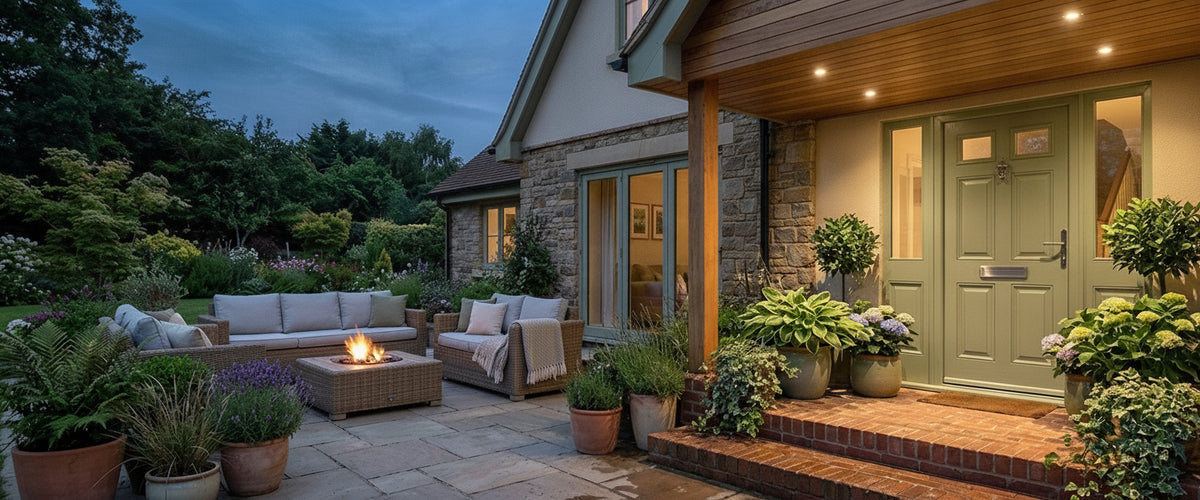

A wall light gets rain on its hood. A step light gets rain, puddles, grit, frost, garden chemicals, pressure washers and the occasional boot heel, often in the same week. That gap is why recessed LED outdoor lights fail so often. A fitting that would last a decade on a wall can mist up, discolour or go dark within a couple of winters once it is set into a riser or a terrace. Choosing well is mostly a matter of matching the specification to the position, so that is where this guide starts.

Key Takeaways
- Position sets the rating: a sheltered riser, a walk-over deck and a pond edge each need a different IP rating. Do not buy one fitting for all three.
- Heat needs somewhere to go: a sealed recess traps driver heat. Check the rated ambient temperature, and use a remote driver where you can.
- Finish matters more than style: marine-grade stainless steel, solid brass and bronze outlast painted or plated aluminium at ground level.
- Low light behaves differently: a 2700K beam aimed across stone from ankle height can read warmer or cooler depending on the surface, and almost always harsher than the same colour temperature from above. Shield the source.
- Check before sealing: most failures are built in on installation day, not by the weather.

Why Ground Level Punishes Recessed LED Outdoor Fittings
Gravity is generous to a wall light. Water runs off a downward-facing hood, debris falls away and the glass rarely sits wet for long. Turn the same fitting to face sideways from a riser, or upward from paving, and everything collects on it instead. Leaves gather in the bezel. Grit from the garden path sits against the gasket. Water pools on the lens after rain, and in a cold snap it freezes there.
Then there is the work around them. Lawnmowers, strimmers and jet washers all hit ground-level fittings in a way they never reach a wall. A jet wash on a limestone terrace can drive water past a gasket rated only for rain. De-icing salt on steps near the front door adds a chloride load that eats cheaper metals quickly. So the honest starting point for any recessed LED outdoor scheme is to assume every fitting will be wet, dirty and knocked about, and to specify accordingly.
IP65, IP67, IP68: Matching the Rating to the Position
The IP code, set out under the IEC's ingress protection standard, has two digits. The first covers dust and solids; a 6 means dust-tight. The second covers water, and that is the number that decides where a recessed LED outdoor fitting can go.
- IP65 for sheltered risers: protection against low-pressure water jets from any direction. Fine for outdoor recessed step lights set into the vertical face of a covered or well-drained step, where water runs past rather than sitting on the lens.
- IP67 for decks and paving: protection against temporary immersion. Any fitting set flush into a walking surface will sit in standing water after heavy rain, so IP65 is not enough here, however good the gasket looks.
- IP68 below a waterline: rated for continuous immersion, but only to the depth and duration the manufacturer states. IP68 on its own is not a promise; ask for the depth figure in writing for pond, rill or pool-edge positions.
Two extras are worth checking for walk-over positions. An IK rating tells you how well the fitting resists impact, and a load rating tells you whether it is designed to be stood on or driven over. A fitting on a garden path and one in a gravel driveway are very different problems.
The Hidden Driver Problem in a Recessed Fitting
LEDs run cool compared with old halogen lamps, but the driver that powers them still makes heat, and so does the LED chip itself. On a wall, that heat leaves through the body into open air. In a recess cut into stone or brick, sealed against water on every side, it has nowhere to go. Heat shortens LED life and shifts colour over time, so a fitting that was warm white on day one can drift greenish or pinkish by its third summer.
Look for the rated ambient temperature (often written as ta) on the spec sheet and check it against a south-facing terrace in July, not a mild spring evening. Where possible, choose recessed LED outdoor lights with a remote driver housed in an accessible, ventilated junction box rather than inside the fitting. A remote driver also makes replacement far easier: when it eventually fails, nobody wants to lift a riser to reach it.
Sealed fittings also breathe as they warm and cool. Each cycle can pull a little moist air past the seals, which is why condensation appears inside the lens. Good manufacturers use breather membranes or properly specified cable glands to manage this. If a sample fitting has neither, ask how it handles it.
Finishes That Last and Finishes That Corrode by Spring
The finish is where the cheapest recessed LED outdoor fittings give themselves away, usually within one winter. Powder-coated die-cast aluminium looks smart in the showroom, but once a stone chip or a mower blade breaks the coat, corrosion creeps underneath and lifts it in blisters. Chrome and plated finishes pit near salt. Even 304 stainless steel can show brown tea-staining in coastal gardens or near a gritted path.
- 316 marine-grade stainless steel: the safe default near the sea, pools or anywhere de-icing salt is used.
- Solid brass or bronze: darkens to a soft patina rather than corroding, and sits well against York stone, slate and old brick.
- Hard anodised aluminium: acceptable in sheltered risers, less so in walk-over positions where abrasion wears the surface.
Mind the fixings too. A brass bezel held with zinc-plated screws sets up galvanic corrosion where the two metals meet, and the screws go first. Ask for fixings in a matching metal, and keep fresh lime or cement mortar from sitting against the bezel while it cures.
Beam Angle at Ankle Height: Why Upward Light Reads Differently
Here is the part most buyers do not expect. Colour temperature on a spec sheet is measured at the source, but you never see the source alone. A 2700K beam from a ceiling pendant falls onto pale surfaces and spreads around the room. The same 2700K from a step light skims across stone at a low angle, picks out every grain and mark, and often shines straight into the eyes of someone coming down the steps. It reads more orange on warm sandstone, cooler on blue-grey slate, and far more glaring than the number suggests.
So for recessed outdoor step lighting, choose louvred, hooded or asymmetric faces that throw light down across the tread instead of out into the garden. Keep output modest; steps need definition, not floodlighting, and a dimmable circuit lets you set the level once you can see it on site. Good colour rendering (CRI 90 or above) keeps natural stone looking like stone rather than putty.
Think about the view from inside, too. Cool white step lights fitted just beyond the glazing are a common mistake: from the dining table, the honey glow of an alabaster pendant suddenly looks tired and slightly muddy next to them, and the terrace reads as a car park. Swapping the step lights to 2700K usually fixes it. If your interiors use warm diffused stone light, such as the pieces in Niori's alabaster lighting collection, match the outdoor colour temperature to it so the garden reads as a continuation of the room, not a different building.
Where Alabaster Belongs, and Where It Does Not
As an alabaster and natural-stone lighting brand, we are often asked whether an alabaster shade can go outside. It cannot. Alabaster is a form of gypsum: soft, slightly porous and mildly soluble in water, which is exactly why it glows so gently indoors and why rain and frost would ruin it outdoors. The better approach is to use hard-wearing recessed LED outdoor fittings to guide people to the door, then let a hallway pendant just inside the entrance, a wall light or a table lamp by the window carry that warm tone across the threshold. The wider lighting range is worth looking through with that handover in mind.
Buyer Checklist: Choosing Outdoor Recessed Step Lights
- Name the position first: riser, walk-over surface or submerged. Then set the IP rating, IK rating and load rating to suit.
- Ask for the rated ambient temperature and whether the driver is integral or remote.
- Specify the metal: 316 stainless, brass or bronze for anything exposed, with matching fixings.
- Check the optic: shielded, louvred or asymmetric for steps; no bare LED visible from the approach.
- Match colour temperature to the interior lighting seen through the glazing, usually 2700K or 3000K.
- Confirm dimming compatibility between the fittings, driver and control before ordering.
- Plan replacement: can a driver or LED module be changed without breaking stone?
Installation Checks Before Any Sealant Goes In
All outdoor electrical work should be carried out by a qualified electrician registered with a competent person scheme. In England and Wales, new outdoor circuits fall under Part P of the Building Regulations and need RCD protection under BS 7671. Treat what follows as the conversation to have with your electrician, not a DIY method.
- Drainage behind the fitting: a gravel bed or drain path below in-ground fittings so water does not sit in the sleeve.
- Correct installation sleeve: use the manufacturer's mounting box, set level and flush, so the gasket compresses evenly.
- Gland and cable match: the cable diameter must suit the gland, or the seal is compromised from day one.
- Waterproof connectors: gel-filled or IP68 junctions, located where they can be reached later.
- Test before sealing: run every fitting for a few hours, check dimming and colour consistency, and only then finish the stonework.
- Record positions: photograph cable runs and junction boxes before they disappear under paving.
Done properly, recessed LED outdoor lighting should be the part of the scheme you stop noticing: steady, warm and sure underfoot. For the rooms those steps lead to, the Niori range of alabaster, marble and onyx fittings is designed to pick up where the garden light leaves off. For hospitality or larger design projects, request a tailored quote, since budget depends on material, scale, engineering, installation and finishing.