
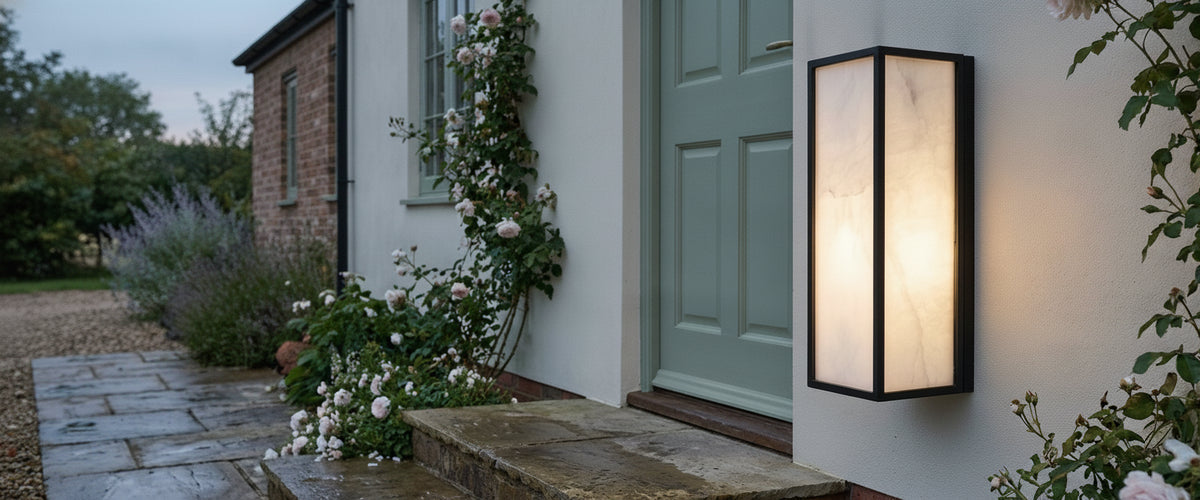

Most front-door lights fail quietly. They look sharp in the product photo, then sit slightly too small beside the door, glare at visitors, or blister at the screw holes by the second February. A modern outdoor wall lantern has more to prove than almost any other fitting in the house. It has to suit the wall it is fixed to, clear the door that swings past it, and stand up to weather that indoor lighting never faces. Nearly every one of those problems can be settled before the order goes in.

Quick Answer
Match the finish to the wall: matte black is crisp on pale render and tends to vanish against dark brick in daylight.
Measure projection before style: check the door swing, any storm porch and the path people actually walk.
Pay for the finish, not the silhouette: galvanized or marine-grade treatment matters more on exposed and coastal walls.
Choose the diffuser deliberately: clear glass sparkles, frosted glass lights the step. They do different jobs.
Size by the door: roughly a quarter to a third of the door height for each lantern in a pair.
Read the IP rating against the wall's exposure: IP44 suits a deep recess; IP65 is the safer call for an open, weather-facing elevation.

Why a Modern Outdoor Wall Lantern Reads Differently on Brick, Render and Timber
"Modern" is not a fixed look. The same cylinder or cone can read as architectural on one house and as an afterthought on the next, and the wall material decides which.
Brick is busy. Its texture and mortar lines compete with fine detailing, so a modern outdoor wall lantern with a strong, simple profile holds up better than a slim, delicate one. Black against red or brown brick can disappear in daylight; graphite, bronze or a warm metallic tone usually gives clearer definition. Wherever possible, fix into the mortar joints rather than the brick face. A mortar joint can be repointed. A cracked facing brick is a far bigger repair, particularly on an older or listed property.
Render is the opposite problem. It is calm, pale and unforgiving. Every shadow line shows, so an up-and-down lantern will throw two scallops of light that reveal every ripple in the finish. That can be handsome on a smooth, well-applied render and unkind on a patched one. Matte black and dark bronze look their most deliberate here.
Matte black reads crisply against smooth, pale render.
Timber cladding needs a mounting block behind the fitting so the backplate sits flat and water cannot track behind the boards through the cable entry. Warm finishes such as brushed brass sit naturally against oak or cedar, while a dark modern outdoor wall lantern on charred or stained timber reads as a quiet, tonal detail.
Porch Depth and Projection: The Geometry Buyers Skip
Projection is how far a modern outdoor wall lantern stands off the wall, and it is the measurement that most often turns a confident choice into a return. Before you look at finishes, stand at the door with a tape measure and check three things:
The door swing. Open the front door fully. Note where its edge, handle and any letterbox flap travel. A lantern within that arc will be knocked within weeks.
The walking line. On a narrow path or a tight porch, a deep lantern sits at shoulder height exactly where people turn with shopping bags.
The canopy. Under a porch roof, an uplighting lantern needs enough clearance to wash the soffit rather than throw a hard bright spot onto it. A downlighter is usually the better fit in a shallow recess.
A practical rule: the shallower the porch, the flatter the lantern. Box and cylinder forms with a shallow backplate suit tight thresholds; projecting lanterns with arms or brackets want an open wall where they can be seen from the side.
Powder Coat, Galvanized Steel and Marine-Grade Finishes: What British Winters Test
On a modern outdoor wall lantern, the silhouette is what you buy. The finish is what you live with. Wet, mild British winters are hard on metal because surfaces rarely dry out completely, and salt air speeds everything up for any modern wall lantern outdoors on the coast.
Powder-coated aluminum is light and will not rust, but the coating is only as good as the preparation beneath it. Once it is chipped, often at fixing points or during installation, moisture creeps under and the finish lifts.
Galvanized steel carries a zinc layer that protects the steel even where the surface is scratched. The Galvanizers Association explains how hot-dip galvanizing bonds zinc to steel. Galvanized and then powder-coated, often called duplex coating, is a strong choice for exposed walls.
Marine-grade finishes, usually 316 stainless steel or specially treated aluminum and brass, are the sensible baseline within a few miles of the sea.
One failure is worth knowing about on exposed coastal walls. A powder-coated lantern body can look fine after two winters while the cheap zinc-plated screws holding it have already rusted and streaked down the render. Ask what the fixings are made of, not only the lantern. Stainless screws cost little and save a repaint.
Clear Versus Frosted Diffusers: Functionally Opposite Fittings
Buyers often treat the diffuser as a style detail. In practice, clear and frosted glass turn the same body into two different lights.
Clear glass puts the light source on show. It gives sparkle and a crisp outline, and works with a decorative filament-style LED at low output. Push the brightness up and it glares: visitors squint at the bulb rather than seeing the step, and neighbors notice it from across the road. DarkSky International makes a useful case for shielded, downward-facing outdoor light to cut glare and spill, and clear-glass lanterns are where that advice bites hardest.
Frosted or opal glass hides the source and spreads light evenly across the doorway, the house number and the keyhole. It suits integrated LED modules and higher output without the harshness. If the modern outdoor wall lantern is your main entrance light, frosted is usually the more useful choice; if it is a decorative accent beside a separately lit door, clear can earn its place.
Whichever you choose, keep the color temperature warm. Around 2700K flatters brick, timber and stone, while cooler light makes a front elevation look like a car park. Dusk-to-dawn sensors and dimmable drivers let you run a lantern softly all evening instead of at full blast.
Scale and Mounting Height: The Two Numbers That Decide Confident or Awkward
An undersized modern outdoor wall lantern is the most common mistake on front elevations, partly because any outdoor wall lantern, modern or traditional, looks larger on a screen than it does on a wall. For a pair either side of a door, aim for each lantern to be roughly a quarter to a third of the door's height. A single lantern beside the door should sit at the top of that range, close to a third, so it does not look lost.
Mounting height usually works best with the center of the fitting slightly above eye level, around 5.5 to 6 ft (1.7 to 1.8 m) from the finished ground, or aligned with the upper third of the door frame. Too low and it glares into faces; too high and it lights the top of the door rather than the person standing at it. Garage and side elevations can go higher, especially with frosted glass.
A pair sized to the door, centered just above eye level.
A quick trick from the studio: cut a cardboard template to the lantern's size and tape it to the wall. Look at it from the sidewalk and from the drive, not just from the doorstep. Ten minutes with tape saves weeks of second thoughts.
IP Ratings on a North-Facing Wall Versus a Sheltered Recess
The IP rating is the least glamorous spec on a modern wall lantern, and one of the most important. It has two digits: the first covers solid particles such as dust, the second covers water. For outdoor lighting, the second digit is the one to read closely.
IP44 protects against splashing water. It is adequate under a deep porch or in a recessed entrance that rain rarely reaches directly.
IP65 protects against water jets and is the sensible choice for open walls, especially those facing the prevailing wind or catching driving rain.
North-facing walls deserve extra caution. They stay damp longer, grow algae more readily and see little sun to dry out seals and glass. An outdoor modern wall lantern on that kind of wall should be IP65 with a well-sealed backplate, even if the brochure suggests IP44 is enough. Outdoor circuits should be installed by a qualified, registered electrician, who can also advise on RCD protection and where the cable enters the wall.
Where Alabaster Belongs in an Entrance Scheme
Alabaster is a soft, gypsum-based stone and does not belong on an exposed outside wall: moisture and frost will dull and erode it. What it does superbly is finish the inside of the threshold. At Niori we often suggest pairing a crisp modern outdoor wall lantern with an alabaster wall light in the hallway behind the front door. Arriving guests move from clean, controlled outdoor light into the warm, diffused glow of stone, and the entrance feels considered from both sides.
The same scale logic applies indoors. In a narrow hallway, where a deep fitting would catch shoulders and coats, a compact piece such as the Selvara LED Small Alabaster Wall Light gives that stone glow without crowding the wall. On a wider hall or a long, uninterrupted run of wall, the Selvara LED Medium Alabaster Wall Light holds its own better, and its brushed brass detail picks up a brass or bronze lantern outside. Our alabaster lighting collection is the place to compare sizes and finishes for the hallway side of the scheme.
Buyer's Checklist Before You Order
Photograph the wall in daylight and decide whether the lantern should contrast with or blend into the material.
Measure the door swing, porch depth and walking line, then set a maximum projection.
Confirm the finish and the fixings suit your exposure, especially near the coast.
Choose clear or frosted glass based on whether the lantern is the main entrance light.
Size it at roughly a quarter to a third of the door height and test with a template.
Specify IP65 for open or north-facing walls; IP44 only in genuinely sheltered recesses.
Plan warm 2700K light, a sensor or dimmer, and installation by a qualified electrician.
Plan the hallway lighting at the same time so inside and outside read as one scheme.
For the indoor half of that scheme, the full niori lighting range covers wall lights, pendants and lamps in alabaster, marble and onyx with brass detailing. Budget depends on material, scale, finishing and installation, so if you are planning a larger project or a hospitality entrance, ask us for a tailored quote.