
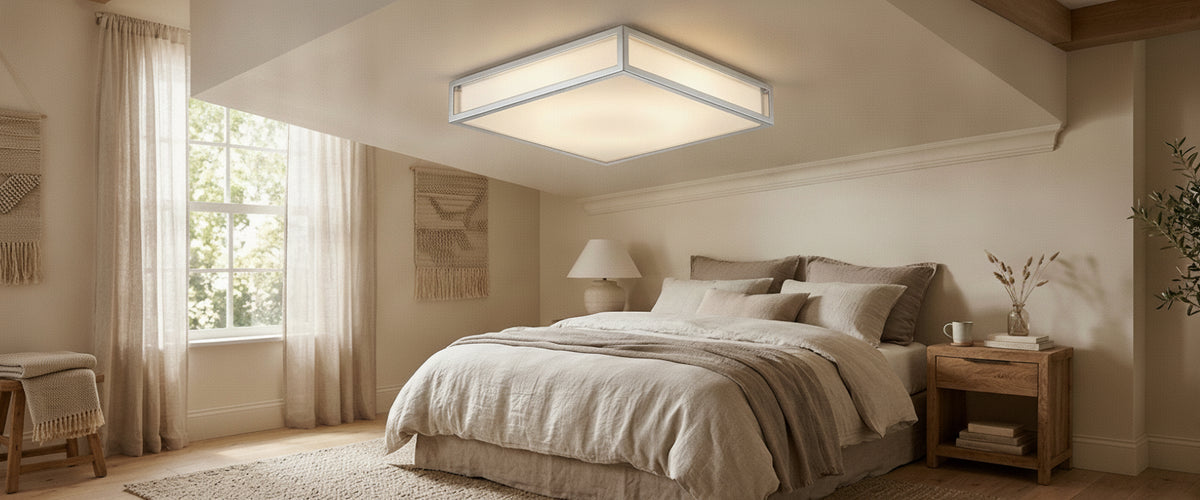

Polished chrome returns almost everything you throw at it, including the glare from its own bulb. That is why a chrome ceiling lights can look crisp and architectural in one room and like a hospital corridor in the next. The finish never changes. The conditions around it do, and most buyers only notice once the fitting is up and the switch is on.
At Niori we work mostly with alabaster and natural stone, materials that soak up light and give it back softly. Chrome does the opposite, which is exactly why we have strong views on when it works and when it does not. What follows is the advice we give clients who arrive with a chrome fitting on their shortlist.

Quick Answer: Is a Chrome Ceiling Light Right for You?
- Chrome mirrors the room. It picks up ceiling colour, wall colour and every light source nearby, so judge it in your space rather than in a product photo.
- Form matters more than finish. Flush fittings read as quiet hardware; pendants turn chrome into a reflective object at eye level.
- Keep bulbs warm. Around 2700K is the safe zone; 4000K and above makes chrome feel clinical in living spaces.
- Diffusion is the fix. Pair chrome with frosted glass, opal or stone shades so you see glow, not filament.
- Check the view from below. If you can see the bare lamp from the sofa or the bed, you will see it twice: once directly and once in the chrome.

What Polished Chrome Does When It Sits Above Your Eyeline
Decorative chrome is a very thin layer of chromium plated over nickel, which is what gives it that slightly cool, blue-white mirror. The Nickel Institute has useful background on how that nickel underlayer provides most of the corrosion resistance and the depth of shine. The practical point for buyers is this: chrome has almost no colour of its own. It borrows.
Brass warms everything near it. Bronze darkens. Chrome reflects whatever is there, and on a ceiling that means it reflects the plaster, the light bouncing off your floor and, critically, the bulb inside or beneath it. A chrome ceiling light hung above a pale oak floor on a sunny afternoon will look soft and almost golden. The same fitting at 10pm under a cool LED will look like stainless steel cutlery.
There is also a scale effect. Because it sits above the eyeline, you rarely see the top of a chrome ceiling light. You see the underside and the edges, which are the areas most likely to catch a hard specular highlight. Small, bright pinpoints of reflection read as sparkle in a chandelier. On a broad, curved chrome dome, they read as glare.
How Ceiling Colour Amplifies or Kills a Chrome Fitting
The ceiling is the largest surface a chrome ceiling light will reflect, so its colour decides much of the finish's character. Brilliant white gives you the brightest, coolest result: maximum bounce, maximum crispness, and a fitting that can almost disappear into the plaster. That suits a minimal kitchen. It can feel sterile in a bedroom.
Warm whites, chalky off-whites and pale plaster pinks pull chrome toward a softer, pewter-like tone. Dark ceilings are more dramatic. A deep navy or charcoal ceiling turns a polished chrome fitting into a sharp outline, and the reflection inside the metal goes dark too, so the shine concentrates on the edges.
Mid tones are where people get caught out. Picture a drawing room ceiling painted mid grey with a large chrome-framed fitting beneath it. In daylight it can look superb. At night, the grey reflects back as a flat, lifeless tone in the metal and the whole fitting goes dull. Frosted lamps and a warmer bulb solve most of it, but the cheaper fix is to test a sample board under evening light before you paint.
Flush, Semi-Flush or Pendant: Form Changes the Finish
A chrome ceiling light behaves very differently depending on how far it hangs from the ceiling and how much of the metal you can see.
Flush Fittings
Flush designs keep the chrome to a slim rim or backplate around a diffuser. The metal reads as a frame, and the diffuser does the visual work. This is the most forgiving format, and the one we recommend for rooms with ceilings around 2.4 m (8 ft) where a hanging fitting would crowd the space.
Recessed downlights take that restraint a step further. In a kitchen or hallway where you want the ceiling to echo chrome hardware without drawing the eye, a brushed finish such as the GU10 Tilt Downlights (3 Pack) in Brushed Chrome keeps the same cool metal but trades the mirror shine for a satin sheen, and the tilt lets you aim light at worktops rather than into anyone's eyes.
Semi-Flush Fittings
A short drop exposes more metal, often a central stem and arms. Here chrome starts to behave like jewellery. Semi-flush works well in bedrooms and hallways if the shades are frosted or opal, because the light then comes from the shade and the chrome only catches it.
Pendants
Hang chrome on a rod or cable and it becomes an object in the room, reflecting the dining table, the people around it and the walls. That is lovely over a marble table or a dark wood surface. It is less lovely over a cluttered kitchen island, where the fitting will mirror every pan and fruit bowl beneath it.
The Bulb Temperature That Stops Chrome Reading Clinical
Chrome has a cool bias, so warm light compensates. In living rooms, bedrooms and dining rooms, stay at 2700K. If you want a touch more crispness, 3000K holds up well in kitchens and bathrooms. Above 4000K, a chrome ceiling light starts to look like office hardware.
Colour rendering matters just as much. A bulb with a CRI of 90 or above keeps skin tones, timber and stone looking natural, and the chrome reflects that richer spectrum. Low-CRI LEDs often have a greenish cast that chrome exaggerates. The Lighting Industry Association is a good starting point if you want to understand LED quality markings before you buy.
Dimming is the other tool. A chrome ceiling light on a compatible dimmer, set low in the evening, loses its hard highlights and picks up a candlelit warmth. Check that the driver and dimmer are compatible, and have a qualified electrician install or change any dimmer switch.
Five Room Conditions Where Chrome Earns Its Place
- Bathrooms with white or marble surfaces. Chrome matches taps and fittings, and it shrugs off humidity well. Choose a fitting with the correct IP rating for its zone and have it installed by a qualified electrician. Where a bathroom ceiling needs a sealed fitting, a design like the Indoor IP65 Fixed Downlight in Chrome keeps the lamp behind frosted glass, so the chrome reads as a slim rim catching soft light rather than a mirror for a bare bulb.
- Kitchens with stainless steel appliances. Chrome ties the ceiling to the hardware below, especially in flush formats with frosted glass.
- Art Deco and mid-century interiors. Chrome was a defining finish of both periods, and it sits naturally against lacquer, velvet and geometric tile.
- Monochrome schemes. In black, white and grey rooms, chrome adds light without introducing a warm metal that would fight the palette.
- Rooms with strong natural stone. A grey-veined marble floor or an onyx feature wall gives chrome something beautiful to reflect. Paired with an alabaster or stone shade, the metal frames the glow rather than competing with it.
That last pairing is where we see chrome at its best. In the studio, we often hold a polished chrome collar against a lit alabaster bowl: the stone pushes warm, diffused light into the metal, and the chrome suddenly looks soft. If that combination appeals, our alabaster lighting range shows how translucent stone changes the character of whatever metal sits beside it.
How to Choose: Buyer Checklist
- Ceiling height: up to about 2.4 m (8 ft), go flush; above 2.7 m (9 ft), semi-flush or pendant opens up. In between, a short semi-flush drop is the safe middle ground.
- Diffuser material: frosted glass, opal, alabaster or stone for soft light; clear glass only if you want sparkle and accept glare.
- Neighbouring metals: match chrome to taps, handles and switch plates, or deliberately contrast with brass. Avoid three competing metals.
- Bulb spec: 2700K to 3000K, CRI 90+, dimmable where possible.
- Finish quality: ask whether the chrome is plated over nickel and how the fitting is finished at joins and screw points.
- Budget: cost depends on material, scale, engineering, installation and finishing, so request a tailored quote for larger or bespoke fittings.
For a wider look at fixture types beyond chrome, from pendants and chandeliers to wall lights, browse the full lighting collection with your room's ceiling height in mind.
The Spec Detail Most Buyers Miss
Look at any chrome ceiling light from where you will actually be. Most product images are shot side-on, but you will spend years looking at it from below or at a shallow angle from a chair. On many open chrome designs, that view reveals the bare lamp, and the polished metal around it reflects the lamp again, doubling the glare.
Before buying, ask for an underside image or the shade depth, and check whether the lamp sits recessed behind the diffuser. If it does not, a frosted or opal lamp helps, but a fitting designed with proper shielding is the better answer.
Caring for Polished Chrome Overhead
Always switch off at the mains and let the fitting cool before cleaning. Dust with a dry microfibre cloth, then wipe with a cloth barely dampened in warm water and a drop of mild washing-up liquid. Dry immediately with a second soft cloth to avoid water spots. Skip abrasive pads, ammonia and limescale removers, which can dull or pit the plating. If the fitting includes alabaster or stone parts, keep water away from them entirely and dust them dry.