
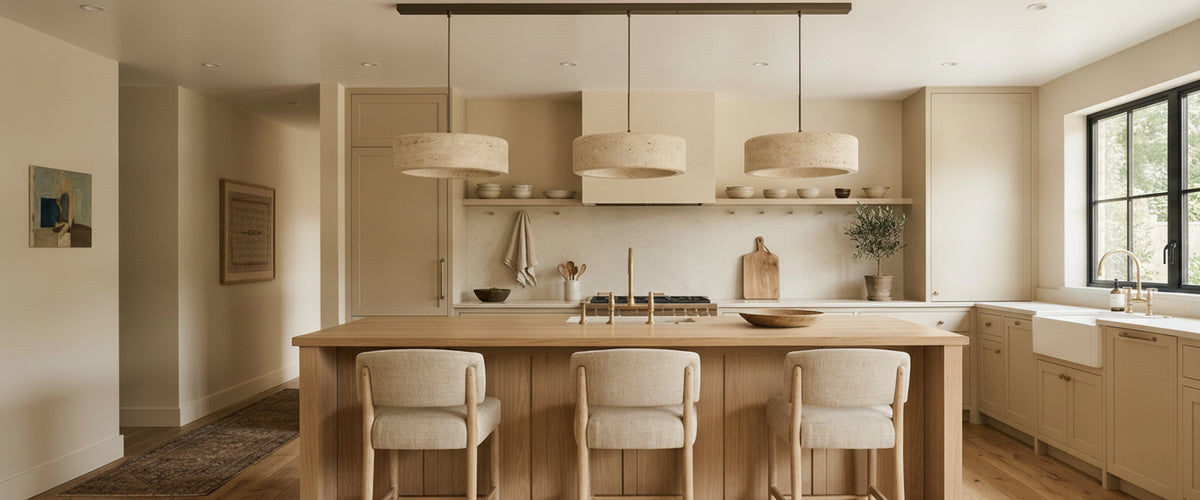

Most pendant track lighting goes wrong before anyone chooses a shade. The rail goes up wherever the old spotlight track used to be, three pendants are clipped on at even intervals, and the result looks like a row of coats on a hook. Planned properly, a track gives you something a fixed ceiling rose never can: the freedom to slide light along a run and re-space it when the table changes. It also asks more of the hardware, because a carved stone shade is far heavier than the spotlights most tracks were designed to carry. At Niori we work mostly in alabaster and natural stone, and those materials are unforgiving on a badly planned rail. So this is the advice we give clients before they buy.

At a Glance
- Plan the layout first. The track position decides where light lands; the pendant only refines it.
- Check the adaptor's rated load. Stone shades are heavier than most track lighting pendants are designed around.
- Match the track profile. Single-circuit, three-circuit and H track lighting pendants use different adaptors and are not interchangeable.
- Hang 30 to 36 inches (75 to 90 cm) above a worktop as a starting point, then adjust by eye.
- Treat the whole track as one dimming circuit unless you are using a multi-circuit system.
- Use a qualified electrician for any change to the track, feed or dimmer.

Pendant Track Lighting Is a Layout Decision First
A dedicated pendant hangs from a fixed point, so you plan the room around it. Pendant track lighting reverses that: you commit to a line on the ceiling, and every pendant you add later has to live on that line. Get the line wrong and no shade will rescue it.
The practical test is simple. Stand where the island, dining table or bar counter will be and ask where the centre of the light should fall. The track should run directly above that centreline, parallel to the long edge of the surface, and stop short of both ends. If the track was installed for spotlights aimed at walls, it is probably too close to the perimeter for pendants, and you will end up with shades hanging over the edge of the worktop rather than above it. That is the moment to move the track, not to compromise on the pendants.
Which Ceilings Suit a Track Run
Not every ceiling is a good host for track pendant lights, and the problems show up before you have picked a shade.
- Flat plasterboard over joists: the easiest case. Fix the track into joists or proper cavity fixings rated for the combined weight of track and pendants.
- Lath and plaster: common in Victorian and Edwardian terraces. It can crumble around fixings, so the track should be screwed into joists, which may mean the run follows the joist direction rather than your ideal line.
- Sloped ceilings and barn conversions: workable with slope adaptors, but each pendant then hangs from a slightly different height on the slope. A run of three needs individually set drops to read level.
- Concrete soffits in warehouse flats: strong, but every fixing is a drilled and plugged hole. Measure twice.
- Suspended grid ceilings: poor candidates. The tiles are not built to carry weight, so the track must be hung independently from the structure above.
Old timber is a common trap. Fix a track along an oak tie beam in a barn conversion and it sounds ideal, until you notice the beam has a gentle twist along its length and the pendants lean visibly out of plumb. The usual fix is to drop the track on short rods so it hangs true below the beam. If your ceiling is old, assume it is not flat.
Drop Length, Shade Material and Beam Angle
These three variables decide what the surface below actually looks like, and they interact.
Drop Length
Start with the bottom of the shade 30 to 36 inches (75 to 90 cm) above a kitchen worktop, and slightly higher over a dining table where people sit and look across it. Shorter drops pool light tightly; longer drops spread it but put the shade in sightlines. Most pendant track lighting fixtures let you adjust the cord at the adaptor, so set the final height on site, with the stools in place.
Shade Material
An open metal cone throws a defined circle of light downwards and leaves the ceiling dark. Where a focused pool on the worktop matters more than an ambient glow, a crisp open cone such as the Astra Cone Pendant Light in matt black is a better choice than a translucent shade. Glass gives a brighter, sparkier spread. Alabaster behaves differently from both: light passes through the stone and comes out as a soft, warm glow, with the veining showing through like watermarked paper. Alabaster is a fine-grained form of gypsum, the same material medieval English carvers worked into the altarpieces now held in the V&A sculpture collection, and its translucency is exactly why it suits a pendant. The trade-off is that a stone shade glows rather than spotlights, so you get gentler task light and a much kinder atmosphere. If you are comparing materials side by side, our alabaster lighting range shows how differently a carved bowl and a cylindrical shade carry light.
Beam Angle
Beam angle matters most with open shades and directional lamps. Under alabaster, the stone does the diffusing, so a standard omnidirectional LED lamp is usually right. Fit a narrow spot lamp inside a stone shade and you get a hot patch on the base and a dull rim.
Spacing Track Lights With Pendants So the Run Looks Intentional
Three pendants evenly spaced along a track can still look like a queue at a bus stop. What turns them into a composition is the relationship between the shades, the gaps and the surface underneath.
- Use odd numbers on islands and long tables. Three reads as a group; two often reads as a pair of strangers.
- Inset the end pendants by roughly 12 to 18 inches (30 to 45 cm) from each end of the surface, so light does not spill onto the floor.
- Keep gaps at least as wide as a shade, and wider for large stone bowls, so each one has space to glow.
- Make sure the pendant lights track the centreline of the surface, not the centre of the ceiling. These are rarely the same.
A detail people overlook: the track itself is visible between the shades. A white rail on a white ceiling disappears; a black rail draws a line that ties the pendants together. The same thinking applies to the shade finish. A pale dome like the Lira Dome Pendant Light in matt white lets a white rail and ceiling read as one quiet plane, while the matt black version picks up a dark rail and turns the run into a deliberate graphic line. Decide which effect you want before you order.
The Hardware Check: Weight, Profile and Adaptors
This is where pendant track lights fail most often. Every lighting track pendant adaptor carries a rated load, and many are designed around lightweight spotlights. Natural stone is dense, and even a modest alabaster shade can outweigh the metal pendants the system was built for. Check the rating of the adaptor and the track, not just the pendant.
Profiles matter too. Single-circuit and three-circuit tracks take different adaptors, and the H, J and L profiles you see on North American listings are separate standards again. H track lighting pendants will not clip safely into a different profile, however close they look. Confirm the track type before buying anything that hangs from it.
Dimming on a Track Circuit
On a dedicated pendant loop, each group of pendants usually has its own dimmer, matched to its own lamps. A single-circuit track is one load: every pendant and spotlight on it dims together through the same dimmer. That has consequences.
- Mix a spotlight and a stone pendant on one circuit and you cannot set them independently.
- Mixing lamp types or brands on one dimmer often causes flicker or uneven dimming, especially at the low end.
- LED dimmers have minimum loads. A track with only one or two low-wattage lamps may sit below that minimum and misbehave.
A three-circuit track solves most of this by letting you put pendants on one circuit and accent spots on another. Whatever the system, use matching dimmable LED lamps at around 2700K, which brings out the honey tones in alabaster rather than turning it grey. Any change to the feed, track or dimmer belongs with a registered electrician; in the UK you can find one through NICEIC.
Keeping a Low Kitchen Ceiling From Feeling Lower
Many UK kitchens sit at around 2.4 m (7 ft 10 in) or less, and a surface-mounted track plus three hanging shades can make the room feel squashed. A few moves help:
- Recess or flush-mount the track where the ceiling allows, so you lose the extra inch or so of rail.
- Choose shorter drops and shallower shades. A wide, low alabaster bowl keeps more headroom than a tall cylinder.
- Let some light reach the ceiling. Translucent stone glows in every direction, washing the ceiling softly; a dark ceiling above opaque cones makes the room feel lower.
- Keep the rail colour matched to the ceiling so the line visually recedes.
- Add light elsewhere. Wall lights or a table lamp on a dresser stop the pendants doing all the work and pulling the eye down. Our wider lighting collection covers the wall and table pieces that balance a track run.
This is often the point where people give up on track pendant lighting in a small kitchen, and it is usually the shade, not the track, that is at fault. Swapping deep opaque shades for shallow alabaster bowls, hung slightly higher than the textbook figure, keeps the track and gives back the headroom.
Buyer's Checklist Before You Order
- Confirm the track sits over the centreline of the surface it will light.
- Identify the track profile and buy matching adaptors.
- Check the rated load against the weight of each stone shade.
- Plan drops with stools, chairs and sightlines in mind.
- Decide whether pendants need their own circuit or dimmer.
- Specify matching dimmable LED lamps at around 2700K.
- Book a qualified electrician for installation and any rewiring.
- Plan care: dust alabaster dry with a soft cloth and keep it away from water and steam where possible.
Pendant track lighting rewards people who plan the line, respect the weight and treat dimming as part of the design. Get those right, and a run of stone shades on a rail can look as considered as any fixed installation, with the bonus that it can move when your room does.