
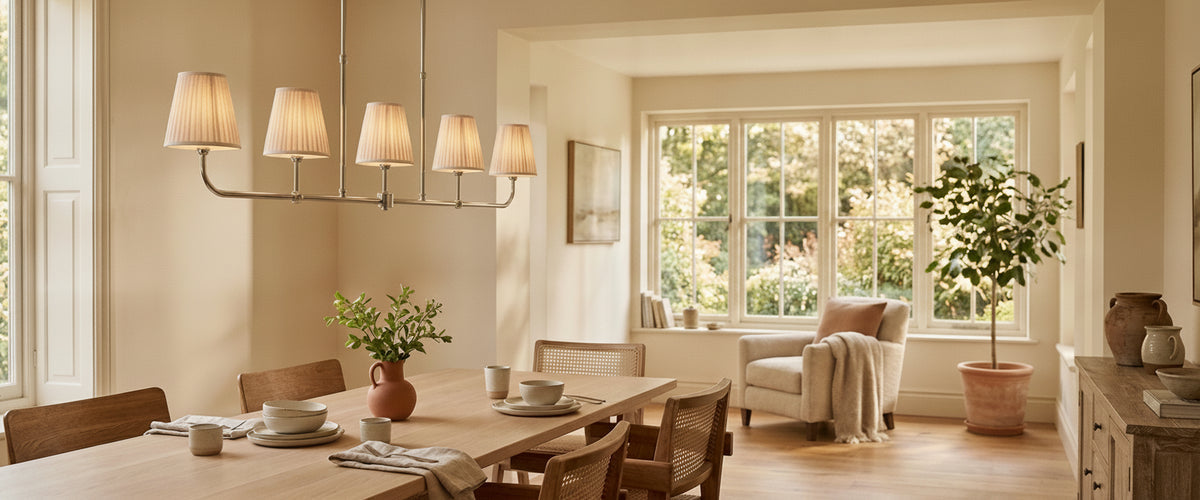

Polished nickel is the finish people choose when they want the glow of silver without its constant need for attention. Hang a polished nickel chandeliers in the wrong room, with the wrong bulb, at the wrong height, and it turns into something that belongs above a dentist's chair. The metal itself is rarely at fault. The specification around it usually is. At Niori we see this most often when a buyer chooses the finish from a product photograph and only meets it properly once it is wired up and switched on after dark.

Key Takeaways
- Polished nickel is warmer than chrome. It has a faint champagne undertone that chrome lacks, and that undertone is what you are paying for.
- Linear forms suit contemporary rooms, while tiered and arm chandeliers belong in period rooms with proper ceiling height.
- Below roughly 2.5 metres (8 ft 2 in), a hanging polished nickel chandelier can look cold and glary. A semi-flush design with diffusing shades is the safer choice.
- Stay at or below 2700K in living and dining spaces. At 4000K the finish turns clinical.
- Pair it with a warm material, such as alabaster, onyx or opal glass, so the metal frames the light without dominating it.

Why Polished Nickel Behaves Differently Once It Is Lit
On a showroom shelf, chrome, satin nickel, silver plate and polished nickel can look like close cousins. Switch the lamps on and they split apart. Chrome is a hard, slightly blue mirror that reflects every bulb as a sharp point. Satin nickel is brushed, so it scatters light into a soft grey sheen and almost disappears at night. Silver plate is the whitest and brightest of the four, but it tarnishes quickly and needs regular polishing.
Polished nickel sits in a useful middle ground. It is reflective enough to sparkle, but the plating carries a subtle warmth, a soft yellow cast that becomes more noticeable under warm light. The Nickel Institute explains why decorative nickel plating has lasted on hardware and fittings for well over a century: it is hard-wearing, it resists corrosion, and it takes a high polish without tarnishing the way silver does. For a polished nickel chandelier, that means a finish that keeps its depth for years with very little upkeep.
Linear or Tiered: Matching Form to the Room
The shape of a polished nickel chandelier affects how a room reads more than the finish does. A polished nickel linear chandeliers is a horizontal statement. It follows the length of a dining table or kitchen island, spreads light evenly along the surface, and looks right in rooms with clean architectural lines. In open-plan extensions and new-build kitchens, a linear bar with three to five diffusing shades does more useful work than any round fitting.
Tiered and arm chandeliers ask for height and symmetry. They read as traditional because they repeat the structure of candle-era fittings: a central stem, radiating arms and light gathered at the centre. Put one in a Georgian drawing room with cornicing and a ceiling rose and it looks at home. Put the same fitting in a low-ceilinged galley kitchen and it looks as if it arrived at the wrong address.
A modern polished nickel chandelier often sits between the two. Think sculptural clusters, offset globes and asymmetric branches. These work well in double-height hallways and stairwells, where the fixture is seen from several angles and does not need to line up with furniture. Where a landing or smaller hallway needs that sculptural quality at a more modest scale, a compact nickel fitting such as the Terzani Stream Mini 5 Light Chandelier in Nickel is closer to the right design language than a formal arm chandelier scaled down.
The Ceiling Height Where a Polished Nickel Chandelier Turns Cold
This is the point most guides leave out. A polished finish reflects whatever is around it. In a room with a standard ceiling of around 2.4 metres (7 ft 10 in), a hanging polished nickel chandelier sits close to the eyeline of anyone standing. Instead of a soft glow overhead, you see bright reflected points from the bulbs on the metal. That is when the finish starts to look cold.
Our view is that below about 2.5 metres (8 ft 2 in), you should either choose a semi-flush polished nickel fitting with shades that fully conceal the lamps, or keep the hanging fixture over a table, where nobody walks beneath it. Leave at least 2.1 metres (6 ft 11 in) of clear space under any fixture in a walkway. Over a dining table, 75 to 90 cm (30 to 35 in) between the tabletop and the bottom of the fixture is a reliable starting point. Have a qualified electrician fit the ceiling support and connections. Heavier stone-shaded fittings in particular need a properly rated fixing, not a plastic ceiling rose screwed into plasterboard.
Colour Temperature: Where the Finish Tips Warm
Bulb choice controls how warm or cool a polished nickel chandelier looks. At 2700K, the warm undertone in the plating shows, and the metal reads as soft and gently golden. Between 2200K and 2400K, which is ideal for dining rooms and evening entertaining, it starts to resemble old silver under candlelight. At 4000K it looks like stainless steel in a commercial kitchen.
A typical case: a polished nickel chandelier fitted over a kitchen island, which its owner describes as "freezing". The fixture is rarely the problem. Lamps at 4000K, often bought in bulk for the rest of the house, usually are. Changing to dimmable 2700K LEDs with high colour rendering fixes it the same evening. The Lighting Industry Association publishes guidance on colour temperature and colour rendering. Aim for CRI 90 or above, so that skin tones, timber and stone keep their natural colour.
Dimming makes a bigger difference here than with matt finishes, because a polished surface reacts to every change in brightness. Use dimmable LED lamps with a compatible trailing-edge dimmer, and ask your electrician to confirm compatibility before fitting. Otherwise you may get flicker or hum at low levels.
Finish Combinations That Make Polished Nickel Feel Deliberate
Polished nickel with clear glass and white walls is where it starts to look like a hotel lobby. The finish needs something warmer to set it off. Alabaster is the most natural partner. The stone filters light through its veining and gives off a honeyed, diffused glow, so the metal reads as a frame around the light rather than the main event. The alabaster lighting collection is a good place to see how carved stone shades soften the cooler metals around them.
Other combinations that work:
- Onyx: richer and more amber than alabaster, ideal where you want a stronger glow in a dining room.
- White or Calacatta marble: a cool-on-cool pairing that works in contemporary kitchens, and in bathrooms with a suitably IP-rated fitting, as long as the bulbs stay warm.
- Opal or etched glass: clean and diffusing, a sensible choice for a modern fixture in a smaller room.
- Small amounts of brass: a brass ceiling cup or finial on a nickel fixture can look intentional, but limit it to one detail.
Repeat the nickel somewhere else in the room, such as door furniture, a tap or picture-light frames, so the chandelier does not look like a one-off.
One Fixture, Two Interiors
The same metal can serve both a period scheme and a contemporary one if you let the details carry the style. A polished nickel traditional chandelier works best with fabric or alabaster shades, a chain suspension and a decorative ceiling rose. Matching wall lights at picture height complete the look. A polished nickel modern chandelier should hang from a slim rod, sit on a plain flush canopy and use geometric shades, with recessed or concealed lighting elsewhere in the room so it does not have to do all the work. For that supporting layer, a discreet nickel-toned downlight such as the Marin SN Round MR16 Recessed Downlight in Nickel Matte picks up the chandelier's metal quietly, and its matte surface avoids adding more reflective points to the ceiling.
Finish alone does not set the style. A Georgian sitting room and a Hackney warehouse flat can both suit polished nickel. What distinguishes them is shade material, suspension and the lighting that surrounds the chandelier.
Buyer's Checklist Before You Order
- Measure the floor-to-ceiling height and decide between hanging and semi-flush before you shortlist anything.
- Match the form to the furniture: linear over long tables and islands, round or tiered over square tables and in hallways.
- Check whether the lamps are concealed. Exposed lamps on polished metal cause the most glare.
- Plan on 2700K dimmable LEDs with CRI 90+, and choose a compatible dimmer.
- Pick one warm partner material: alabaster, onyx, opal glass or a fabric shade.
- Confirm the fixture's weight with your electrician and arrange a suitably rated ceiling fixing.
- For budget, ask for a tailored quote. Cost depends on material, scale, engineering, installation and finishing, so a fixed figure is rarely meaningful.
If you are still choosing between forms, the wider lighting collection lets you compare chandeliers alongside wall lights and pendants that could share the same finish across a room.
Caring for a Polished Nickel Chandelier and Its Shades
Polished nickel needs very little maintenance, but the wrong product can damage it permanently. Switch the fixture off at the wall and let the lamps cool. Dust the metal with a soft microfibre cloth. For fingerprints or kitchen grease, use a cloth barely dampened with warm water and a drop of mild washing-up liquid, then dry it straight away so no water marks remain. Avoid ammonia-based glass cleaners, metal polishes made for brass or silver, and any abrasive pad. All of these can cloud or wear through the plating.
Stone shades need separate care. Alabaster is soft and porous, so dust it dry with a clean brush or microfibre cloth and never wet it or spray cleaner near it. Remove the shades before you clean the metal if you can do so safely. If not, cover them with a dry cloth while you work.
Specified carefully, a polished nickel chandelier is one of the most versatile fittings in lighting. It suits a Regency dining room or a minimal kitchen extension equally well, provided the bulb is warm, the height is right and there is some stone or glass to soften the light.