
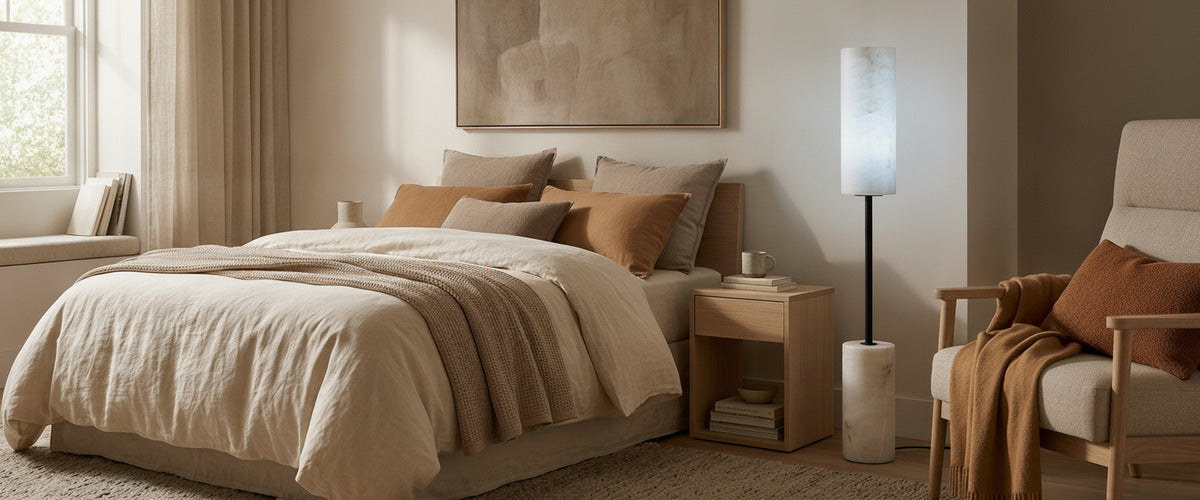

Most bedrooms are lit for the person standing in the doorway, then lived in by the person lying in bed. That gap is where floor lamps for bedroom spaces go wrong. A lamp that looks right on the walk-through can put a hot spot of glare straight into your eyeline once you are under the duvet, or leave the one corner you use after 10pm in shadow. The fix is rarely a different lamp. Usually it is a different position, a different shade or a different bulb.

Quick Answer
Yes, floor lamps for bedroom use make sense, provided the light source is hidden from the pillow.
Best positions: beside a reading chair, on the far side of a bedside table, at a dressing area, or tucked into a corner to wash the wall.
Avoid: the corner nearest the door, and right at the head of the bed with an open-bottomed shade.
Shade: alabaster, onyx, linen or raffia diffuse well. Bare metal domes need careful aiming.
Bulb: 2700K or warmer, on a dimmer, for evening use.

Why the Bedroom Punishes a Badly Placed Floor Lamp
In a living room you move around. You sit on different seats, stand at the kitchen counter, cross the room. A slightly glary lamp gets glanced at and forgotten. In a bedroom you spend hours in one fixed position, at one fixed height, looking in roughly one direction. Every flaw in a bedroom floor lamp's placement is locked into that view.
The bedroom is also the room where you use the least light. At low levels the eye adapts and becomes more sensitive, so a small bright point that would vanish in a sunny sitting room becomes the brightest thing in the room. The Sleep Foundation's guidance on light and sleep is clear that bright, cool light late in the evening works against winding down. A badly placed bedroom floor lamp is an aesthetic problem, but it also affects how the room feels at the exact hour you want it to feel calm.
The Sightline Problem: Start From the Pillow
Before you buy anything, lie on the bed with your head where it actually rests and look around. Note what you see at eye level and slightly above. When you lie down, your eyeline drops to roughly 24 to 30 in (60 to 75 cm) off the floor, depending on mattress height and pillows. From there, you see the underside of the shade on most bedroom floor lamps.
That is the detail most product photography hides. Lamps are photographed from standing height, where the shade reads as a soft glowing drum. From the pillow, an open-bottomed shade can show a naked bulb. The simplest check is to lie down where you sleep, look up at the spot the lamp will occupy and picture the shade from below. Plenty of floor lamps for bedroom use look calm from across the room and still fail that test more often than you would expect.
Three questions from the pillow settle most decisions. Can I see the bulb? Is the brightest surface in the room the lamp, or the wall it lights? Does the light fall where I need it (a book, a chair, a wardrobe) or just into the room in general?
Four Positions for Floor Lamps in Bedroom Layouts That Work
1. Beside a Reading Chair
Set slightly behind the chair, an adjustable arm aims light at the page and away from the pillow.
This is the most natural home for bedroom floor lamps, especially in a principal bedroom with space for a chair near the window. Set the lamp slightly behind and to the side of the chair, on the side opposite your writing hand, with the bottom of the shade around shoulder height when you are seated. An adjustable arm lets you swing the light over the page and away from the bed, which matters if one of you reads while the other sleeps. For a reading chair that sits within sight of the pillow, a slim adjustable design on a heavy base, such as the Nala Adjustable Floor Lamp with Marble Base, makes more sense than a fixed drum shade: the arm does the aiming, and the marble keeps it steady when you reposition it.
2. On the Far Side of a Bedside Table
In a wide room, a tall lamp placed just beyond the bedside table, rather than tight against the headboard, gives side light without sitting directly over your head. The table stays clear for a glass of water and a phone. This position suits bedroom floor lamps with a shade that is closed or deep enough to hide the bulb from a lying position.
3. At the Dressing Area or Wardrobe Wall
Ceiling lights flatten color and throw shadows down your face. A bedroom floor lamp beside a full-length mirror gives softer, more flattering light for dressing. The dim alcove wardrobe is the classic case: a single stone-shaded floor lamp at the end of the run can turn the corner nobody liked into the one used most, and makes it far easier to tell navy from black in the morning.
4. Tucked Into a Corner to Wash the Wall
In compact doubles, lofts and guest rooms, the most useful job floor lamps for bedroom corners can do is light the wall, not the person. A lamp pulled into a far corner, ideally one you face from the bed, bounces light off two surfaces and makes the room feel wider. Multi-headed designs with woven raffia shades suit this: the texture breaks up the light and throws a soft pattern across the plaster. Where the corner needs that dappled, spread-out glow rather than one bright point, the three-shade Ombressa Floor Lamp with Raffia Shades in Brushed Aged Brass is a good fit, and the aged brass reads warmer against bedroom textiles than a stark black frame.
The Two Spots Buyers Always Try First, and Why They Disappoint
The corner by the door. Of all the spots people test for floor lamps for bedroom use, this one feels the most logical, because you walk in and want light. But it lights the least-used part of the room and often puts the lamp behind you when you are in bed, so you end up lying in your own shadow. Leave this job to a switched ceiling or wall light.
Directly at the head of the bed. Buyers often try to make a floor lamp do a bedside lamp's job by placing it right against the headboard. From standing height it looks balanced. Lie down and the bulb is often visible, the light hits your face rather than your book, and anyone sharing the bed gets the full glare. If space forces this position, choose a closed or deeply hooded shade and dim it well down.
Shade Material and Color Temperature: The Daytime Choice Versus the After-Dark Reality
Shades on bedroom floor lamps are chosen in daylight, when they are switched off and judged as objects. The color of the fabric, the weave of the raffia and the veining in the stone all read clearly. After dark, the question changes completely: what does the shade do to the light passing through it?
Alabaster glows across the whole shade, so it stays soft even when seen from the pillow.
Alabaster is the clearest example. It is a fine-grained form of gypsum (Britannica outlines its mineralogy), translucent enough to let light pass but dense enough to scatter it, so the whole shade glows rather than one point burning. That makes alabaster one of the most forgiving materials for floor lamps in bedroom settings, where you will inevitably catch sight of the shade from low angles. The veining shows up warm and amber once lit, which is a very different look to the creamy stone you saw in daylight. Our alabaster lighting collection is worth browsing with this in mind: imagine each piece lit, not off.
Other materials behave in their own ways:
Onyx tends to show bolder banding and stronger color once lit; it suits a lamp you want to be a feature.
Ribbed or pleated fabric diffuses evenly and stays soft from most angles, which is why a ribbed shade like the Kilma Ribbed Fabric Floor Lamp is easier to live with near the bed than a bare metal dome.
Raffia and jute give texture and dappled light but leak more directly through the weave.
Opaque metal domes, in matte black or white, push all the light down and out. Excellent for reading, unforgiving if the opening faces the pillow.
For color temperature, treat 2700K as your upper limit and consider 2200K for bedroom floor lamps used only in the last hour of the day. Warm-dim LED bulbs, which shift warmer as they dim, suit stone shades particularly well because they deepen the honey tone of the material. Check that any bulb you choose is listed as dimmable and matched to your dimmer, and that its wattage sits within the lamp's stated maximum.
When the Floor Lamp Replaces the Bedside Lamp, and When It Sits Beside One
Floor lamps for bedroom use can stand in for a bedside lamp when your bedside table is too small to share, when you want the surface clear, or when the bed sits under a sloped ceiling where table lamps look squat. In those cases, an adjustable arm or a hooded shade aimed at the pillow edge does the job well.
Keep both when the room has two very different evening uses. A pair of alabaster table lamps either side of the bed handles the final half-hour; a floor lamp across the room handles reading in a chair, dressing or simply lighting the room while the bed stays dark. The two layers let you switch off the bedside light and keep the room glowing, which is the sequence most people actually follow.
Buyer Checklist for Floor Lamps for Bedroom Spaces
Test the sightline: measure your eye height lying down and check whether the shade opening will expose the bulb.
Match the job: adjustable arm for reading, closed or stone shade near the bed, multi-head or textured shade for wall washing.
Check the footprint: on bedroom floor lamps, a heavy base in marble or stone is far less likely to tip when a duvet or dressing gown catches it.
Plan the switch: a foot or inline switch you can reach from the bed, or a smart plug, saves a cold walk across the room.
Choose the bulb with the shade: 2700K or warmer, dimmable, within the lamp's maximum rating.
Route the cable: along the baseboard and away from where you walk at night.
Get the wiring done properly: if you want a 5A socket controlled from the wall switch by the door, use a qualified electrician. It is a common upgrade in UK bedrooms and well worth doing.
Care for bedroom floor lamps is simple but material-specific. Dust alabaster and marble with a soft dry cloth, never water or household sprays: alabaster is soft and marks easily, and marble etches on contact with acidic cleaners. Fabric and raffia shades respond best to a low-suction vacuum brush.
If you are planning a full bedroom scheme rather than a single lamp, start with the pillow test, then build the layers around it. You can compare floor lamps for bedroom use alongside wall lights and table lamps in the full niori lighting range, from stone and alabaster pieces to woven and fabric designs.