

Most people buy dimmable wall lights for the evening setting, then judge them in a bright showroom at full output. That is backwards. A wall light spends most of its life somewhere between a quarter and half power, and the shade material decides whether that low setting reads as a warm glow or a grubby smudge on the plaster. Choose the shade, driver and dimmer as one system and dimmable wall lights become the most useful layer in a room. Choose them separately and you get flicker, hum and a light that looks wrong the moment you turn it down.

Key Takeaways
- The shade sets the mood at low output. Alabaster and onyx glow from within when dimmed; opal glass goes flat and ceramic only washes the wall.
- Flicker usually starts at the driver or lamp. A dimmable lamp paired with the wrong dimmer will misbehave however good the switch looks.
- Buy trailing-edge dimmers for LED. Check the minimum load against the real wattage of your lamps, not the old incandescent equivalent.
- Set targets per room. A hallway at night and a dining room during dinner need very different low ends.
- Use a qualified electrician for any change to fixed wiring, even a straightforward swap.

How Shade Material Rewrites the Mood on the Dimming Curve
At full output, almost any dimmable wall lights looks acceptable. The lamp is bright enough to overpower the character of the shade, and your eye adjusts. As you turn it down, the balance shifts. The light source gets weaker and the material around it starts doing the work: its colour, thickness, veining and translucency become the dominant part of what you see.
This is why natural stone behaves so differently from manufactured diffusers. Alabaster is a fine-grained form of gypsum, carved thin enough for light to pass through, and that thickness is never perfectly even. Where the stone is thinner, it glows brighter; where a vein runs through, it holds back. At high output, those differences soften. At low output, they become the whole point of the fixture. The stone also carries its own warm, slightly honeyed tone, so even a standard 2700K LED appears warmer once it has passed through it.
In the studio we test lamps behind offcuts of every stone we work with before signing off a new range of dimmable wall lights, and the lesson repeats itself: a shade that looks merely pleasant at 100 percent can look exceptional at 25, and the reverse is just as common.
Stone Versus Ceramic Versus Glass: What Each Looks Like at 20 Percent
Twenty percent is a useful benchmark. It is roughly where most people run their dimmable wall lights during a relaxed evening, and it is where poor material choices show.
Alabaster
The surface turns into something close to a watercolour. Veining reads clearly, the colour drifts towards amber, and the glow sits inside the stone rather than on top of it. Alabaster is forgiving at low levels because it never looks empty. Browse the alabaster lighting collection with this in mind: look at how much veining each piece carries, because that is what you will see most of after dark.
Onyx
Onyx is more translucent than alabaster, with bolder banding. It can handle a lower setting before it starts to look dim, which suits bedrooms and late-evening lounges. It can also look busy at full output, so it rewards a dimmer more than most materials.
Marble
Marble is denser and usually reserved for frames, backplates or very thin-cut diffusers. At 20 percent a solid marble wall light tends to glow at its edges only, throwing a crisp halo onto the wall. Beautiful in a corridor, less useful if you need light to read by.
Ceramic
Opaque, so all the light escapes up and down. Dimmed, you get two neat scallops of light on the wall and a dark body in between. Good for rhythm along a long wall, but it contributes nothing to the glow of the room itself.
Glass
Clear glass shows the lamp, and at low output a cheap LED can look spotty or slightly green. Opal glass diffuses evenly but tends to read as a flat, milky disc when dimmed, sometimes with a faint grey cast. It is clean and practical; it is rarely atmospheric. That makes it a sensible choice where the light will mostly run nearer full output, such as a dressing area or a busy hallway, and there a twin-shade design such as the Antic 2 Light Opal Glass LED Wall Light in gold is closer to the right design language, with the metal finish supplying the warmth the glass itself will not.
Why Flicker and Hum Start at the Driver, Not the Dimmer Plate
When dimmable wall lights flicker, people blame the switch on the wall. Usually the culprit is the electronics inside the lamp or fixture. An LED does not dim the way an old filament bulb did. A small driver converts mains power into what the LED needs and interprets the chopped-up signal coming from the dimmer. A poorly designed driver misreads that signal at low levels, producing visible flicker, a pulsing shimmer, or a high-pitched buzz.
Some flicker is invisible but still noticeable as eye strain or a stroboscopic effect on moving objects. The IEEE 1789 recommended practice on LED flicker is the reference most specifiers use when judging drivers. You do not need to read it, but it is worth asking a supplier whether their drivers or lamps have been tested against it.
A real example: we supplied a pair of alabaster wall lights to a client restoring a townhouse in Bath. Within a week they reported a faint buzz below about a third of full power. The fixtures were fine. The electrician had reused the property's old leading-edge dimmer, designed for halogen loads. A trailing-edge replacement cured it in twenty minutes. Fixture-integrated LEDs and replaceable lamps both need this kind of matching; for replaceable lamps, buy ones explicitly marked dimmable and check the manufacturer's dimmer compatibility list.
Trailing-Edge Versus Leading-Edge Dimmers: The Distinction That Matters
There is a lot of jargon around dimmers. For a buyer, one distinction is enough.
- Leading-edge dimmers were built for incandescent, halogen and older wire-wound transformers. They tend to have high minimum loads and can cause flicker and buzzing with LED.
- Trailing-edge dimmers suit modern LED drivers. They run quieter, cooler and usually have much lower minimum loads.
The minimum load is where most installations fail. If a dimmer needs a minimum of 10 watts and you connect a pair of dimmable wall lights drawing 4 watts each, the circuit is below threshold and the lights will misbehave at the bottom of the range. Add up the actual LED wattage on the circuit and make sure it sits comfortably within the dimmer's stated range. Many good trailing-edge dimmers also allow you to set a minimum level, which trims off the unstable bottom of the curve.
Room-by-Room Dimming Targets for Dimmable Wall Lights
Spec guides rarely state what level you should actually aim for. These are working rules of thumb from projects we have supplied, expressed as a share of full output with good LED and a trailing-edge dimmer.
- Living room: 30 to 50 percent for evenings with other lamps on; 15 to 25 percent when the wall lights carry the room alone during a film.
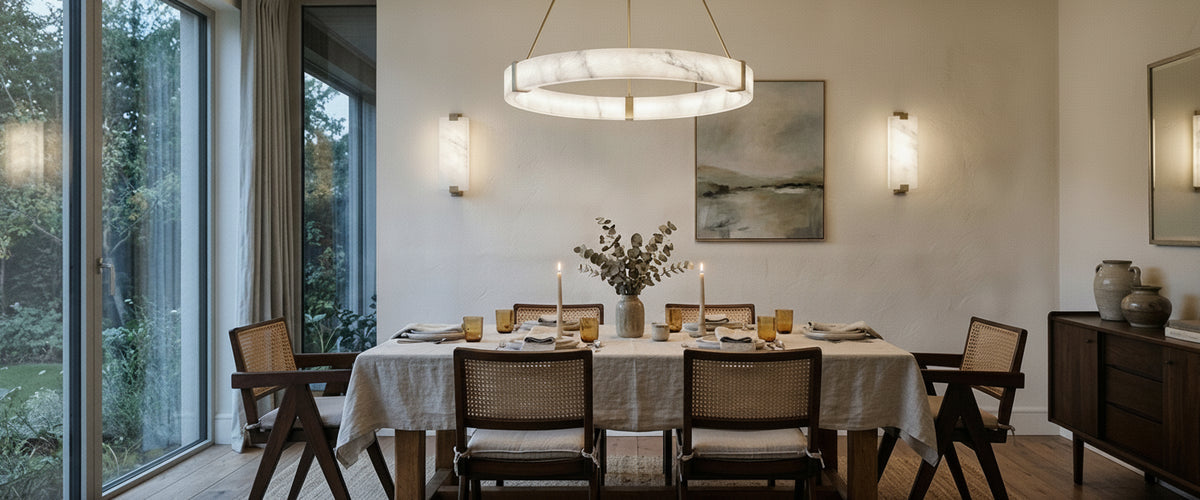
- Dining room: 25 to 40 percent while eating, so faces are lit without glare off glassware. Alabaster wall lights either side of a sideboard work especially well here.
- Bedroom: full output for dressing, 10 to 20 percent for winding down. Dimmable wall lights in onyx and thinner alabaster shine at this end. Beside the bed, where one person reads while the other winds down, a fitting with its own directed reading light, such as the Nao Circular LED Wall Light with Reading Light in matt white, lets the main glow stay low without leaving the page in shadow.
- Hallway and landing: a near-night setting of 5 to 15 percent, left on late, is safer and kinder to the eyes than a bright overhead.
- Restaurants and hotel corridors: plan the low end first and size fixtures so the room still reads warmly at the setting you will run for most of service.
- Bathrooms: wall lights must carry the correct IP rating for their zone. Stone pieces belong outside the wet zones unless the fixture is specifically rated.
Adding a Dimmable Wall Light Without a Full Rewire
You rarely need to rewire a room to add a wall light. In many homes an electrician can take a feed from an existing lighting circuit, chase a short run to the new position, and fit a dimmer in place of the existing switch. Older plaster in period properties can be fragile, so ask about routing cables through voids or alongside skirting to limit damage.
Always use a qualified electrician. In England, electrical work in dwellings falls under Approved Document P, and some jobs, such as new circuits or work in bathrooms, must be notified to building control or self-certified by a registered installer. Scotland, Wales and Northern Ireland have their own rules. If fixed wiring is not an option, a plug-in wall light with an inline or smart dimmer is a reasonable stopgap for renters.
Buyer Checklist
- Judge the shade dimmed. Ask for photos or a video at low output, not just full brightness.
- Confirm the light source. Integrated LED or replaceable lamp? Is it explicitly dimmable?
- Match the dimmer. Trailing-edge, with a minimum load below your total LED wattage.
- Check colour temperature. 2700K suits stone; dim-to-warm lamps add a candlelit shift at the bottom of the range.
- Think about height and spacing. Most wall lights sit around eye level, roughly 1.5 to 1.8 metres (5 to 6 feet) from the floor, but follow the fixture's guidance.
- Plan for care. Alabaster is soft and porous: dust with a dry, soft cloth and never use water or chemical cleaners.
- Request a quote for larger projects. Budget depends on material, scale, finishing and installation, so a tailored quote is more useful than a guess.
If you are planning several rooms at once, it helps to see wall lights alongside pendants and table lamps across the full niori lighting range, so the stone tones and brass details carry through. Get the shade, driver and dimmer working together and dimmable wall lights will look their best exactly when you use them most.