
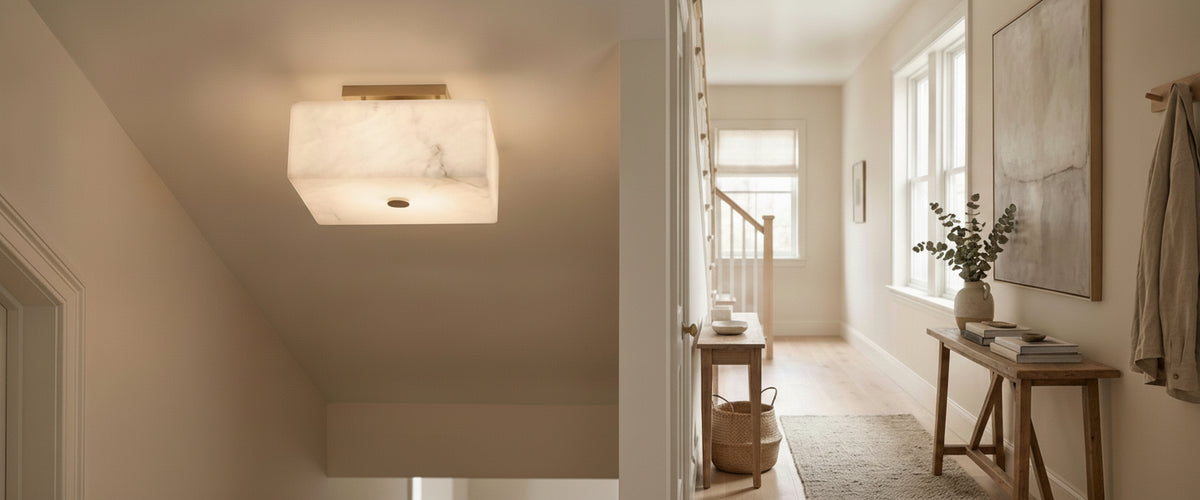

Everyone passes through your hallway and nobody lingers, yet a poor ceiling light there gets noticed quickly. Hallway ceiling lights are seen from below, from the front door, from the stairs and from every room that opens off the corridor, usually at a distance of a few feet. A fitting that would pass unnoticed in a living room can look harsh, clumsy or simply wrong when it hangs over a narrow run of floor with nothing else to look at.
At a glance
- Ceiling height decides the format. Under 8 feet (2.4 m), choose flush. From 8 to 9 feet (2.4 to 2.7 m), semi-flush works. Pendants and chandeliers need more height than that.
- Size by width as well as length. In a narrow corridor, a fitting around a third of the hallway's width keeps proportions calm.
- Keep the colour warm. 2700K to 3000K suits most halls. 4000K tends to look clinical in a room with little daylight.
- Long halls need a run of lights. Space fittings roughly 8 to 10 feet (2.4 to 3 m) apart rather than relying on one central light.
- Check the details the spec sheet leaves out. Weight, fixing method, dimmer compatibility and drop height cause most installation surprises.

Why the Hallway Is the Hardest Test for a Ceiling Light
Most rooms give a ceiling light some cover. Artwork, sofas and lamps compete for attention, and you look up at the fitting from a comfortable angle. A hallway gives it none. The walls are close, the ceiling is often low, and you walk directly beneath the fitting. A bare LED chip or a frosted glass dish with a visible hot spot is right in your line of sight on the way in and on the way out.
This is why we think hallway ceiling lights should be diffused, not bare. Alabaster passes light through the stone instead of throwing it straight down, so a thin carved bowl glows evenly with its natural veining showing. You get no point of glare, and the soft light on the walls makes a tight space feel wider. Marble and onyx behave in a similar way when they are cut thin enough, though onyx usually lets through more amber and more pattern. If you want to compare how the different stones read when lit, the alabaster lighting collection shows a range of bowl depths and veining in one place.

Flush, Semi-Flush or Pendant: What Your Ceiling Height Allows
With hallway ceiling lights, work from the ceiling height first and choose the style second. Plan for at least 7 feet (2.1 m) of clear headroom beneath the lowest point of any hallway fitting. In practice that gives you three options:
- Flush (under about 8 feet / 2.4 m): the fitting sits tight to the ceiling. Common in modern flats and many UK new builds. A shallow alabaster dish works well here because the whole stone face glows and nothing hangs down to catch the eye.
- Semi-flush (roughly 8 to 9 feet / 2.4 to 2.7 m): a short stem drops the bowl a few inches, so light also reaches the ceiling. That upward wash makes the ceiling look higher, which helps in period terraces where the hall is tall but narrow.
- Pendant or chandelier (above about 9 feet / 2.7 m, and stairwells): this is where a carved alabaster pendant or a tiered chandelier earns its place, especially in a double-height entrance or over a stair void.
Check clearances as well as ceiling height. A fitting that clears the floor comfortably can still sit too close to a tall internal door as it opens, a loft hatch as it drops, or the line of a staircase where heads rise as people climb. Measure from the lowest point of the fitting, bowl and lamp included, to the top of anything that moves or rises beneath it. It is a two-minute check that is easy to skip, and far cheaper than swapping a fitting after it has been fixed in place.
Narrow Corridor or Open Entrance Hall? Where Scale and Finish Split
A corridor and an entrance hall share a name and very little else. In a corridor around 3 to 4 feet (0.9 to 1.2 m) wide, scale is about restraint. Choose a fitting roughly a third of the width, so 12 to 16 inches (30 to 40 cm) in most homes, and keep the profile shallow. Pale alabaster with fine veining is the safer choice here. Bold, dark-banded stone can look busy when you only ever see it from directly below at close range.
An open entrance hall, such as a vaulted entrance in a barn conversion, a wide Edwardian hall or a Georgian house with a stair rising off it, needs the reverse. Scale up, and let the material show. Add the room's length and width in feet, and use the total as a rough guide to fitting diameter in inches. A 12 by 14 foot hall points toward a fitting around 26 inches (66 cm) across. Here the stronger veining of onyx or a deeper alabaster bowl has room to read, and brass detailing on the gallery or ceiling plate picks up warmth from nearby timber floors and stair rails.
Finish follows the same logic. Brass and bronze suit warm stone in most halls, and the principle carries over to simpler LED fittings too: a soft white diffuser framed in bronze, as on the Nifu Round LED Ceiling Light in White and Bronze, keeps the warmth in the trim without letting the metal dominate. Chrome and polished nickel can work in a cooler, more minimal scheme, but they draw the eye to the hardware. In a narrow corridor you usually want the eye on the glow, not the fixing.
Why 4000K Looks Colder in a Hallway
On paper, 4000K is a neutral white. In a hallway it often looks harsh, for two reasons. Hallways rarely get much daylight, so there is nothing to balance the artificial light. They also connect warm rooms. Step out of a living room lit at 2700K into a 4000K corridor and your eye registers the change as cold, almost institutional.
Stone makes the difference obvious. Lit at 2700K, the honey and cream tones in alabaster come through. At 4000K the same veining turns grey-green and the piece looks like a different material. For hallway ceiling lights in a home, 2700K to 3000K is the sensible range. Ask for a colour rendering index (CRI) of 90 or above so that wood, paint and stone keep their true colour. The Energy Saving Trust's lighting guidance explains how colour temperature and lumen output are labelled, which helps when comparing bulbs. Cooler light has its place in back-of-house corridors in hotels and venues, but not in a home.
Dimming matters more for hallway ceiling lights than many buyers expect. A hallway lit at full output at 11pm feels like a waiting room. A dimmer, or a two-scene control, lets the hall act as a soft night light without a separate lamp.
One Central Fitting or a Zoned Run of Hallway Ceiling Lights
A single central fitting works in a square entrance hall or in a corridor up to about 12 to 15 feet (3.7 to 4.6 m) long. Beyond that, one light leaves dark ends, and anyone walking away from it sees their own shadow stretch ahead of them. A long hall needs a run.
As a starting point, space fittings 8 to 10 feet (2.4 to 3 m) apart, with the end fittings set about half that distance from each end wall. A 30 foot (9.1 m) corridor usually takes three or four flush fittings. Three at 10 foot spacing gives even light. Four, set slightly closer, gives a softer, more continuous glow, which suits a dark corridor or one with artwork on the walls. Matching fittings in a row read as one considered element. Mixing styles along a single corridor rarely works. Where the ceiling is low and the run is long, a slim warm-white disc such as the Rifa LED N2 Round Ceiling Light in White repeats quietly along the corridor, sitting tight to the ceiling with an even, glare-free face.
Zoning brings a second advantage. If the stair landing, the front door area and the far end of the corridor are on separate circuits or switches, you can light only what you need. Changes to switching, two-way circuits or new ceiling points are a job for a qualified electrician; Electrical Safety First explains why ceiling and circuit work should not be treated as DIY.
What Hallway Ceiling Light Fixture Spec Sheets Leave Out
Spec sheets list wattage, dimensions and cap type. The details that cause trouble on installation day are often missing. Before you order hallway ceiling lights fixtures, ask about the following:
- Total weight and fixing method. Natural stone is heavy. A carved alabaster bowl can weigh much more than a glass dish of the same size, so your electrician may need to fix into a joist or fit a support bracket rather than rely on a plasterboard fixing.
- Ceiling plate diameter. A small plate may not cover the marks left by an old, larger fitting. Find this out before you have the hall repainted.
- Dimmer compatibility. Integrated LED fittings and some LED bulbs flicker or hum on older dimmers. Confirm the driver type and dimmer pairing.
- Lamp access. In a stairwell, a fitting that needs a tall ladder and two people to change a bulb will be resented within a year.
- Overall drop, not just body depth. This includes the stem, ceiling plate and any lamp that sits below the stone rim.
- Location suitability. Alabaster is a soft gypsum stone and does not like damp. Keep it in the dry interior hall, not an unheated porch or a vestibule exposed to rain.
Buyer Checklist for Hallway Ceiling Lights
- Measure ceiling height and confirm at least 7 feet (2.1 m) of clear headroom below the fitting.
- Check door swing, stair nosings and loft hatches for clearance.
- Size the fitting to the hall's width for corridors, and to width plus length for open entrance halls.
- Choose 2700K to 3000K, CRI 90+, and plan for dimming.
- For runs longer than about 15 feet (4.6 m), plan for multiple fittings at roughly 8 to 10 foot spacing.
- Get the weight and fixing details, and book a qualified electrician.
- Plan care: alabaster needs a dry, soft cloth or brush only, and no water or spray cleaners.
The cost of a hallway fitting depends on the stone, its size, how complex the carving is, the engineering behind the fixing, installation and finish. For a run of matching pieces or a large entrance chandelier, request a tailored quote. If you are still deciding between stone and other materials, the full niori lighting range puts ceiling fittings next to the wall lights that often complete a hallway scheme.
A good hallway light rarely draws comment. The hall simply feels calm when you come in, and the warmth of the stone carries through into the rooms beyond.